





 Portuguese
  English
  Spanish
  6 min of reading
  0 comments


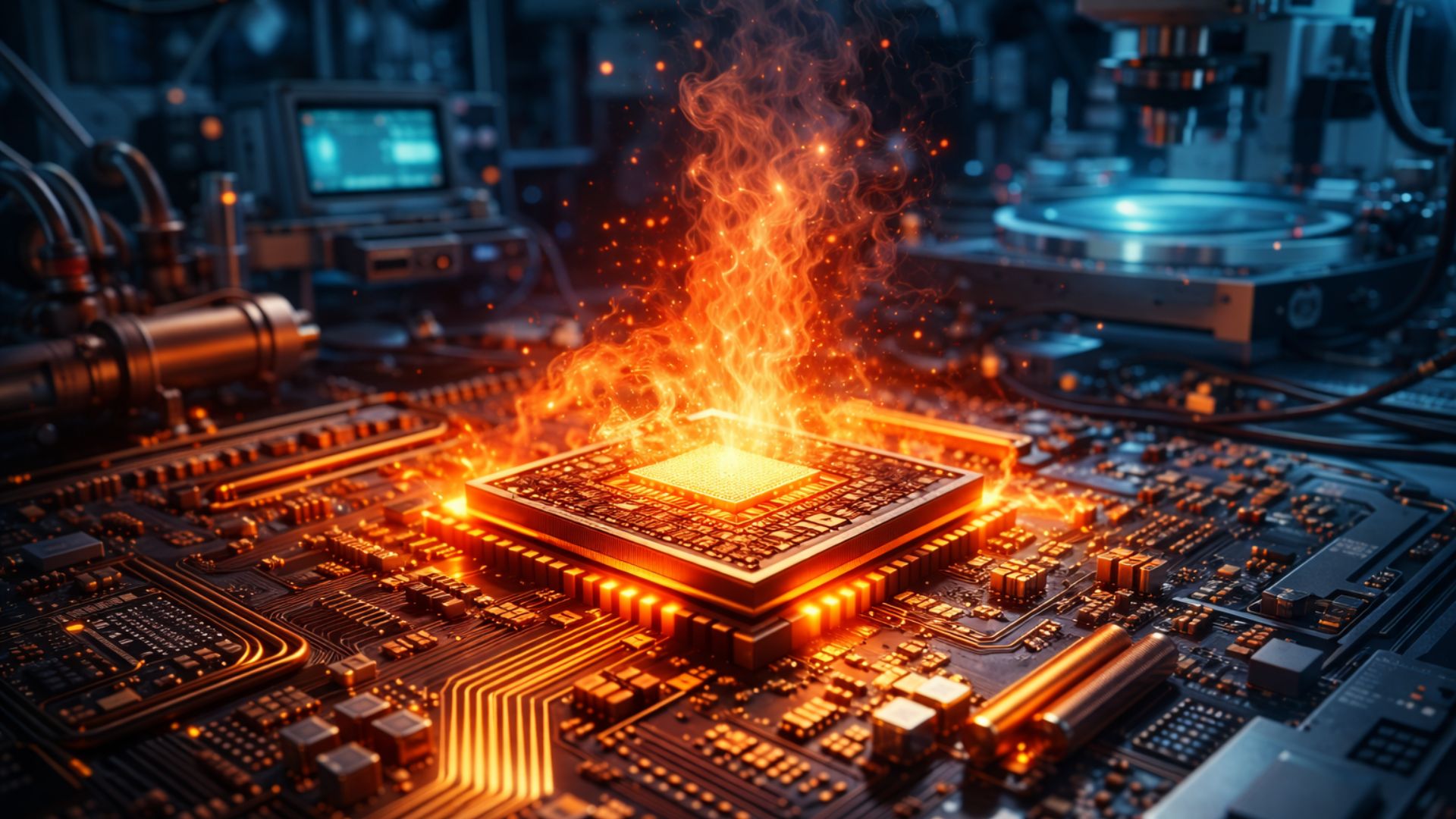
New chip developed by engineers shows how new technology can make computing more resistant to extreme heat, increase AI efficiency, and reduce failures in critical and industrial applications.
A recent breakthrough may redefine how technology functions in extreme environments. A new chip developed by engineers from the University of Southern California has demonstrated the ability to operate at temperatures up to 700 °C — a milestone far beyond the limits supported by most current devices. The discovery was published in the scientific journal Science and presents a new technology with the potential to transform computing and AI.
According to the study published in the Science Journal on March 26, while traditional systems fail around 200 °C, this innovation maintains stable performance even under conditions comparable to lava heat. This paves the way for unprecedented applications in critical sectors, as well as offering significant gains in energy efficiency and reliability.
New chip surpasses historical thermal limits of computing
For decades, temperature has always been one of the biggest challenges in computing. Electronic components begin to fail when exposed to intense heat, usually above 150 °C to 200 °C. This limit restricts the use of technology in extreme environments.
-
JBL launches BandBox in Brazil with Stem AI capable of separating vocals and instruments in real-time and features a portable amplifier of up to 135 W, 4 simultaneous inputs, a 10-hour battery, and a starting price of R$ 1,699.

-
A mass blockade of over 100 Baidu robotaxis in Wuhan exposes serious flaws as the sector tries to prove that autonomous cars are already ready.

-
Archaeologists went to study a well-known trail and ended up finding another one that is even older, dated between 3,770 and 3,640 B.C., hidden under the swamp for almost 6,000 years.

-
Frequently described by astronauts as one of the most improbable natural phenomena on Earth, the Okavango Delta spreads over up to 15,000 km² in the middle of the Kalahari Desert and transforms Botswana into a living maze of channels, islands, and floodplains that emerge and disappear every year.

The new chip created by engineers breaks this barrier by continuing to operate at 700 °C. This difference is not just technical, but practical. It redefines where and how systems can be used.
In practice, this new technology allows devices to function in places previously considered unviable. This includes severe industrial environments, space exploration, and even underground operations. Furthermore, AI can be directly integrated into these scenarios, reducing the need for remote processing and increasing response speed.
New technology memristor integrates storage and processing in a single device
The heart of the advancement lies in the use of a memristor, a nanoelectronic component that combines memory and processing. Unlike traditional chips, which separate these functions, this model allows for greater efficiency.
The new chip developed by engineers uses three main materials:
- Tungsten, known for having the highest melting point among metals
- Hafnium oxide, essential for electrical control
- Graphene, an extremely strong and conductive material
This combination is what makes the new technology capable of withstanding extreme conditions. Graphene, for example, is a sheet of carbon just one atom thick, yet with exceptional thermal resistance.
For computing, this architecture reduces the need for data movement between memory and processor. This improves efficiency and decreases energy consumption.
In the field of AI, the impact is even greater. The memristor allows calculations to be performed directly in the electrical flow, accelerating complex operations.
Engineers verify new chip performance in extreme long-duration tests
The tests conducted reinforce the potential of the innovation. The device showed consistent results even under severe conditions.
Among the main data observed:
- Data retention for over 50 hours at 700 °C
- Ability to withstand over one billion operational cycles
- Continuous functional stability at extreme temperatures
These numbers show that the new chip is not just a proof of concept. It already exhibits relevant practical characteristics for real applications. For engineers, this advancement could solve a problem that has persisted for decades in computing: the thermal limitation of components.
Another interesting point is that the discovery occurred partially by chance. During experiments with graphene, researchers noticed an unusual resistance to heat, which led to the development of this new technology.

How new technology directly impacts AI and computing efficiency
Energy efficiency is one of the main current challenges in computing, especially in AI systems. Data centers consume large amounts of energy to process complex operations.
The new chip could change this scenario. It performs calculations directly in the circuit, reducing the need for data transfer. This brings clear benefits:
- Reduction of energy consumption on a large scale
- Lower heat generation in computational systems
- Increased processing speed
- Greater efficiency in machine learning applications
For AI, this means greater scalability without a proportional increase in energy costs. For computing, it represents an evolution towards more sustainable systems.
This new technology can also reduce failures, as less data movement implies less wear on components.
Real applications of the new chip in environments where traditional computing fails
The ability to operate at 700 °C opens up possibilities that were previously unviable. The new chip can be applied in various critical areas.
In space exploration, for example, planets like Venus have temperatures close to 500 °C. With this new technology, AI systems could operate directly in these environments for longer periods.
In industry, environments with extreme heat — such as steel mills — require resilient equipment. The use of solutions developed by engineers can enhance safety and operational efficiency.
Other applications include:
- Geothermal exploration in high-temperature regions
- Monitoring in nuclear reactors
- Embedded systems in engines and turbines
In all these cases, computing is no longer limited by the environment and begins to operate in an integrated manner with the scenario.
New chip and the role of engineers in the evolution of extreme computing
The development of this new technology reinforces the fundamental role of engineers in the evolution of computing. Solving physical limitations has always been one of the great challenges in the field.
The new chip represents an advancement that relies not only on software but also on innovation in materials and architecture. This shows that the future of AI is also linked to the evolution of hardware.
Moreover, the integration between materials science and electronic engineering is becoming increasingly important. The use of graphene and tungsten is a clear example of this convergence. For the industry, this means new development opportunities and more robust applications.
What changes from this innovation in practice
Although still in the laboratory phase, the impact of the new chip can already be projected. The trend is that this new technology will evolve and become commercially viable in the coming years.
In practice, this could mean:
- More durable and resilient equipment
- Reduction of maintenance costs
- Expansion of computing to extreme environments
- New real-time AI applications
In the long term, this innovation could redefine standards in the tech industry. The work of engineers shows that there is still room for significant advancements in hardware. More than an incremental improvement, it represents a structural change in how systems are designed and utilized.
An advancement that repositions the limits of current technology
The emergence of the new chip capable of operating at 700 °C marks an important point in the evolution of computing and AI. Developed by engineers, the device presents a new technology that overcomes historical limitations and opens new possibilities.
The results obtained — such as continuous operation at extreme temperatures, data retention for over 50 hours, and resistance to over one billion cycles — show that this is not just theory.
This advancement could transform entire sectors, from industry to space exploration. More than that, it reinforces the idea that the future of technology depends on the ability to operate where it was once impossible.
With this, computing is no longer limited by the environment and begins to expand its own boundaries, driving the next generation of solutions in AI and intelligent systems.
And you, do you believe that this new generation of heat-resistant chips can really change the future of computing and AI in critical environments, or are we still far from seeing this technology applied in everyday life?








Seja o primeiro a reagir!