Portuguese
  Spanish


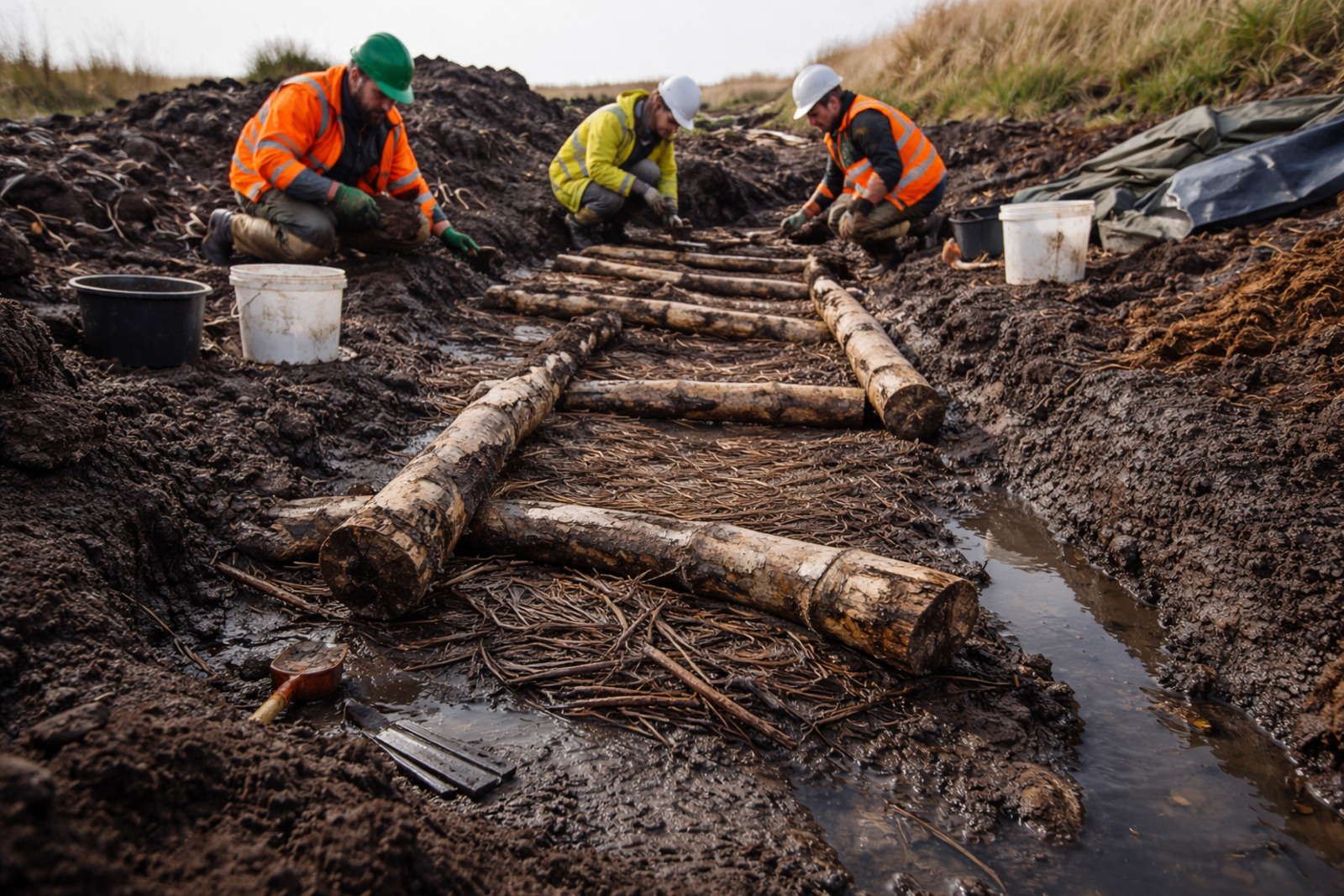


Discovery at Honeygar Farm revealed under the peat a path about 1,000 years older, preserving rare environmental and human vestiges
At Honeygar Farm, in Somerset, archaeologists evaluating a prehistoric path already protected found, under deep layers of peat, an even older structure, dated between 3,770 and 3,640 B.C., expanding knowledge about Neolithic occupation in flooded areas of England.
Unexpected discovery at Honeygar Farm
Wessex Archaeology was contracted by the Somerset Wildlife Trust and the Species Survival Fund to assess the conservation status of a known prehistoric path at Honeygar Farm, in the Westhay area.
This path, about 4,600 years old, was already cataloged as a protected monument by Historic England.
-
UFG’s Innovative Use of Air Conditioner Drip Saves 400 Liters of Water Daily in Brazilian Public Building

-
China Builds Underwater Wall After Discovering Technology That Could Shift Military Balance in the Pacific, Study Reveals Why the Asian Power Reacted Now

-
After Over 8 Months in a Simulated Mars Habitat in Houston, 4 NASA Volunteers Communicate Almost Silently and Will Exit in October
-
Natural Phenomenon Turns Black Sea Turquoise Blue Due to Billions of Microscopic Organisms


The work was intended to analyze this structure, but the excavation revealed a second path, hidden in deeper layers of the peaty ground.
The new structure was approximately 1,000 years older than the path the team expected to study.
The site then began to gather two distinct layers of human presence, separated by about a millennium.

Dating confirms the antiquity of the Neolithic path
Radiocarbon dating placed the newly found structure between 3,770 and 3,640 B.C. The result confirmed the exceptional antiquity of the find and placed the Neolithic path in a much earlier moment than the already cataloged passage.
The two structures identified at Honeygar Farm correspond to different periods of occupation. The already known path is about 4,600 years old and is linked to the late Neolithic and early Bronze Age.
The newly discovered path, in turn, is about 5,900 years old and belongs to the early Neolithic. The overlap shows that the same territory was used at distinct times, with similar solutions for crossing the swamp.
How the pathway was built over the swamp
The Neolithic path was constructed with birch logs and intertwined plant material. The structure served to allow early Neolithic communities to cross flooded areas that covered much of the British Isles.
Building on waterlogged ground required planning and knowledge of the environment. The walkways of the Somerset Levels were not improvised shortcuts, but structures designed to withstand use in a water-dominated landscape.
The choice of birch also had a practical function. The tree grows well in wet ground, and its wood withstands prolonged contact with water better than denser species, favoring the durability of the crossing.
What the peat preserved for millennia
The layers of peat at Honeygar Farm preserved more than wood. The anoxic and acidic environment hindered the decomposition of organic matter for millennia and maintained essential vestiges to reconstruct the landscape of the time.
Among the recovered materials are fossilized pollen from plant species about 6,000 years old, remains of aquatic and terrestrial plants, preserved insects, microorganisms, and faunal vestiges linked to the region’s margins.
These elements help to reconstruct the existing vegetation, humidity, average temperature, and environmental conditions of the period.
They also allow understanding the chemical composition of water and soil in the early Neolithic.
Somerset Levels as an archive of prehistory
The Somerset Levels are one of the regions with the highest concentration of organic archaeological finds in Europe.
The peaty soil, high humidity, and low human disturbance favored rare preservation over the centuries.
The discovery at Honeygar Farm reinforces this role. The region holds not only stone monuments but also overlapping layers of human history, each offering its own window into the past.
The Neolithic path found by chance shows that already studied sites may still hide decisive evidence.
Under the swamp, history remained intact for millennia and is now beginning to reveal, more clearly, how these communities lived and moved.
As long as this soil remains preserved, new fragments may emerge from the deep layers of Somerset, expanding understanding of a territory occupied, crossed, and transformed long before written records.
With information from Revista Oest.