





 Portuguese
  English
  Spanish
 6 min of reading
  0 comments


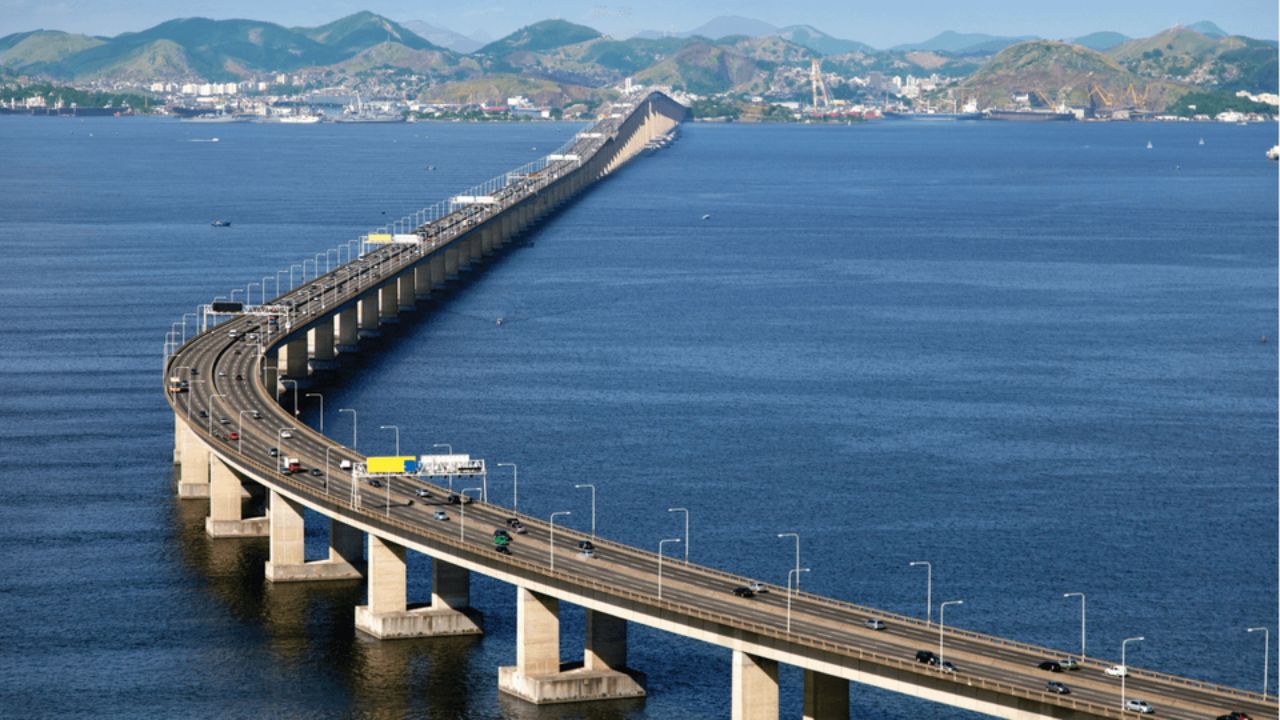
Understand The Technology That Prevents The Bridge From Swaying, The Real Panic Of Drivers, And Why Crossing The Rio-Niterói Bridge With Crosswinds Still Forces The Closure Of The Road.
Panic is a familiar scene: a “curtain of rain” seems to swallow the Central Span. For those facing the crossing of the Rio-Niterói Bridge with crosswinds, at 72 meters high, the feeling is absolute panic. Reports from drivers, like those documented by Portal Terra (via YouTube), capture the terror of motorcyclists: “If you don’t hold on, it’s taking all the bikes”. This fear, focused on vehicle safety, is the trigger for chaos.
But if the panic is real, why does the bridge not “sway” anymore like it used to? The answer lies in a Brazilian technology that changed the game. The structure is no longer at risk of collapse, but the Operational Control Center (CCO) of Ecoponte goes into maximum alert for another reason. The decision to close the road is no longer structural but rather a vehicle safety measure, triggered when the wind exceeds specific limits.
The Panic At 72 Meters And The Terror Of Motorcyclists
The scene is a nightmare for any driver. The Central Span of the Rio-Niterói Bridge, the point where the structure reaches its peak of 72 meters above Guanabara Bay, becomes the epicenter of a battle against the elements. Reports and videos of crossings during severe storms, as highlighted in a report by Portal Terra, describe a “curtain of clouds and rain” that advances rapidly and seems to “swallow” the entire bridge. The structure of 13.2 km literally disappears, and the feeling of isolation and exposure is absolute.
-
Untouched for 2,200 years, the tomb of China’s first emperor hides up to 100 tons of mercury, lethal traps designed to kill invaders, and a mystery so dangerous that archaeology still refuses to uncover it.

-
With 220 meters, 721 feet, and 25 thousand gross tons, the world’s largest sailing cruise ship sets a record before its debut and promises to reinvent luxury at sea with giant sails and futuristic engineering.

-
A Brazilian city is being invaded by the sea, buildings are leaning, and the solution could cost R$ 200 million with support from BNDES to prevent flooding, modernize drainage, and protect more than 200,000 residents within 5 years.

-
Lula’s government puts R$ 1 billion on the table to revitalize watersheds with 60 projects, including the São Francisco and Parnaíba rivers, sanitation, navigation, urban drainage, pollution control, and actions in strategic areas of Furnas.
If for cars the experience is panic, for motorcyclists it is visceral terror. This group is, without a doubt, the most vulnerable to crosswinds. According to an audio recording from a witness during the crossing, shared by Portal Terra (via YouTube), the danger is extreme and immediate: “The bike, it’s taking the bike. (…) If you don’t hold on, it’s taking all the bikes”. Many are forced to interrupt the crossing, and the modern risk is this: not the collapse of the bridge, but the wind dragging the vehicle.
This current fear overshadows a collective memory of a different, but perhaps deeper fear: the fear that the bridge itself could fail. Older drivers still recall the “chill” they felt crossing the Central Span on windy days, remembering an era when the bridge “moved a lot”. A shocking video from 1997 showed the structure “vibrating” visibly under the action of the wind, a phenomenon that forced closures due to fears of structural failure. The panic of 1997 was about the integrity of the bridge; today it is about the safety of the vehicle on it.
The Engineering That “Calmed” The Bridge: The End Of Swaying
The infamous “swaying” of the Rio-Niterói Bridge was not caused by just any wind. According to the magazine Ciência Hoje, the culprit was a specific wind coming from the Southwest quadrant that, even at relatively low speeds (around 55 km/h), hit the structure and created a “aeroelastic phenomenon”. This created alternating vortices that induced a vertical oscillation of up to 60 cm, a “waltz rhythm” that, while not posing a risk of collapse, was terrifying and forced the closure of the road, on average, twice a year.
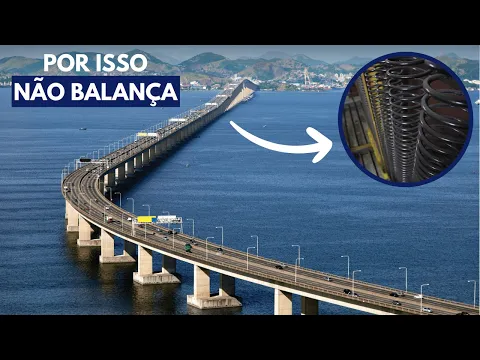
The solution came from Brazilian engineering. Ciência Hoje details that, in 2004, the bridge received a revolutionary system: the Synchronized Dynamic Dampers (ADS), developed and patented by COPPE/UFRJ. There are 32 units (essentially, large steel boxes suspended by giant springs and connected to dampers) strategically installed within the steel box girders of the Central Span.
The most brilliant aspect of the ADS technology is that it operates through “passive control”. There is no operator “turning on” the dampers. The system operates purely by physics: when the bridge begins to sway, the steel boxes inside it move out of sync, applying a contrary and opposite force that “counterbalances” and neutralizes the sway the moment it begins. The bridge, in practice, uses the energy of the wind against itself to stabilize. The result, according to Ciência Hoje, was a transformation: the ADS system reduced wind-induced oscillations by over 80%. The bridge that once swayed at 55 km/h now remains steady, eliminating the need for closures due to structural risk.
Inside The CCO: The Protocol That Closes The Bridge Today
If the bridge no longer sways, why does it still close? The answer lies in the Operational Control Center (CCO) of Ecoponte. Monitoring hundreds of cameras and wind sensors (anemometers) and the structure (SHM), the team is no longer concerned about the structural integrity of the bridge, the ADS system takes care of that. The CCO’s entire focus has shifted to operational risk: the effect of the wind on vehicles.
The closure protocol has changed radically. The installation of the ADS has rewritten the operations manual. The portal iG (Último Segundo) clarifies the current procedure, which is no longer based on engineering risk, but exclusively on vehicle safety. The risk of motorcycle tipping, and even the displacement of lighter cars in extreme winds, is the decisive factor.
The “Storm Manual” of Ecoponte, in coordination with the PRF, follows clear steps. According to iG, the bridge enters “alert status” when winds consistently reach between 60 km/h and 70 km/h; the message boards are activated and alert drivers, with special focus on motorcyclists. If wind strength intensifies and exceeds 80 km/h, the protocol for total closure is activated. The bridge is closed in both directions until the anemometers in the CCO indicate that wind speed has dropped to a safe level.
The Curious Reopening: Why Do Trucks Go First?

When the sensors in the CCO confirm that the worst has passed and wind gusts have dropped below the danger threshold, the reopening protocol is initiated. However, reopening 13 kilometers of road after a panic event is not as simple as removing cones. After hours of waiting and congestion, the natural tendency of passenger car drivers would be to accelerate quickly, which would be disastrous if a surprise and residual gust of wind hit the road.
Here comes one of the most curious and lesser-known procedures of the operation: the use of trucks as “escorts”. Records from previous reopenings indicate that it is done with “the help of trucks to reduce traffic speed”. Although it seems like a paradox, since large vehicles are also susceptible to wind, the objective here is purely traffic control and crowd psychology.
The trucks function as “pace cars” (safety cars), creating a deliberate “rolling roadblock”. By placing them in front of the reopening convoy, the CCO and the PRF force all traffic behind them to cross the bridge at a reduced and controlled speed (for example, 40-50 km/h) on the first passage. It’s a management solution that uses the slower vehicles to ensure the safety of all, mitigating the risk of an unexpected gust at high speed.
The Panic Is Real, The Risk Has Changed
In summary, crossing the Rio-Niterói Bridge with crosswinds exposes a complex real-time risk management operation. The panic that drivers feel, especially motorcyclists, is a visceral and justified reaction to a real tipping risk. Brazilian engineering, with the ADS system detailed by Ciência Hoje, has triumphed by eliminating the specter of “swaying” structural.
Today, the decision to close the bridge, as reported by iG (Último Segundo), is no longer about the integrity of the structure; it’s about the safety of the vehicles using it. The challenge has shifted from civil engineering to traffic management, with a clear limit of 80 km/h defining when safe crossing becomes impossible.
Have you ever had a scare during a strong wind on the Rio-Niterói Bridge or another large structure? Do you think the limit of 80 km/h is adequate or should it be even lower to protect motorcyclists? Leave your opinion in the comments section, we want to know what it’s like to live this experience in practice.






-

Uma pessoa reagiu a isso.