





 Portuguese
  English
  Spanish
  3 min of reading
  0 comments


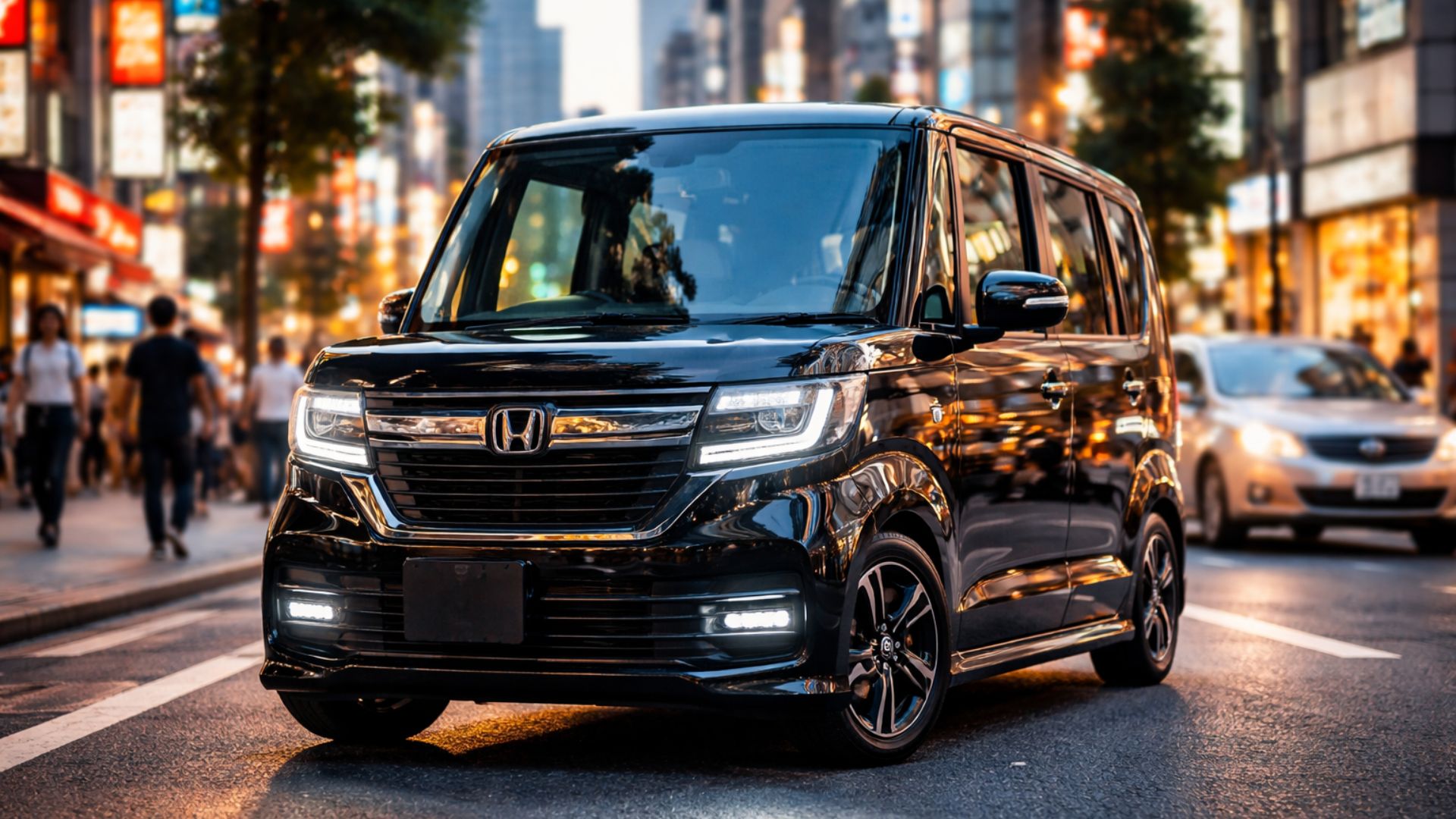
Compact model dominates the Japanese market with smart space solutions, advanced safety, and a variety of versions that expand its reach among different consumer profiles over the years.
The Honda N-Box once again finished the Japanese fiscal year as the leader among the best-selling new cars in the country, with 198,893 units sold between April 2025 and March 2026.
This result placed the kei car minivan at the top of the overall ranking for the fifth consecutive year and kept Honda in the lead among light four-wheelers for the 11th consecutive year.
Consolidated leadership in Japan
In a market where reduced size, cost of use, and internal space are highly valued, the N-Box continues to be a rare case of continuity.
-
New Chevrolet car barely arrived in Brazil and already made GM break a record with 14,000 units sold and R$ 2 billion in sales

-
Neighboring country of Brazil sells Suzuki Alto for around R$ 51,000, cheaper than Fiat Mobi, Renault Kwid, and Citroën C3 in Brazil, with a 1.0 engine, 5-speed manual transmission, and 180-liter trunk; city car shows a type of urban popular that has disappeared from here.

-
Hyundai Aura arrives in the automotive market cheaper than Chevrolet Onix Plus, Hyundai HB20S, and Nissan Versa in Brazil, with a 1.2 four-cylinder engine, manual or automated transmission, 6 airbags, and a CNG version; the affordable compact sedan that the brand does not sell here is in India.

-
Without a category A driver’s license, without a minimum age of 21, and without two years of licensing: a new Provisional Measure from the government allows any Brazilian aged 18 to become a motorcycle courier or motorcycle taxi driver with just an Authorization to Drive a Moped on a 50cc motorcycle.




Even with compact dimensions, it maintains broad appeal in Japan by combining a tall shape, functional cabin, and solutions that bring it closer to the use of an urban minivan.
Internal space and smart solutions
The recipe also involves internal space, one of the main arguments for the model since its launch.
Honda attributes this gain to its central tank layout, which moves the fuel tank to the area under the front seats and allows for better use of the rear area and floor space.
This set of solutions helps explain why the N-Box remains competitive even measuring just 3,395 mm in length, within the typical limit of the kei category in Japan.
The official specifications also indicate a width of 1,475 mm and a height of 1,790 mm in front-wheel-drive versions, reaching 1,815 mm in 4×4 configurations.
Safety and embedded technology
In the current lineup, the brand maintains the Honda SENSING package across the range, reinforcing one of the most valued points by buyers in this segment.
The system includes driving assistance features and comes equipped, in all types, with front side airbags and curtain airbags.
0.66 turbo engine and 4×4 drive
Under the hood, the N-Box continues to rely on the well-known 658 cm³ engine, with offerings of both naturally aspirated and turbo versions, always paired with a CVT transmission.
The lineup also continues to offer four-wheel drive, a relevant combination for part of the Japanese market, especially in regions prone to snow and low-traction surfaces.
Recent updates and new versions
The update announced by Honda on April 17, 2025 made important changes to the lineup without altering the vehicle’s central proposal.
Among the changes confirmed by the manufacturer, the N-Box Custom began receiving LED fog lights and decorative trims depending on the version, while the N-Box Fashion Style gained new two-tone paint combinations.
Months later, the family was expanded with the arrival of the N-Box Custom Black Style, launched on December 11, 2025.
The special series added darkened finishes and specific appearance and cabin elements, a move that reinforces Honda’s strategy to preserve the basic model while allowing for more sophisticated profile variations within the same architecture.
Why the N-Box continues to sell so well
The ongoing interest in the N-Box shows that, in Japan, the success of a small car does not depend solely on economy or entry price.
In Honda’s case, commercial performance seems linked to the ability to deliver everyday practicality, uncomplicated drivability, and a sense of space beyond what the external dimensions would suggest.
It also weighs in that the model currently occupies a very consolidated segment of the domestic market, with versions aimed at both family use and work and urban mobility.
This breadth of proposal helps explain why the N-Box remains relevant even in a constantly renewing Japanese industry and intense competition among kei cars.
By maintaining leadership in the fiscal year 2025, the N-Box prolongs a trajectory that has already crossed different generations and updates without losing its prominence.
Staying at the top suggests that Honda succeeded in treating the model less as a niche car and more as a central mobility solution for the Japanese market.






Be the first to react!