





 Portuguese
  English
  Spanish
  7 min of reading
  0 comments


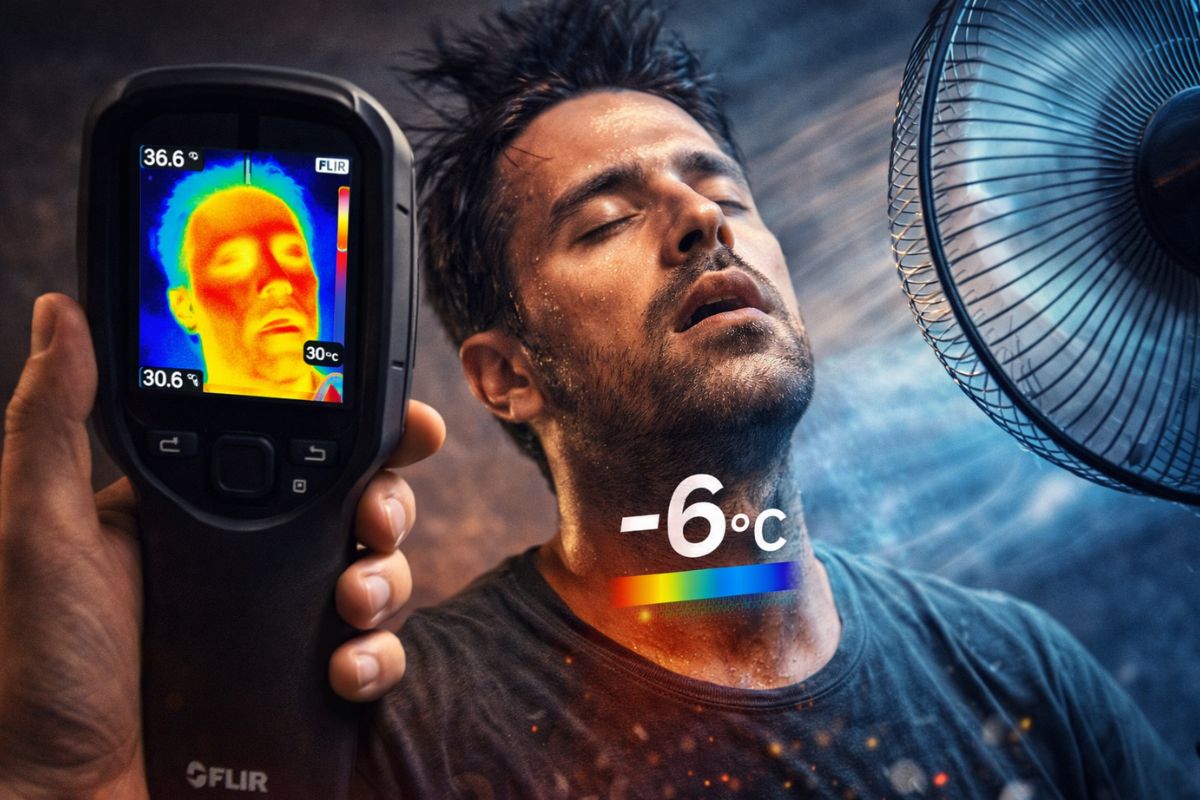
A series of experiments with a thermal camera showed that the fan does not alter the temperature of the environment nor of objects that are at the same temperature as the air, but reduces the temperature of the human skin by up to 6 degrees because it accelerates the evaporation of sweat and removes the layer of warm air that surrounds the body.
Does the fan really cool or is it just an illusion? The question may seem obvious, but the answer is not as simple as it seems. A series of experiments conducted with a thermal camera proved that the fan does not cool the air, does not cool objects, and does not alter the temperature of the environment but reduces the temperature of the human skin by up to 6 degrees. The difference between cooling the air and cooling you is what separates the fan from being useless to being surprisingly effective.
According to the channel Manual do Mundo, it explains that the secret lies in three physical mechanisms that occur when the wind from the fan hits the skin: it accelerates the evaporation of sweat, removes the layer of moisture that forms on the skin, and sweeps away the “bubble” of warm air that naturally surrounds the human body. It is the same principle that makes you feel cold when you get out of a pool; the evaporating water steals heat from your skin. The fan turbocharges this process. And the thermal camera showed, frame by frame, exactly how this happens.
First experiment: the fan heats what is cold

The test began with two black-painted aluminum cups (to work properly with the thermal camera) filled with cold water at about 11 degrees. One cup was placed in front of the fan; the other, without receiving wind.
-
Scientists find a new explanation for the origin of Earth, which may have formed solely from material close to the Sun, changing an old theory and indicating that Jupiter may have been the cause of it all.

-
Brazilian beaches are among the most contaminated in the world by cigarette butts, with levels up to 40 times above the global average and areas where this waste already represents the majority of all the trash found.

-
2,000-Year-Old Machine Gun: Roman weapon found in Pompeii fires arrows at 109 m/s with an automatic gear mechanism, leaving perfect geometric patterns on the walls and proving its real use in the siege of 89 B.C.

-
Petrobras builds inverted bridge and the project becomes a tourist attraction: unique structure allows the river to flow over the road and replaced precarious crossings.


In a few minutes, the cup in front of the fan heated significantly faster, reaching 21 degrees while the other still marked 18. In the thermal camera, the difference was visible: one dark blue cup (colder) and another light blue cup (warmer).
The result seems counterintuitive, but it is exactly what physics predicts. The fan blows air at room temperature, in this case, about 24 degrees.
Since the cup was colder than the environment, the wind accelerated the heat exchange and pushed the temperature of the cup closer to the air temperature. In other words: the fan does not chill; it equalizes. And if the object is cold, the fan heats it.
Second experiment: the fan cools what is hot
The next test used the inverse logic. The same cups were filled with hot water at 40 degrees and placed in the same position, one with the fan on, the other without.
In seconds, the cup in front of the fan dropped to 30 degrees while the other was still at 36. In the thermal camera, one appeared red and the other was already yellow. The difference was striking.
And the third test was the most revealing of all. Two cups at room temperature 24 degrees were exposed to the fan for five minutes.
Result: a difference of tenths of a degree, practically zero. The fan did nothing. The conclusion so far was clear: the fan pushes everything to room temperature.
What is hot cools, what is cold heats, and what is already at the same temperature does not change. The question that remained was: if the fan does not change the temperature of anything, why do we feel that it cools?
The secret that changes everything: you are not a cup and that is why the fan works on your skin
The turning point of the experiment came when the test moved from objects to the human body. And here comes the mechanism that almost no one understands properly: sweat.
When the body is hot, it releases water through the pores and as this water evaporates, it steals heat from the skin to transition from liquid to gas. It is the same principle that makes refrigerators and air conditioners work: a fluid evaporates and, upon evaporating, cools what is around it.
To test this, the experiment used two wet cloths, one in front of the fan, the other without wind. In the thermal camera, the cloth exposed to the fan dropped to 19 degrees while the other remained at 22, a difference of 3 degrees on a surface that simulates wet skin.
The wind accelerated the evaporation of the water and, with that, cooled the cloth. But the definitive test was yet to come.
The scientist sprayed water on both arms and turned on the fan pointed at only one of them. The result was the largest difference of all the tests: the arm without wind was at 29.5 degrees; the arm in front of the fan dropped to 25.4, a real difference of more than 4 degrees, which reached 6 degrees at peak moments.
In the thermal camera, an intense blue spot appeared on the arm exposed to the wind. The difference was, in the words of the experimenter himself, “absurd.”
The three factors that explain why the fan cools your skin but does not cool the cup

The wind from the fan does three things when it hits the wet skin of sweat. First, it mechanically pulls water molecules from the surface of the skin, as if it were “sanding” the layer of sweat. This already causes evaporation.
Second, it sweeps away the layer of humid vapor that naturally forms over the skin because evaporation is more efficient when the air is dry, and if there is already vapor accumulated above the skin, evaporation slows down. The fan clears this layer and allows sweat to continue evaporating at full speed.
Third, and this is the factor that few know: the human body forms a kind of “blanket” of warm air around it because the skin is warmer than the environment and heats the nearby air.
When the fan blows, it removes this layer of warm air and facilitates thermal exchange with the cooler environment.
None of these three mechanisms work on an aluminum cup. The cup does not sweat, does not form a layer of moisture, and does not generate its own heat. That is why the fan cools you but does not cool the cup.
When the fan does not work: the case of Manaus at 40 degrees
There is a situation in which the fan loses much of its effectiveness: when the environment is extremely hot and extremely humid at the same time.
In cities like Manaus, with 40 degrees and high humidity, the fan still pulls water molecules from the skin, but cannot remove the layer of moisture because the air it blows is already humid.
Furthermore, if the environment is hotter than the body, there is no layer of warm air to be removed because everything around is already hot.
In this extreme scenario, of the three mechanisms that make the fan work, only one (the mechanical pulling of water molecules) continues to operate.
The other two lose effect. That is why, on days of extreme humid heat, the fan seems not to help much, and in these cases, only the air conditioner actually solves it, because it really reduces the temperature of the entire environment.
Final verdict: the fan works but only for those in front of it
The fan does not cool the environment, does not cool the wall, does not cool the sofa, and does not cool the cup of water. But on wet human skin, it reduces the temperature by up to 6 degrees, a real, measurable difference proven by thermal camera.
The mechanism behind this is the combination of accelerated evaporation of sweat, removal of the layer of moisture over the skin, and elimination of the “blanket” of warm air that the body naturally forms.
This also explains a practical problem: if the fan only works on the skin, it only helps those within its reach.
If there are several people in the room and only one fan, the best use is to set it to oscillate so that the wind reaches everyone, even if for short intervals. Each gust that touches your skin restarts the cycle of evaporation and cooling.
Did you know that the fan worked this way? Have you ever had that feeling that it didn’t help at all on very humid days and now understand why? Let us know in the comments if you prefer a fan or air conditioning and what works best in your home.








Seja o primeiro a reagir!