Portuguese
  Spanish


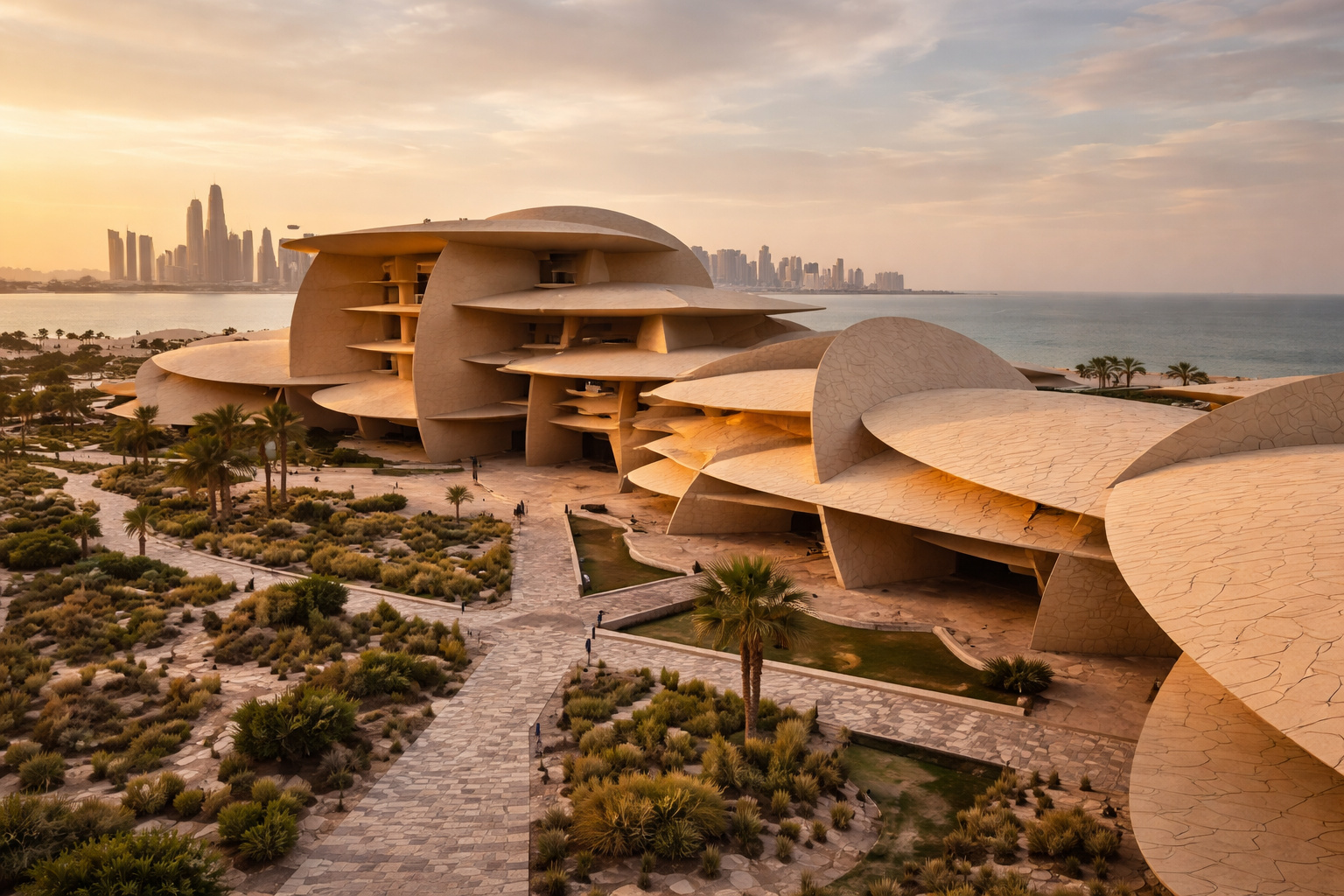

The project inaugurated in 2019 combines advanced engineering, historical narrative, and audiovisual experiences to present the evolution of Qatar in an immersive way
The National Museum of Qatar, inaugurated in 2019, has established itself as one of the most iconic architectural works in Doha.
The project, designed by Jean Nouvel, was inspired by the desert rose, a natural symbol of the region and Qatari culture.
The building covers 40,000 square meters and embodies resilience, climate adaptation, and cultural identity.
The architectural proposal also stands out for integrating innovative design and historical preservation within a single structure.
Architectural concept reveals integration between nature and engineering
The museum’s design was developed from hundreds of interconnected disks, with varying diameters and curvatures.
These structures create natural shadows and dynamic internal environments, enhancing thermal comfort in the Gulf climate.
-
Giant 3,600-ton Crane Breaks Two World Records by Installing World’s Largest Single-Piece Forged and Welded Hydrogenation Reactor, Weighing 3,037 Tons, in Chinese Petrochemical Plant in Just Six Days

-
$80 Million Bridge in Brazil Cuts Travel Time from 30 Minutes to 1 Minute, but Audit Reveals Major Flaws
-
Man Builds Stone Bed with Granite Rocks and Hand-Sawn Cedar Beams, Home Extension Garners Over 437,000 Views on Bonus Bolts Channel

-
Brazilian Researcher Develops Color-Changing Roof Tile to Reduce Air Conditioning Use by Up to 15%



The execution required advanced engineering technology, as reported by technical teams involved in the project in 2019.
The so-called “Desert Rose” surrounds the former palace of Sheikh Abdullah bin Jassim Al Thani, connecting the past and present.
The project integrates historical heritage with a futuristic structure, reinforcing Qatar’s national identity.
The architecture was also designed to interact with the arid environment and protect the collection from intense heat.
Galleries present the historical evolution of Qatar
The interior of the museum presents a clear and continuous chronological narrative.
The galleries showcase the country’s journey from prehistory to the discovery of oil and modern development.
The content has been organized to facilitate visitor understanding.
The historical sequence allows for the visualization of social, economic, and cultural transformations over time.
The project values sensory experiences to enhance public engagement.
Among the main highlights of the exhibitions are:
- Immersive panoramic projections that recreate the desert environment;
- Surrounding sound environments that simulate traditional life;
- Narratives about pearl divers, an essential historical activity for the country.
The proposal enhances understanding of Qatar’s roots and evolution.
Audiovisual experience transforms the visit
The museum uses its own architecture as a narrative support.
The curved walls of the disks function as giant screens, creating visual continuity throughout the journey.
High-definition films, produced by renowned filmmakers, are projected directly onto the structure.
The projection creates a seamless visual narrative, accompanying the visitor throughout the experience.
Audiovisual technology has been integrated into the building’s design.
Museology experts point out that this model facilitates the absorption of historical content.
Integration between history, technology, and cultural identity
The National Museum of Qatar consolidates itself as a landmark of contemporary architecture and cultural preservation.
The union between the historic palace and the modern structure reinforces the continuity between past and present.
Jean Nouvel’s work demonstrates how design, technology, and historical narrative can coexist in an integrated manner.
The museum preserves the country’s memory and projects its identity into the future.
How can contemporary architecture continue to transform the way history is presented to a global audience?