





 Portuguese
  English
  Spanish
  4 min of reading
  0 comments


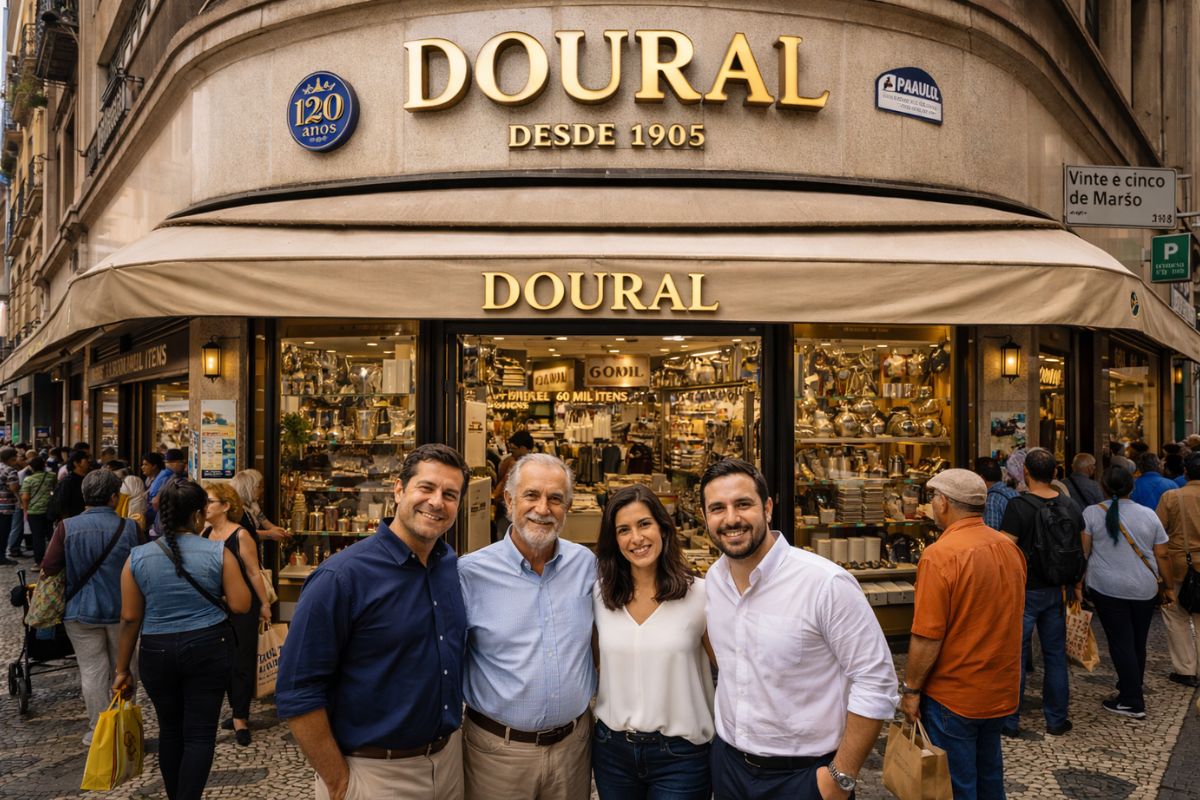
Assad Abdalla was born in Homs, Syria, in 1870, crossed the ocean, worked as a peddler on the streets of São Paulo, and founded what would become the oldest store still in operation on the most commercial street in Latin America
On the corner of Rua 25 de Março with Ladeira Porto Geral, number 595, there is a yellow mansion that has been there since before World War I. Before the Spanish flu. Before the radio arrived in Brazil. Doural opened its doors in 1905 and has never closed. It has been 120 years at the same address, on the same street, with the same family.
Those who hurry through 25 de Março in search of low prices hardly imagine that facade hides one of the longest immigration stories in Brazilian commerce. The oldest store still in operation in the largest commercial center in Latin America was founded by a man who arrived in Brazil without speaking Portuguese and started selling fabric on the street.
The peddler who became a patriarch

Assad Abdalla was born in 1870 in Homs, one of the oldest cities in Syria. At 33, in 1903, he embarked for Brazil with another Syrian immigrant, Nagib Salem. The two had no store, no commercial point, nothing but the willingness to work.
-
Plato said 2,400 years ago that poverty does not come from a lack of money but from an excess of desires, and modern neuroscience has proven he was right by showing that the human brain releases dopamine not when it achieves something but when it is still desiring, which turns each purchase into fuel for the next.
-
“No one hires you based on your school record”: a drama in Brazil shows the difficulty of finding a job even with a deficit of 530,000 vacancies in IT, salaries of up to R$ 35,000, and 50% of hires without a diploma.

-
Research uncovers the 4.5 billion-year-old secret of Earth and locates a missing reservoir of lead within the planet.

-
Porsche’s luxury SUV arrives with technology inspired by Formula E, extreme power, and an innovative system that allows for high-efficiency wireless charging.

Assad became a peddler. He walked the streets of São Paulo carrying fabrics and notions, knocking on doors, selling to anyone who wanted to buy. It was the most common job among Syrian and Lebanese immigrants who arrived in Brazil at the turn of the century. It required no initial capital. It required legs, patience, and the ability to convince someone to buy something they hadn’t asked for.
In two years, Assad saved enough to rent a spot on Rua 25 de Março. In 1905, Doural opened its doors. At first, it sold what Assad knew: fabrics and notions. The same type of product he carried on his back when he was a peddler.
What 120 years do to a store

The Doural that exists today no longer sells fabric. Over the decades, the Abdalla family transformed the business as the market changed. Notions were phased out, and household items came in. Today, the yellow mansion houses 60,000 different items for the home: pots, cutlery, fine porcelain, curtains, rugs, decorations, popular dishes, and luxury pieces.
The catalog ranges from a R$ 5 glass to an imported rug worth thousands of reais. It is the kind of store where a housewife from Capão Redondo and a decorator from Jardins find what they are looking for in the same aisle. Few commercial establishments in Brazil manage to cater to such different audiences for so long.
The store has also entered e-commerce, selling online without abandoning the physical mansion. The same family that started selling fabric on the sidewalk now ships orders across the entire country. From peddler to marketplace in four generations.
The family that never left
The most impressive detail of Doural is not its age. It is its continuity.
Assad Abdalla made a point of teaching the trade to his children. The children taught the grandchildren. The grandchildren taught the great-grandchildren. Doural is now in the fourth generation of the Abdalla family. 120 years, same family, same address, same commercial CNPJ passing from hand to hand without ever leaving the bloodline.
In 120 years, Brazil has had 16 presidents, two dictatorships, six different currencies, two world wars, a pandemic, and at least three economic crises that closed thousands of stores. Doural survived them all. In the same place. With the same surname on the door.
The founder’s wife, Corgie Assad Abdalla, became a reference for philanthropy in São Paulo. Her social work was recognized with a tribute: a street in Morumbi bears her name. The Syrian peddler who arrived with nothing left the family name engraved on the city map.
Why this story matters
Rua 25 de Março receives estimates of 400,000 people per day on peak dates. It is the largest center of popular commerce in Latin America. And the oldest store still operating there was founded by an immigrant who started carrying goods on his back.
Doural is not just a store. It is a living document of how São Paulo was built. By immigrants who did not speak the language, who had no capital, who had no network of contacts. They had work. And the work became a corner, the corner became a store, the store became an institution, and the institution completed 120 years without leaving the place where it all began.
If you have ever passed through 25 de Março and didn’t notice the yellow mansion at the corner with Ladeira Porto Geral, now you know what it holds. Four generations, 60,000 items, and the story of a man who left Homs with nothing and left his surname on a street in Morumbi and on a corner of 25 de Março at the same time.
With information from São Paulo Secreto and the book “Family Assad Abdalla & Corgie Haddad — 1903-2003”.








Seja o primeiro a reagir!