





 Português
  Inglês
  Espanhol
  4 min de leitura
  0 comentários


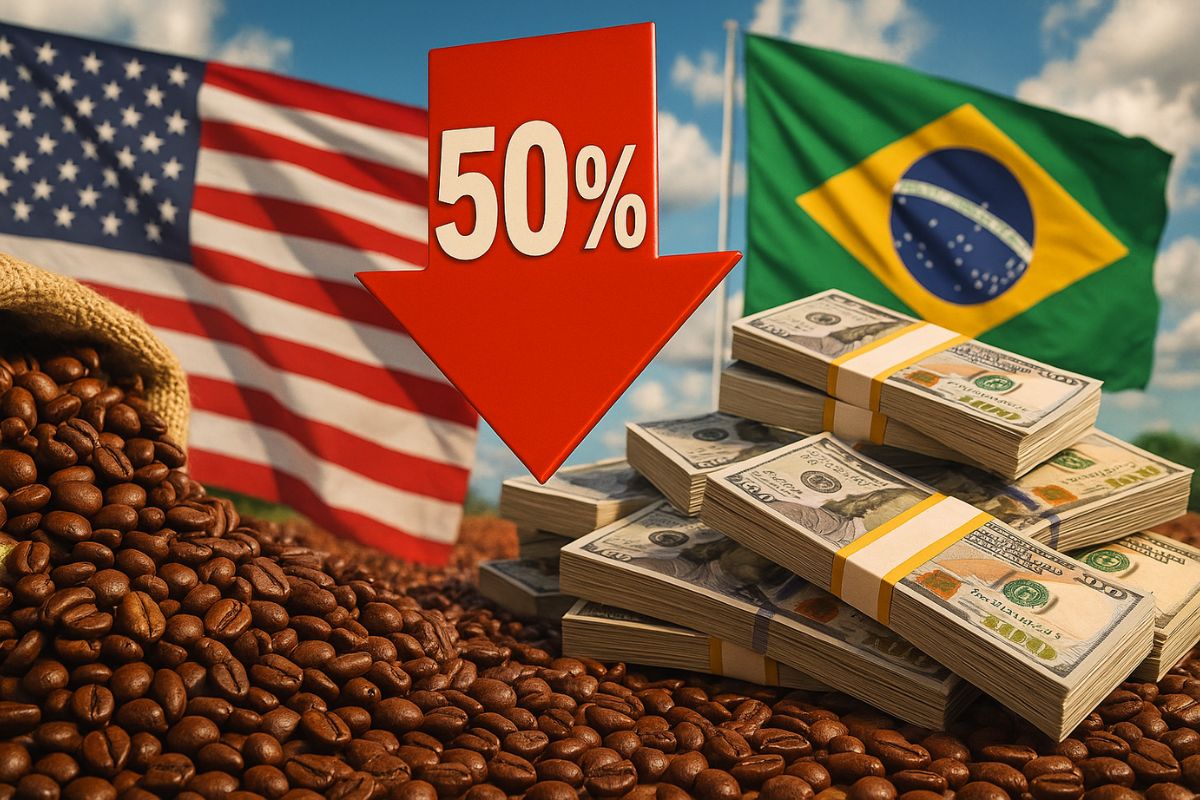
The 50% Tariff Imposed by Donald Trump on Brazilian Coffee Affects Importers in the United States, Raises Logistics Costs, Causes a Price Increase of Up to 40% on the Final Price, and Intensifies Trade Tensions Between Brazil and the USA.
The 50% tariff imposed by Donald Trump on Brazilian coffee is already directly impacting the American market, with rising prices, canceled contracts, and redirection of shipments to other countries. The measure, in effect since August 6, altered the balance of imports in the largest coffee-consuming country in the world, forcing companies to seek alternatives to avoid the tax.
According to the G1 portal, Brazilian coffee represented one-third of the total beans sold in the USA. With the new rate, importers such as Lucatelli Coffee have started sending their shipments to Canada, where they can store products without the tax incidence. Logistics costs have increased, but they are still lower than the loss caused by the 50% tariff.
The Direct Impact of the 50% Tariff on the American Market
Since the implementation of the 50% tariff, Brazilian coffee has become less competitive in the United States. Importers report an increase of up to 40% in prices for the end consumer and a contraction in stocks.
-
In a silent race, Shopee signs a mega contract in Guarulhos and accelerates the e-commerce war with faster deliveries, pressured shipping, and a new threat to rivals in Brazil.

-
Oil surged to $115 a barrel due to the war in the Middle East, and diesel in Brazil has already risen to R$ 7.45 per liter, while the United States…

-
Brazilian city bets on the business environment to generate jobs and attract investments in the energy sector — secretary reveals strategy at Macaé Energy 2026.

-
50 viaducts, 4 tunnels, 28 bridges, and 40 kilometers of bike paths: BR-262 in Espírito Santo will receive 8.6 billion reais for the largest engineering project in the state’s history, inspired by the Immigrant Highway in São Paulo.


Some contracts have been canceled, and some American roasters have begun testing beans from other countries to compensate for the supply deficit.
Businessman Steven Walter Thomas from Lucatelli Coffee states that the extra costs with transportation and storage are the price to pay to avoid the tax.
“It’s a dilemma: wait for a trade agreement or bear the higher logistics costs,” he told the international press.
Coffee Shortage and Substitution with Beans from Other Countries
With the 50% tariff, roasting companies in the USA are rapidly depleting their stocks of Brazilian coffee. Some, such as Downeast Coffee Roasters, reported that they canceled orders for shipments valued at up to US$ 250,000 per container to avoid losses.
In search of alternatives, the sector has begun purchasing coffee from Colombia, Mexico, and Central America, which has raised regional prices by up to 10%.
Still, the quality and availability do not entirely compensate for the absence of Brazilian beans, known worldwide for their standardization and flavor.
The Surge in Prices in U.S. Retail
The most visible reflection of the 50% tariff is felt by American consumers. The price of roasted and ground coffee rose by 41% in September compared to the same period last year, according to government data from the USA.
Part of the inflation is explained by crop failures in producing countries, but the new tax has been decisive for the price increase on the shelves.
Importers and roasters report that the increase is inevitable. “The consumer is picking up the tab,” summarized Thomas. Customers report that products that used to cost US$ 6 or US$ 7 are now over US$ 11, representing the largest annual increase in a decade.
The Political Motivations Behind Donald Trump’s Decision
Donald Trump’s decision to impose a 50% tariff on Brazilian coffee was presented as a trade measure but had a strong political component.
The former American president accused the Brazilian government and the Supreme Federal Court of persecuting Jair Bolsonaro after investigations into the attempted coup.
Weeks after the measure, Trump and Lula met in Malaysia to discuss the situation. Lula expressed optimism about the possibility of revising the tariffs, while Trump stated that the meeting was “very good,” but with no guarantees of an agreement.
The episode exposes the blend of foreign policy and economic protectionism that marks the current cycle of relations between Brazil and the USA.
A Stalemate That Challenges Producers and Importers
For the coffee sector, the challenge is twofold: preserve international contracts and maintain competitiveness in the face of the 50% tariff.
American companies are already warning that if the stalemate persists, there will be a contraction in imports and a definitive change in the origin of coffee consumed in the United States.
Meanwhile, Brazilian producers are watching with concern the temporary loss of a consolidated market and the risk of seeing other countries fill that space.
The expectation is that the issue will return to the table in upcoming bilateral meetings, but analysts consider it unlikely that Donald Trump will reverse the measure in the short term.
Do you believe that the 50% tariff imposed by Donald Trump on Brazilian coffee should be reviewed to stabilize prices in the USA, or will the American sector adapt without the Brazilian product?








Seja o primeiro a reagir!