





 Portuguese
  English
  Spanish
  3 min of reading
  0 comments


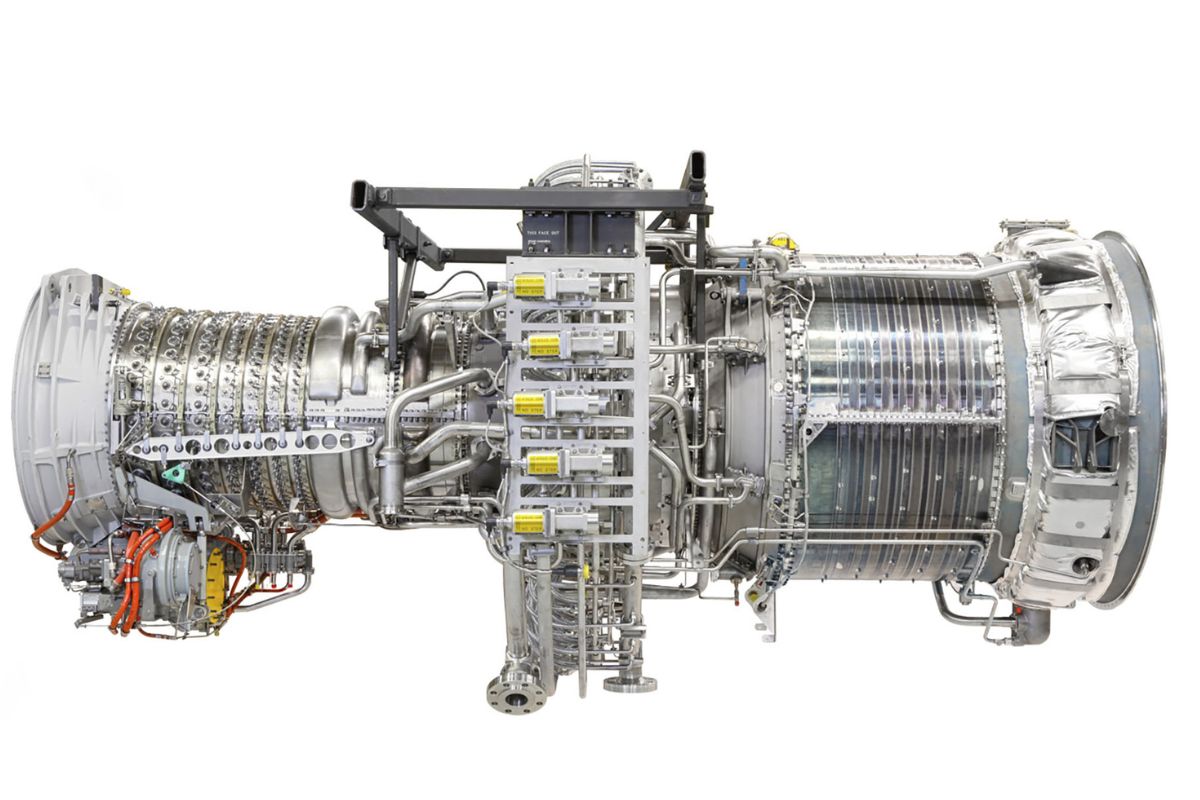
Discover How the General Electric LM2500 Engine, Derived from Aviation, Allows 9,000-Ton Ships Like the Arleigh Burke to Reach 55 Km/H in Seconds
Imagine an engine with the soul of a Boeing 747 installed at the heart of a combat ship. This is the reality of a gas turbine of a warship today. The most famous model, the General Electric LM2500, is the power behind the impressive agility of the Arleigh Burke-class destroyers of the U.S. Navy and dozens of other allied navies.
This technology transforms steel giants into agile predators. With a combined power of up to 100,000 horsepower, a destroyer can accelerate from zero to over 55 km/h in less than 90 seconds. This ‘sprint’ capability is not just for show: in modern combat, agility is synonymous with survival.
From Boeing 747 to Naval Combat, the Origin of the GE LM2500
The story of the LM2500 turbine begins in the skies. It is a naval, or ‘aeroderivative’, version of the famous GE CF6 jet engine, which powered commercial aviation giants like the Boeing 747 and the Airbus A300. GE adapted this proven technology, which had already accumulated millions of flight hours, to meet military needs. The process, known as ‘marinization’, was a major engineering challenge.
-
Couple transforms abandoned house after years of being closed; residence was overgrown with weeds, had a green pool, and a deteriorated structure in the interior of Rio de Janeiro.

-
Hidden marks on the walls of the site associated with the Last Supper of Jesus for centuries have been deciphered in Jerusalem, revealing medieval inscriptions left by pilgrims, European nobles, and travelers from the Middle East.

-
One of the most important lakes in the United States for birds, the balance of nature, and the climate has dried to historic levels, leaving boats stranded, revealing salt flats, and showing how the lack of water can transform an entire landscape.

-
It’s not Cristiano Ronaldo or Messi: the richest football player in the world is only 27 years old, has a fortune of 100 billion reais, and is the nephew of a sultan from an Asian country that few people know about.


Engineers had to modify the engine to withstand the corrosive marine environment, which destroys common metals. Metal alloys and special coatings were developed to protect the internal components from salt and sulfur in naval fuel. Additionally, the engine was mounted on a structure with shock absorbers to withstand the shock of underwater explosions, a critical requirement for a warship. The first naval use of this technology occurred in 1969, and it has been continuously improved since then.
The Engineering Behind the 100,000 Horsepower

To achieve such extreme performance, an Arleigh Burke-class destroyer does not use one, but four LM2500 turbines. They operate in a configuration known as COGAG (Combined Gas And Gas), where they can be activated in pairs for cruising speed or all together for maximum power. This combination results in an impressive 100,000 horsepower transferred to the propeller shafts.
However, raw power would be useless without precise control. This is where controllable pitch propellers come in. Unlike a common propeller, they can change the angle of their blades while rotating. This allows the ship to change direction or reverse thrust almost instantly, without needing to stop and reverse the engines, which would be a much slower process.
Brutal Acceleration, Moving 9,000 Tons in Seconds
The synergy between the fast-response turbines and controllable pitch propellers results in astonishing performance. Official data confirms that an Arleigh Burke-class destroyer, even weighing over 9,000 tons, can accelerate from complete standstill to its maximum speed, exceeding 55 km/h (30 knots), in less than 90 seconds.
This agility is a weapon. In naval combat, where missiles and torpedoes travel at high speeds, the ability to accelerate and change course quickly can mean the difference between survival and a direct hit. Superior maneuverability allows the ship to position itself better to attack and, crucially, to defend itself by evading threats that were calculated to hit its previous location.
Why the LM2500 Became the Standard for NATO Navies?
The success of the gas turbine of a warship like the LM2500 goes beyond power. Its reliability, proven at over 99% of the time, is a direct legacy of its aviation origin. Moreover, its modular design and a horizontally opening casing allow complex maintenance to be performed on board in just a few days, rather than requiring engine removal, which could leave the vessel out of service for months.
These factors, combined with its performance, have made the LM2500 the choice for 39 navies around the world, including key NATO nations. This standardization creates an immense strategic advantage. In a coalition operation, ships from different countries can share parts, technicians, and repair facilities, increasing the resilience and readiness of the entire allied fleet.








-

-

-

-

-

-

32 pessoas reagiram a isso.