





 Portuguese
  English
  Spanish
  3 min of reading
  0 comments



With the Start of the Operation of the Pre-Salt Sets Historical Record, Production in the Pre-Salt Rises to a New Level and Consolidates the Importance of the Area for Brazil’s Energy Future
The Pre-Salt Sets Historical Record and Drives a New Turning Point in Petrobras’ Production. In April 2025, the state-owned company announced a milestone in its operations, reaching a production of 3.38 million barrels of oil equivalent per day (MMboed) in the pre-salt layer during the first quarter of the year. The result consolidates the pre-salt as the largest and most important production frontier in the country.
The main driver behind these impressive numbers was the start of operations of the FPSO Almirante Tamandaré. The new platform, the largest in operation in Brazil, began extracting oil in the Búzios field, in the Santos Basin, in February 2025. This operational success reinforces Petrobras’ strategy to focus on high-productivity assets to secure its reserves and its future.
The Numbers That Consolidate the Success of the Pre-Salt
The record announced by Petrobras reflects the maturation and efficiency of operations in the Santos Basin. The volume of 3.38 MMboed operated by the company in the pre-salt during the first quarter of 2025 represents not only a 5.4% increase in the company’s total production but also a new ceiling for the sector.
-
Brazil’s nuclear submarine with a speed 5 times greater than normal advances after nearly 50 years and R$ 40 billion spent.
-
A Brazilian island charges R$ 0.50 to receive visitors and prohibits any new residents.
-
Why was the Great Wall of China built? The truth that many are unaware of!

-
At 73.8 meters tall, the world’s tallest teapot-shaped building has 15 floors, ensures stability, and impresses with an internal space of 28,000 cubic meters.


Data from the National Agency of Petroleum, Natural Gas, and Biofuels (ANP), released in March 2025, confirms this dominance. According to the agency, the total production of the pre-salt (including all operators) reached 3.716 million boe/d, which corresponds to almost 80% of all oil and gas production in Brazil. This shows that the pre-salt has ceased to be a “frontier” and has become the heart of the national energy system.
The Giant Platform That Boosted the Record
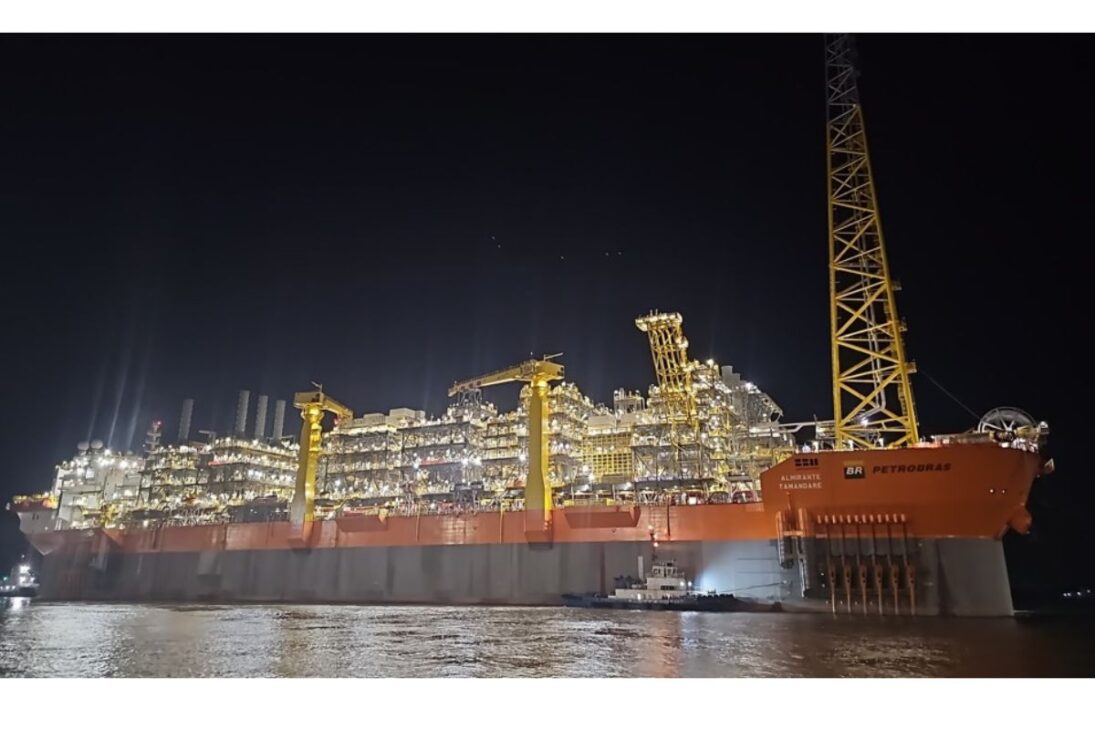
The key piece for the Pre-Salt Sets Historical Record was the entry of the FPSO Almirante Tamandaré. The platform, which is a floating unit for production, storage, and transfer, commenced its activities in the Búzios field on February 15, 2025.
It is the largest unit of its kind in operation off the Brazilian coast. The platform has the capacity to process 225,000 barrels of oil and 12 million cubic meters of gas daily. As the sixth platform to operate in Búzios, one of the most productive fields in the world, the Almirante Tamandaré is a symbol of Petrobras’ commitment to cutting-edge technology and large-scale projects to maximize extraction.
Why Does the Pre-Salt Set a Historical Record? The Strategy to Secure the Future
The pursuit of production records is not an end in itself. It is part of a clear strategy from Petrobras to ensure its long-term sustainability. As stated by the company’s president, Magda Chambriard, the focus is on “replenishing oil and gas reserves in new frontiers, in Brazil and abroad”.
Over time, the older fields, even those in the pre-salt, will begin to enter a phase of natural decline. The investment in new high-capacity production units, such as the Almirante Tamandaré, is the way the company has found to offset this future decline and diversify its portfolio, ensuring a continuous production flow for the coming decades.
The Other Side of the Record, Criticisms and Environmental Challenges
Although the operational success is undeniable, the expansion of the oil frontier does not happen without controversy. The news that the Pre-Salt Sets Historical Record comes at a time of intense global debate over the climate crisis and the need for a transition to cleaner energies.
Environmental groups criticize the strategy, arguing that Petrobras should invest more in renewable energies instead of expanding fossil fuel exploration. Petrobras, in turn, defends itself by stating that oil will still be essential for the energy matrix for many years and that the company is committed to using its vast technical experience to conduct more responsible exploration, with technologies that reduce greenhouse gas emissions.









-

-

2 pessoas reagiram a isso.