





 Portuguese
  English
  Spanish
  3 min of reading
  0 comments


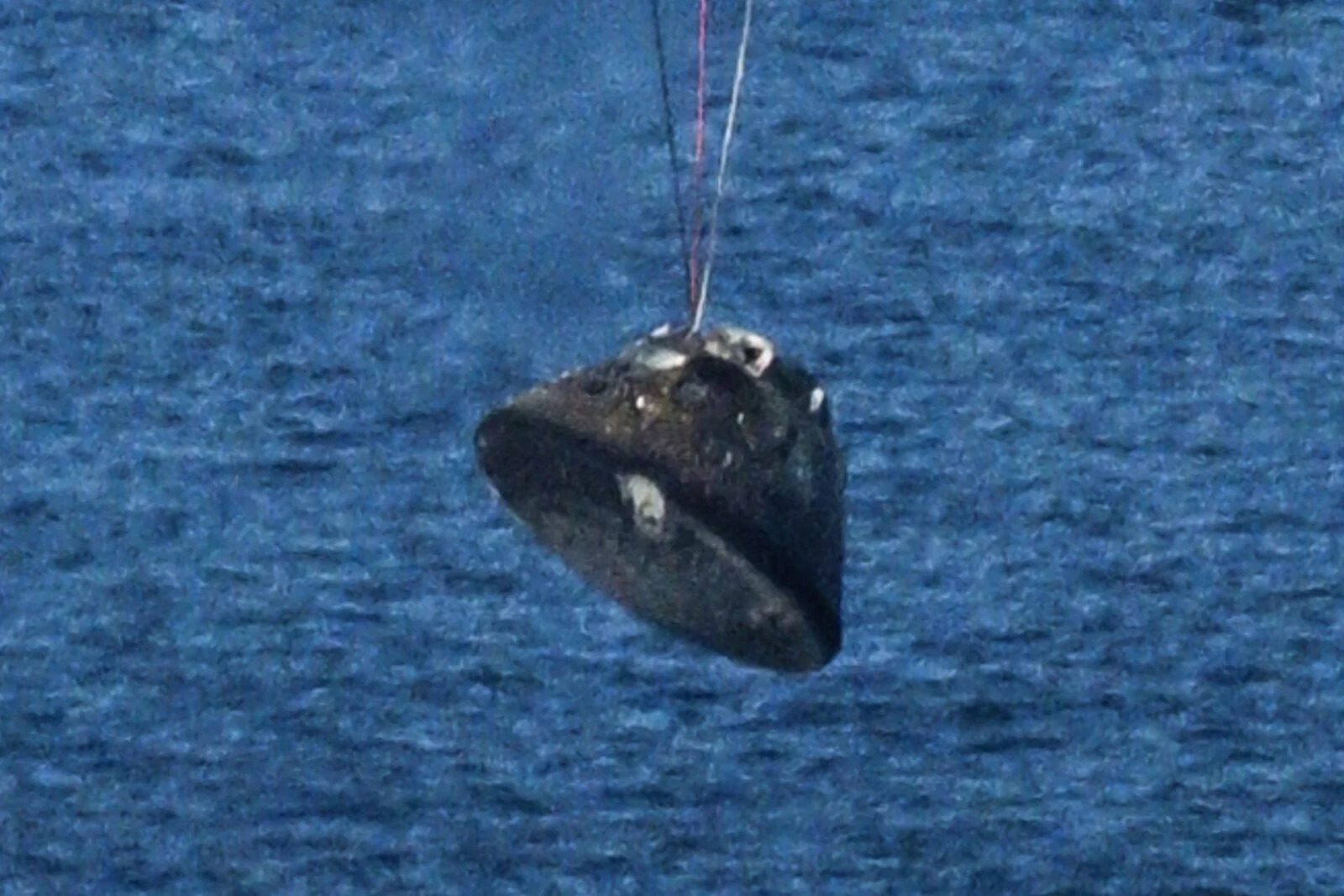
After viral photo raised doubts about Orion, NASA stated that the discoloration on Artemis 2’s heat shield was expected after reentry
The Artemis 2 mission returned to Earth on Friday with the Orion capsule protected by its heat shield during reentry, after facing temperatures of up to 1,650 degrees Celsius, while post-landing images raised doubts about possible damage to the structure.
Viral photo raises suspicions
The Artemis 2 mission concluded safely, but an enlarged image of the bottom of Orion went viral over the weekend and raised suspicions.
In the photo, a white area seemed to indicate the absence of a large piece of material on the heat shield. As controlled ablation is expected during reentry, the hypothesis of abnormal wear emerged.
-
Meteorologists warn that the polar vortex is behaving in an unprecedented manner, and the speed of this anomaly could cause frost and droughts outside the norm in major agricultural production areas.

-
The phenomenon of the “brown ribbon” of sargassum is advancing across the Atlantic Ocean on a gigantic scale, becoming visible from space and directly impacting tourist beaches, maritime activities, diving, and the environmental balance in tropical regions.

-
Young person dismantles 500 vapes, removes their lithium-ion batteries, and makes an electric car run for almost 29 km, exposing the amount of energy that is still being wasted in electronic waste.

-
Damage caused by zero-calorie sweeteners can affect up to 2 generations, alter genes related to inflammation, provoke glucose intolerance, and raise blood sugar levels, reveals a study with sucralose and stevia.

The reaction grew because the photographed point was in a sensitive area at the base of the capsule. For some observers, the appearance suggested an abnormal loss during atmospheric reentry.
NASA clarifies the image
The response came after a post on X by Eric Berger, senior editor of Ars Technica. Jared Isaacman, NASA administrator, stated that the observed discoloration did not indicate material release.
He explained that the white color corresponded to the area of the compression pad and was consistent with the local geometry, with byproducts from AVOCAT and with the transition heating environments.
Isaacman added that this behavior had already been observed in arc jet tests and was expected in that specific area of the compression pad of Orion in Artemis 2.
For the administrator, there is nothing abnormal in the released image. Still, NASA will review data from all Orion systems, as planned, and will release the conclusions.
Artemis 1 still weighs
The caution surrounding Artemis 2 is related to Orion’s history. After the return of Artemis 1 in December 2022, engineers identified irregular detachments of large pieces of the heat shield.
The investigation indicated that gases generated within the outer ablative layer were unable to escape properly. This led to pressure buildup and then the irregular detachment of parts of the material.
For the crewed Artemis 2 mission, NASA decided to modify Orion’s reentry trajectory instead of altering the heat shield design. The idea was to allow the outer layer to breathe.
Decision generated criticism
Not everyone agreed with the solution adopted. Retired astronaut Charles Camarda criticized the choice and argued that the engineers did not fully understand the root cause of the damage observed in Artemis 1.
In his assessment, without this complete understanding, it would be difficult to predict how the shield would behave under the modified reentry profile. The post-water landing analysis is still ongoing.
Safe return of Orion
Even with the debate, Isaacman stated that no unexpected conditions appeared in the images taken by divers immediately after landing or in the initial inspections aboard the USS John P. Murtha.
Regardless of the final outcome of the investigation, the heat shield fulfilled its function in Artemis 2.
Reid Wiseman, Victor Glover, Christina Koch, and Jeremy Hansen returned, and the spacecraft performed excellently, despite issues with the hydraulic system.
With information from Daily Galaxy.








Seja o primeiro a reagir!