





 Portuguese
  English
  Spanish
  5 min of reading
  0 comments


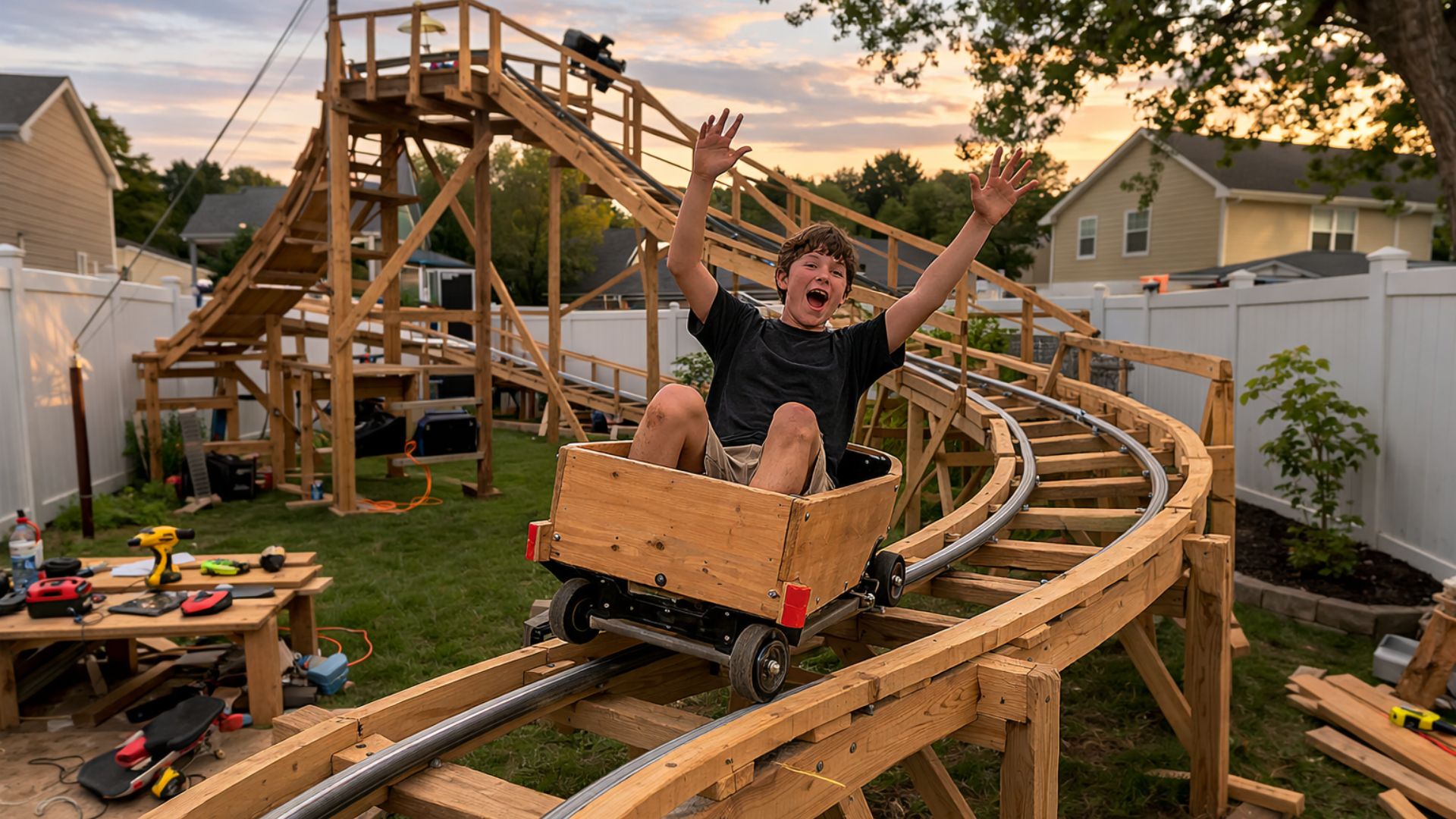
Structure Built By Teenager In The United States Draws Attention For Functioning Like A Real Roller Coaster, With Track, Cart And Cable Lift System. Project Occupied Almost The Entire Backyard Of The Family, Gone Viral On Social Media And Gained Spotlight In International Reports.
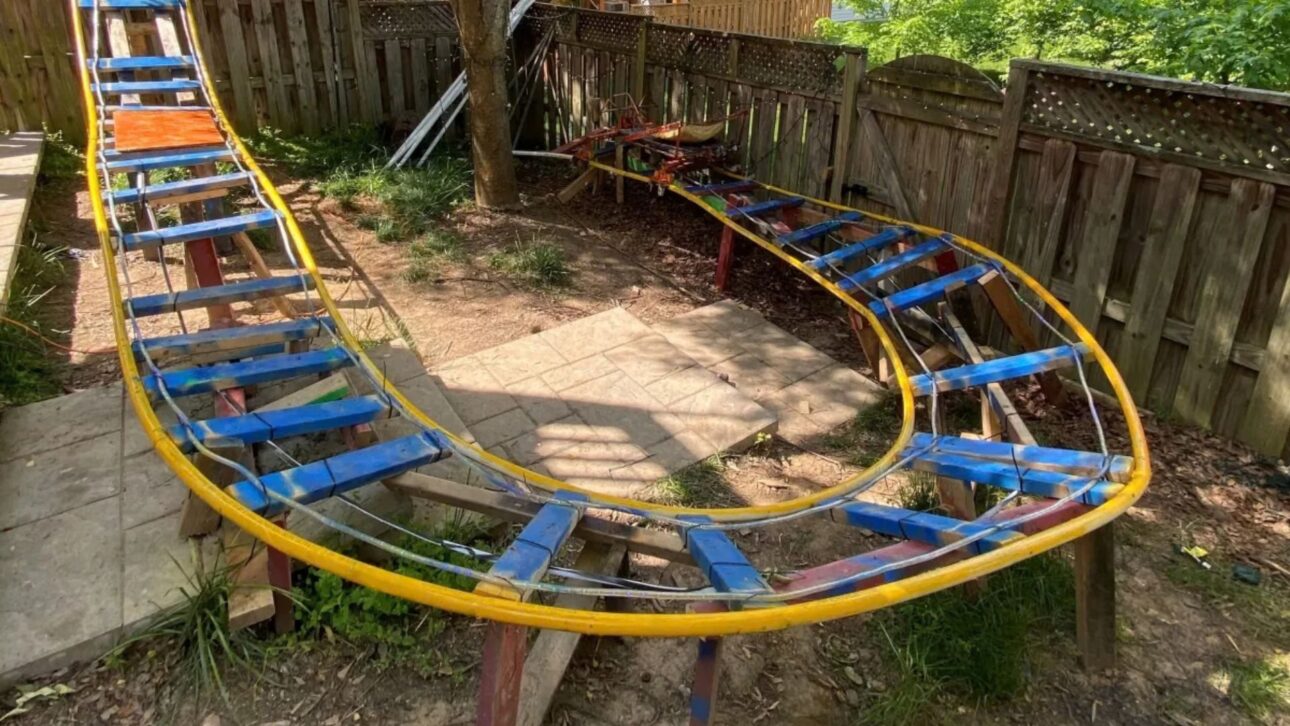
A project built in the backyard of a house in Northern Virginia, United States, turned Jake McCluskey, then 17 years old, into the character of a story that mixes engineering, repurposing materials, and repercussions on social media.
The structure, made of wood, PVC pipes, and skate wheels, spans practically the entire family’s lot and gained attention after videos posted on TikTok reached over 16 million views, in addition to garnering coverage from outlets like Newsweek and FOX 5 DC.
Roller Coaster Built In The Backyard Occupies Almost The Entire Lot
The attraction is not limited to an improvised track with a loose cart on the track.
-
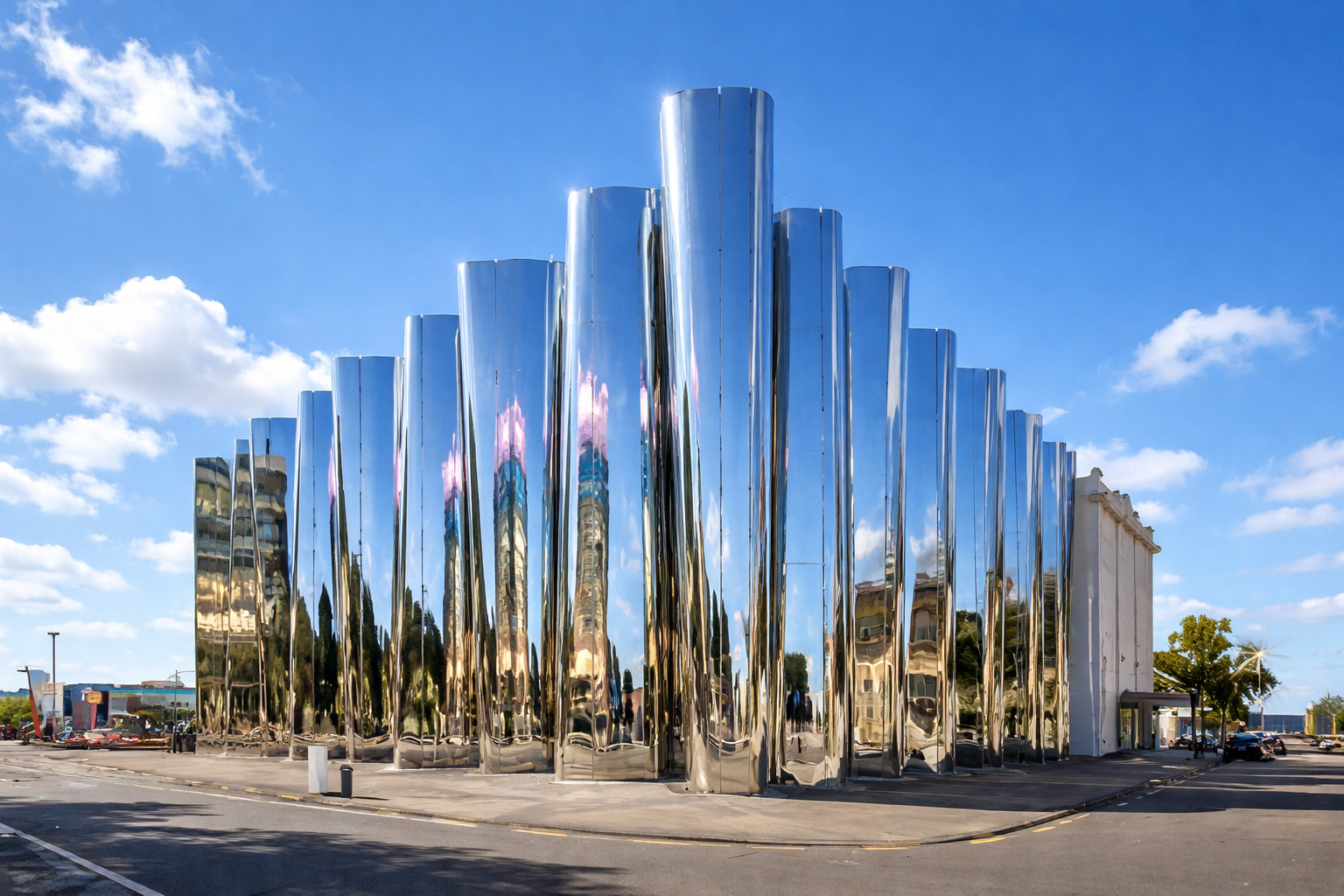
New Zealand builds a shimmering building that vibrates, featuring a 62-seat cinema, moving sculptures, and an environment where sound, light, and energy are felt in the body.
-
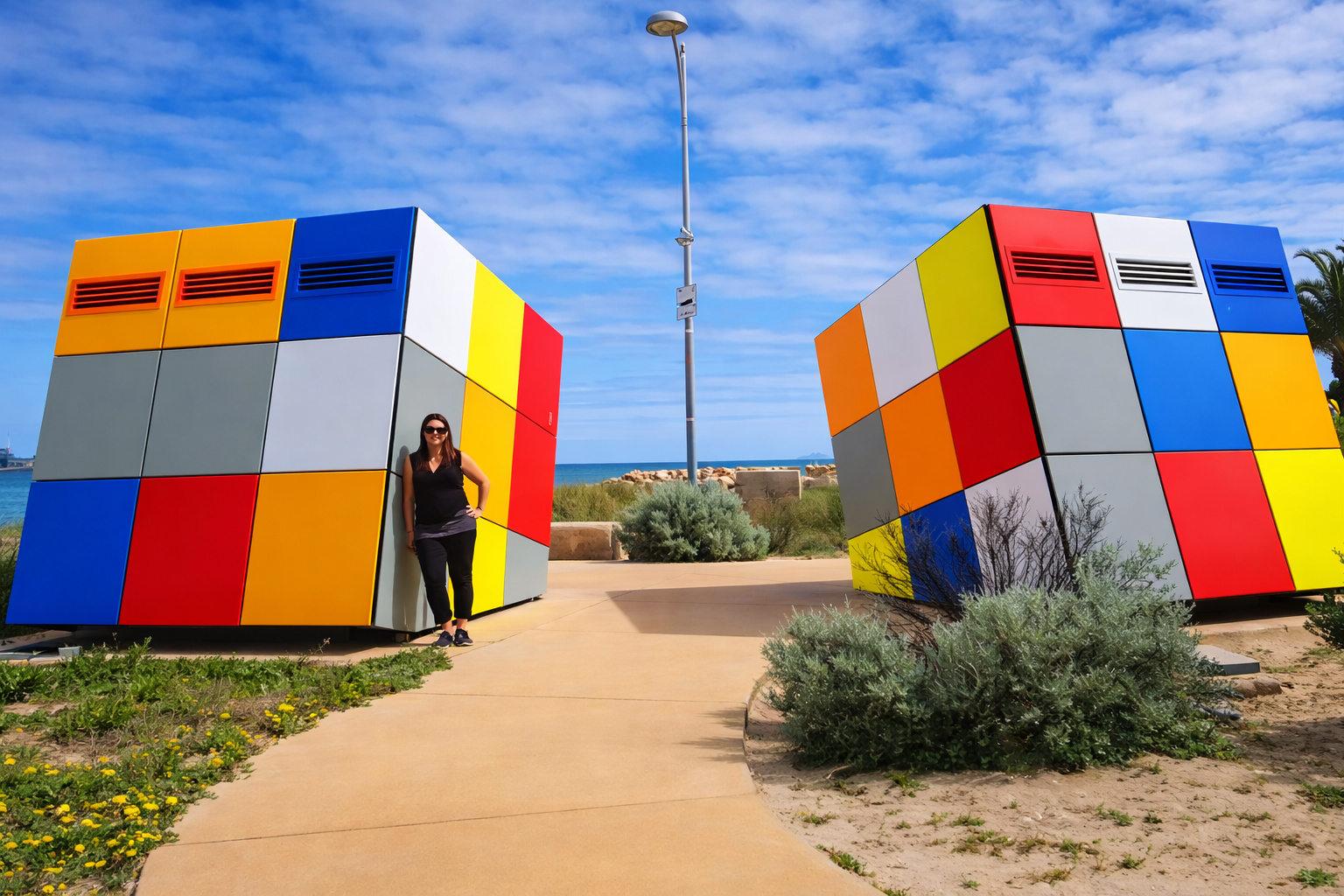
Two colored cubes of 2.5 m transform a public bathroom into a selfie spot in Western Australia, costing up to 75% less than traditional construction and helping to reduce vandalism in public spaces.
-
Santa Catarina produces up to 7 times more than it consumes in some sectors, and its century-old industries founded by grandparents and great-grandparents now compete on equal footing with Germany and the United States in the international market.

-
U.S. war giant weighing 9,600 tons and equipped with long-range missiles is sent to the Atlantic to protect global internet and hunt submarines.


According to a report by Newsweek, McCluskey built a compact roller coaster equipped with elements found in larger versions, including descent, track winding around the garden, cable lift system, and lever release mechanism.
This setup was what made the experience draw attention beyond the visual appeal of a homemade project.
The backyard used for the project measures about 24 by 15 feet, roughly 7.3 by 4.6 meters.
Even with this limited space, the track was designed to occupy almost the entire available area, winding around the garden and utilizing every free area of the lot.
The physical limitation, rather than reducing the proposal to something symbolic, ended up serving as part of the technical challenge faced by the teenager.
The construction was made, according to McCluskey himself, with repurposed wood from construction sites, screws, PVC pipes, and skate wheels.
In one of the statements recorded by Newsweek, he summarized the buying and assembly routine by saying that the Home Depot was like his “second home”, a phrase that came to encapsulate the handmade nature of the project and the volume of adjustments needed throughout its execution.
Cable Lift System Differentiates The Handmade Project
The most cited point in the reports was the cable traction system installed on the attraction.
In many DIY experiences of this kind, the cart depends on manual push to start the ride.
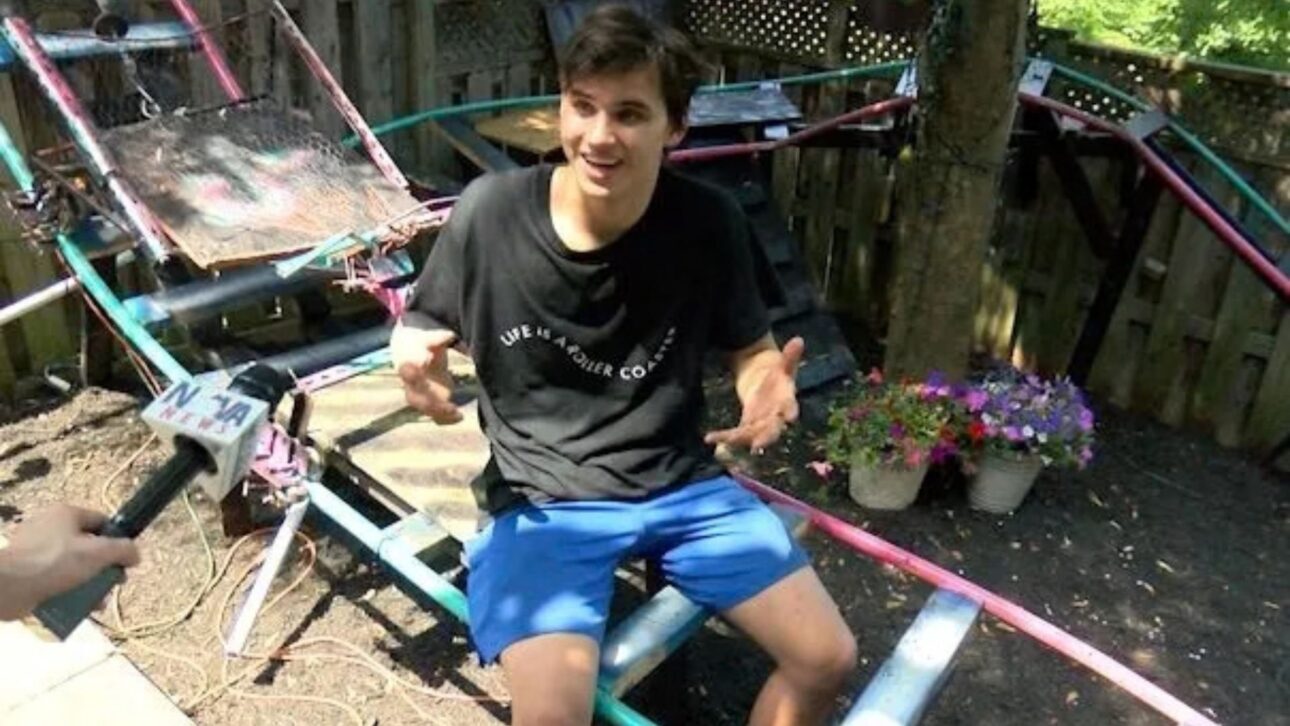
In McCluskey’s case, the vehicle is pulled to the highest point and then released by a lever, a mechanism that brings it closer to the functioning logic adopted in conventional roller coasters.
This technical detail helps explain why the structure was regarded as something beyond a mere internet curiosity.
The presence of this system also reinforces the organization of the project by well-defined functions.
The track guides the path, the cart traverses the track, the cable makes the ascent, and the lever controls the release, forming a mechanical sequence that reproduces basic principles used in larger park attractions.
Attempts And Versions Until Arriving At The Functional Model
Before going viral, the roller coaster went through several testing stages.
Newsweek reported that McCluskey began the first version in January 2020 and spent about five months trying to solve, above all, how to make the cart round the curve more smoothly.
The work was resumed later, already in April 2021, when he reached the third and fourth versions of the structure until achieving a functional result.
This history helps shift the story from the realm of pure improvisation to that of technical persistence.
What resonated on social media was the image of a working homemade toy, but the trajectory shown in the reports reveals a sequence of attempts, errors, corrections, and reconstructions.
It was this process, and not just the final result, that sustained the interest of those who followed the videos.
YouTube And Creators Inspired Engineering Learning
McCluskey told Newsweek that he turned to YouTube to develop engineering skills and seek references for the project.
Among the inspirations he mentioned is Will Pemble, known for building roller coasters in his own backyard, an experience that had already been portrayed by Wired magazine in reports and videos about this type of handmade project in the United States.
According to Newsweek, the teenager said he wanted to become a roller coaster engineer since he was five years old.
In the same interview, he associated the construction with the attempt to learn practically, outside the traditional classroom model.
The statement gave the case a broader dimension: a young person who turned a childhood vocation into a real experiment, using his backyard as a laboratory.
Videos On TikTok Boosted Global Repercussion
The scale turnaround came when videos of the structure began circulating on TikTok.
Records published on the platform surpassed 16 million total views, quickly expanding the reach of the project beyond the neighborhood where it was built.
The peak of the uproar occurred when the creator noticed the sudden spike in audience even during an English class.
Within days, a home initiative transformed into an international topic on social media.
Subsequently, FOX 5 DC featured McCluskey on a local program and described him as a Loudoun County teenager who built a roller coaster in his own backyard.
The television appearance helped further amplify the visibility of a story that was already circulating strongly among internet users.
Family Backyard Turned Miniature Amusement Park
The teenager’s mother, Jill McCluskey, also appeared in reports about the case.
She reported that she initially resisted the idea of transforming the garden into a fun area.
Over time, however, she began to support the project as she realized her son’s dedication to making the idea a functional structure.
Jill herself participated in a video recording her first ride down the cart of the attraction.
This moment helped reinforce the contrast that made the story so shareable.
On one side was a common residential neighborhood backyard.
On the other, an organized handmade structure designed to replicate the experience of a miniature amusement park.
The lot ceased to be just open space of the house and became a showcase of an engineering project developed almost entirely by the teenager.
Project Combines Simple Engineering, Creativity And Persistence
The resonance of the case can be explained by a rare combination of factors gathered in the same image.
Among them are the age of the author, the handmade construction, the use of repurposed materials, and the real functioning of the structure.
It was not just a curious object, but a system that ascended, released, and traversed the track, revealing visible planning even under an improvised appearance.
The reports also showed that McCluskey intended to continue improving the attraction.
Among the ideas mentioned were the inclusion of new elements in the course, such as a more complex ascent and even a tunnel, indicating that the backyard roller coaster would continue evolving with new versions and adjustments.






-

-

-

-

-

-

65 pessoas reagiram a isso.