






 Portuguese
  Spanish


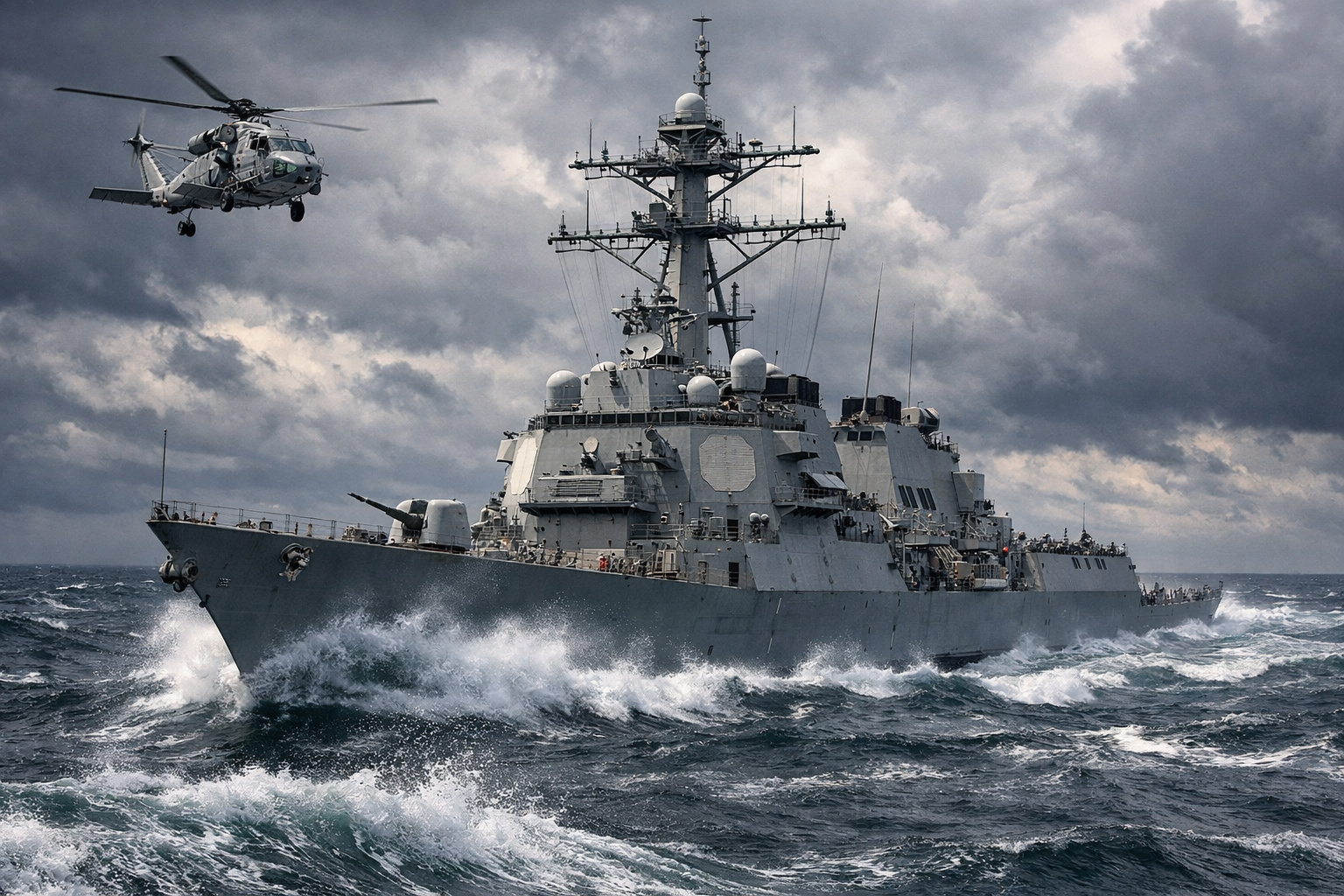

Military ship of 155 meters equipped with advanced technology, high-precision radar, and arsenal with a range over 1500 km strengthens surveillance on strategic routes and critical submarine infrastructure
One of the most advanced ships in the world has once again drawn attention on the global stage. A guided missile destroyer of the Arleigh Burke class has been sent to the Atlantic Ocean on a strategic mission involving maritime security, submarine surveillance, and protection of essential infrastructures.
The information was released based on analyses of naval movements and the current geopolitical context, which indicates an increase in military activity in deep waters.
Weighing about 9,600 tons and approximately 155 meters long, the ship operates as a true floating fortress. In addition, a crew of around 300 highly trained military personnel ensures continuous operation on long-duration missions.
-
Crab Trapped in Plastic Bottle for 62 Days Near Okinawa Highlights Little-Known Impact of Marine Pollution on Small Animals

-
Esperanza’s Bamboo Barrier in Oaxaca Redirects River and Reduces Erosion by 85% in Five Years

-
Family Builds Homemade Wind Turbine to Power Off-Grid Home, Video Reaches 555,000 Views on Ngô Thị Huyền’s Channel
-
Indian Brand Creates Sneakers from Recycled PET Bottles and Discarded Tires, Repurposing Over 1 Million Bottles and Raising $4 Million for Expansion





Mission involves hunting submarines and protecting cables that sustain the global internet


The objective of the operation goes beyond military presence. The destroyer is engaged in a multifaceted mission that includes three main pillars.
Firstly, the ship conducts anti-submarine warfare operations, identifying and monitoring hostile submarines hidden in the depths of the ocean.
Furthermore, it protects strategic trade routes, through which millions of tons of goods pass daily, connecting global economies.
Finally, the ship monitors submarine fiber optic cables, responsible for carrying about 99% of the entire global internet. Any disruption to these cables can have severe impacts on financial systems, communications, and government operations.
Consequently, the presence of this type of vessel acts as a strong deterrent element.
Advanced detection system transforms the ship into a hunter of submarines
The ability to locate submarines is one of the destroyer’s greatest differentiators. To achieve this, the ship utilizes a highly sophisticated sonar system, which combines hull sensors and a towed array measuring hundreds of meters.
While the forward sonar emits acoustic signals and detects echoes, the towed array picks up extremely subtle noises, extending the detection range.
Additionally, the ship operates with two MH-60R Seahawk helicopters. These aircraft expand the search area and utilize sonobuoys and dipping sonar to identify submerged targets.
If necessary, the helicopters can respond quickly with MK54 torpedoes, reducing reaction time against threats.
Next-generation radar monitors hundreds of threats simultaneously
Another highlight is the Aegis combat system, responsible for integrating sensors and armaments into a highly efficient network.
The AN/SPY-1D radar, composed of four fixed antennas, ensures complete 360-degree coverage. Unlike traditional radars, the system electronically directs signals, allowing for almost instantaneous response.
In this way, the ship can simultaneously track hundreds of targets, including aircraft, cruise missiles, and even ballistic missiles.
Moreover, the system classifies threats, prioritizes targets, and coordinates automatic responses, significantly increasing operational efficiency.
Arsenal with more than 90 cells can hit targets over 1500 km away
The offensive power of the destroyer is concentrated in the vertical launch system (VLS), which has more than 90 cells.
This system allows for the use of different types of missiles, adapting the ship for specific missions.
Among the main armaments are Tomahawk missiles, capable of hitting targets over 1500 km with millimeter precision.
Additionally, the ship uses missiles from the Standard family, such as the SM-2 and SM-6, which intercept aerial threats and even ballistic missiles.
For short-range defense, the Evolved Sea Sparrow missiles come into play, highly maneuverable and effective against fast attacks.
Military presence reflects increase in geopolitical tension in 2026
The deployment of this type of vessel to the Atlantic occurs at a time of increasing global tension. In recent years, there has been a significant increase in submarine activity in strategic regions.
In this context, naval presence reinforces security and ensures freedom of navigation.
Moreover, monitoring critical infrastructures, such as submarine cables, has become a priority due to the risk of sabotage or espionage.
Therefore, the destroyer acts not only as a combat platform but as a strategic element of global stability.
An invisible guardian of routes and global connectivity
More than a warship, this vessel represents a key piece in modern geopolitics.
It protects trade routes, monitors submarine threats, and ensures the functioning of systems that sustain the global digital economy.
Thus, its presence in the Atlantic sends a clear message: the security of the seas remains a strategic priority.
Do you think this military presence increases global security or raises international tensions?

Source: Curiosities with VDZ


