






 Portuguese


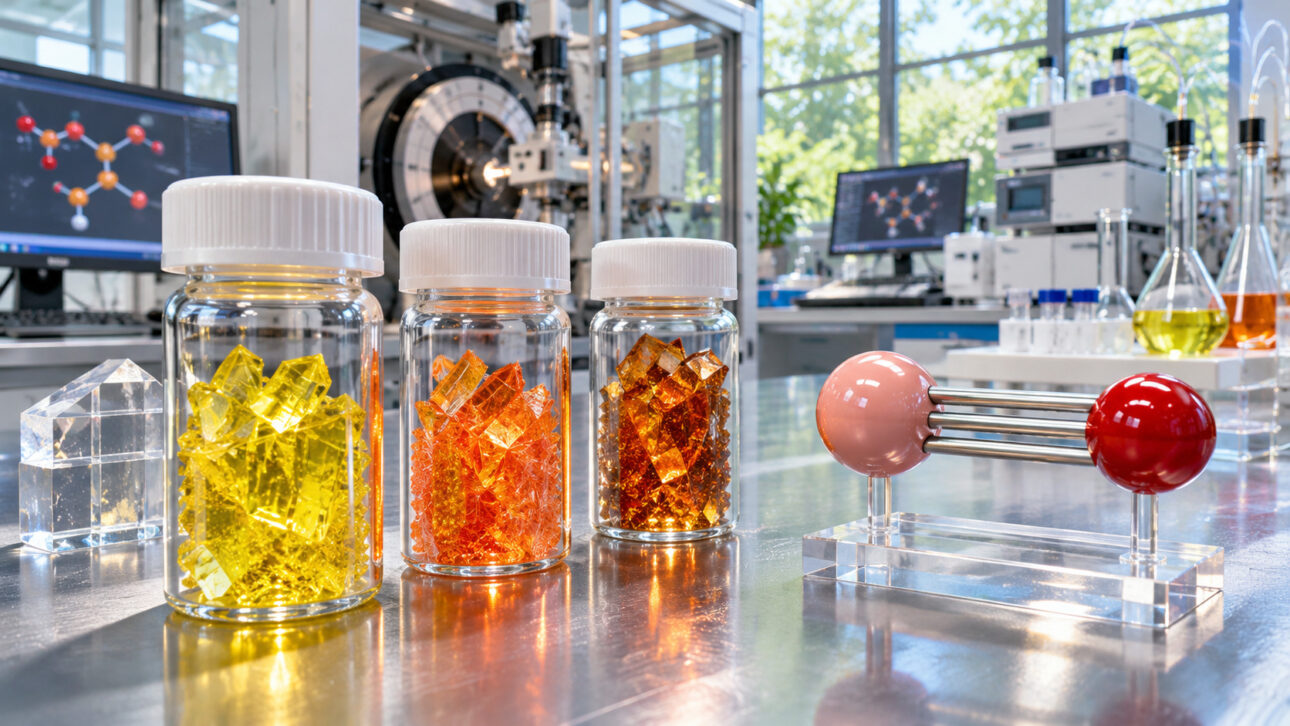

Researchers in Germany and India have isolated three oxoboranes, compounds with a triple bond between boron and oxygen that have challenged chemists since the 1960s. The discovery came unexpectedly during experiments with common reagents and was published in Nature Chemistry.
A chemical discovery that scientists had awaited for more than 60 years happened unexpectedly in a laboratory at the University of Würzburg in Germany. Two doctoral researchers mixed substances during experiments and observed the formation of yellow and orange solids. After investigating the materials, they realized they had produced three molecules that scientists had been trying to isolate since the 1960s.
The compounds are known as oxoboranes, a class of molecules containing triple bonds between boron and oxygen atoms. For decades, these structures were considered highly reactive, with insufficient stability to be isolated under ordinary ambient conditions.
The team synthesized three types of oxoboranes and kept them as stable crystals at room temperature, allowing researchers to examine their structures and chemical properties.
-
After 174 years, scientists develop an algorithm that colors maps with just four colors, cuts processing time, and could speed solutions to complex computing problems

-
Physicist creates artificial black hole with 604 million bits, discovers information can escape simulated horizon
-
Scientists destroy ‘forever chemicals’ at just 110 °C, nearly ten times below incineration temperatures, opening a path to treating waste that contaminates water
-
NASA-backed scientists cultivate potatoes in lunar-like soil using worm-produced fertilizer, achieving Earth-like yields and paving the way for space agriculture



The work was published on October 27, 2026, in the scientific journal Nature Chemistry and drew renewed international attention on November 23, when ScienceAlert reported details of the discovery.
The findings expand opportunities to investigate little-studied chemical bonds and give scientists a new way to study highly reactive substances.
Two researchers found yellow and orange crystals during experiments
The discovery began when doctoral researchers Lukas Lubczyk and Christian Markl, members of Professor Holger Braunschweig’s team, were investigating reactions involving a substance called diboracumulene.
This compound contains boron atoms and is highly chemically reactive.
During the experiments, the researchers combined diboracumulene with various substances, including ketones, reagents widely used in organic chemistry laboratories.
The result surprised them both.
The reactions produced solid materials in shades of yellow and orange. When the researchers analyzed the products, they identified molecular structures that chemists had been searching for over decades.
Lubczyk and Markl observed the phenomenon independently. Repeating the experiments helped show that the molecules formed as a result of the chemical reactions used.
A University of Würzburg statement published on October 28, 2026, said the spontaneous formation of the oxoboranes surprised even the specialists involved in the study.
The team led by Braunschweig had been researching chemical bonds involving boron for more than 15 years. The group had previously helped produce molecules with triple bonds between two boron atoms and, later, between boron and carbon.
The triple bond between boron and oxygen remained one of the field’s biggest challenges.
Why these molecules eluded researchers for more than six decades
The problem lies in boron’s electronic properties.
Unlike many other chemical elements, boron is electron-deficient in many of its compounds, a property that makes it difficult to form and stabilize certain bonds.
The oxoboranes under investigation have a triple bond between boron and oxygen, represented by the structure B≡O.
This type of bond is particularly interesting because it involves an electronic distribution that is difficult to stabilize.
Since the early 1960s, different teams have tried to produce these molecules.
Scientists managed to detect certain species under extreme conditions, including in gas-phase experiments and through isolation techniques using special matrices.
Other studies produced derivatives or stabilized similar structures using metals.
The main challenge was to produce molecules with the desired triple bond and keep them stable long enough to study them as isolated substances.
The new discovery changed that.
The researchers obtained three compounds that remained stable as crystalline solids at room temperature, allowing them to conduct detailed structural analyses.
The distinction matters: detecting an extremely reactive molecule for an instant and isolating it as a solid are separate experimental achievements.
Extremely short chemical bonds confirmed by X-rays
After forming the crystals, the scientists used experimental techniques and computational calculations to understand their structures.
One of the main tools was X-ray crystallography, a method used to investigate how atoms are arranged in crystalline materials.
The results identified boron-oxygen bonds with lengths of approximately 1.208 to 1.217 angstroms.
An angstrom is one ten-billionth of a meter.
These extremely short distances, combined with electronic analyses, confirmed the presence of strong bonds between the elements.
The researchers also investigated why the molecules were able to remain stable.
The explanation involves an additional chemical group called borylenyl, whose electronic properties can help stabilize the structure.
This group helps redistribute electron density, reducing conditions that would normally promote the decomposition of oxoboranes.
The analysis was conducted in collaboration with the team of Professor Ashwini K. Phukan at Tezpur University in India, which carried out some of the computational studies.
The result shows that choosing the right groups attached to a molecule can make it possible to stabilize structures previously considered difficult to obtain.
Discovery could pave the way for new reactions and chemical materials
The research’s main impact is the opportunity to study directly molecules that, until now, were known mainly through limited experimental evidence.
With oxoboranes available as isolated compounds, scientists can investigate their reactivity, better understand their bonds and test new chemical transformations.
The study has already demonstrated reactions involving amines, nitrogen-containing substances found in a range of chemical synthesis processes.
These experiments showed that oxoboranes can take part in different transformations, including addition reactions and molecular rearrangements.
For materials chemistry, the significance lies in access to little-explored structures and electronic behavior.
The discovery also provides a strategy that could be investigated in efforts to stabilize other highly reactive chemical species.
Industrial applications will depend on further research. The current results demonstrate the synthesis, stability and certain reactions of these compounds. Developing commercial materials or specific production processes will require additional studies.
This distinction between fundamental discovery and technological application is central to understanding the advance: first, the researchers succeeded in producing the compounds; now, they can investigate potential uses.
German university plans to expand discovery to other molecules
After synthesizing three oxoboranes, the team is working to determine how broadly the method can be applied.
One goal is to produce new compounds with chemical bonds that are difficult to stabilize, using strategies similar to those identified in the research.
The scientists also plan to explore the reactions of oxoboranes and understand how their properties could be used to build other molecular structures.
The work was conducted by the University of Würzburg in collaboration with Tezpur University, with support from scientific funding agencies in Germany and India.
The discovery brings a search that began more than six decades ago to a close and opens a new phase of investigation.
What began with the unexpected formation of yellow and orange crystals demonstrated that molecules considered excessively unstable can be isolated when their electronic structures are adequately stabilized.
The next challenge will be to turn this experimental achievement into knowledge about new reactions, new families of compounds and possible applications in materials chemistry.


