






 Portuguese


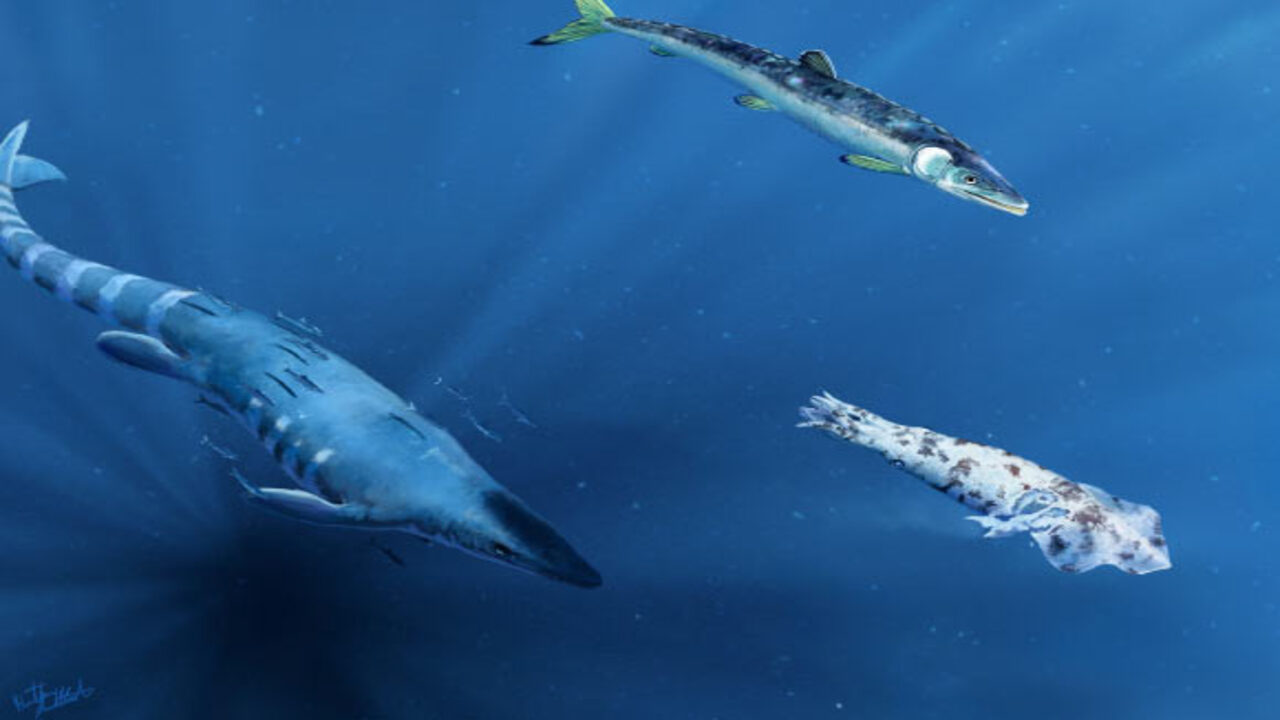

Paleontologists identified two bite marks on the internal skeleton of an 81-million-year-old Enchoteuthis fossil in Canada, revealing rare evidence of predator-prey interactions in the Cretaceous seas.
The analyzed specimen, cataloged as Q80.05.14, measures about 49 centimeters in preserved length. It was originally collected in 1980 from the Pierre Shale formation located in the province of Manitoba.
Analysis of the gladius of the Enchoteuthis cephalopod
Currently housed at the Canadian Fossil Discovery Centre, the fossil consists of a gladius, the internal support structure of the animal. The piece shows an almost complete suture and part of the mantle, missing both anterior and posterior ends.
Researchers estimated that the total length of the gladius was approximately 60 centimeters. From this measurement, scientists projected that the total body length of the Enchoteuthis was less than one meter.
-
Amazon to Span the Pacific with 420 Tbps Submarine Cable Connecting the U.S. to Japan by 2029

-
Superhot Rock Geothermal Well Reaches 10,350 Feet in Just 15 Days of Drilling in Oregon, 80% Faster Than the Company’s Previous Well, Pushing Installed Kilowatt Costs Toward $3,200

-
Flying cars are not yet transporting passengers in Brazil, but São José dos Campos is already testing landings, takeoffs, and charging to prepare for a future eVTOL airport

-
Hubble Spots Ten-Sided Wave at Saturn’s South Pole, Where One Side Exceeds 16,700 Kilometers and Moves East Nearly Fifty Times Slower Than the Wind That Forms It


To examine the material, a team led by paleontologist Melina Jobbins from the University of Manitoba utilized 3D scanning technology and silicone molds. The procedure allowed for detailing the two subtriangular marks present in the fossilized structure.
Bite marks and predation dynamics
The first puncture, located at the front of the structure, was confidently interpreted as a bite mark. Since it shows no signs of healing, the damage occurred shortly before or at the time of the animal’s death.
The second mark, positioned at the back, had a more ambiguous origin during analyses. Researchers assessed that the damage could represent a second strike from the same attack or an injury resulting from a separate confrontation.
Another hypothesis for the second mark is delamination of the structure. This occurs when the gladius separates along its natural fibrous layers during an attack or during the decomposition of the animal’s carcass.
Researchers emphasized that identifying the exact predator based on indirect evidence carries uncertainties. The absence of embedded teeth or a regular spacing prevented definitive confirmation of the species responsible for the attack on the Enchoteuthis.
Possible predators and the Cretaceous ecosystem
Despite uncertainties about the bite’s author, the team was able to narrow down suspects. The marine reptile mosasaur, such as Latoplatecarpus, and the predatory fish Cimolichthys inhabited the same waterway as the Enchoteuthis and remain possible aggressors.
On the other hand, other animals that lived in the same environment were ruled out by experts. Sharks and the giant mosasaur Tylosaurus were excluded from the suspect list based on the shape of their bites or the morphology of their teeth.
In the Mesozoic Era, cephalopods, including coleoids and ammonites, were among the most abundant groups in the seas. They served as an important food source for larger marine reptiles and fishes of the time.
The dynamics between prey and predators is supported by direct evidence, such as fossils with preserved stomach contents, and indirect evidence, such as fractures and bite marks. Studying these marks aids in understanding the food webs of the Western Interior Seaway.
Source: Science News


