





 Portuguese
  English
  Spanish
  5 min of reading
  0 comments


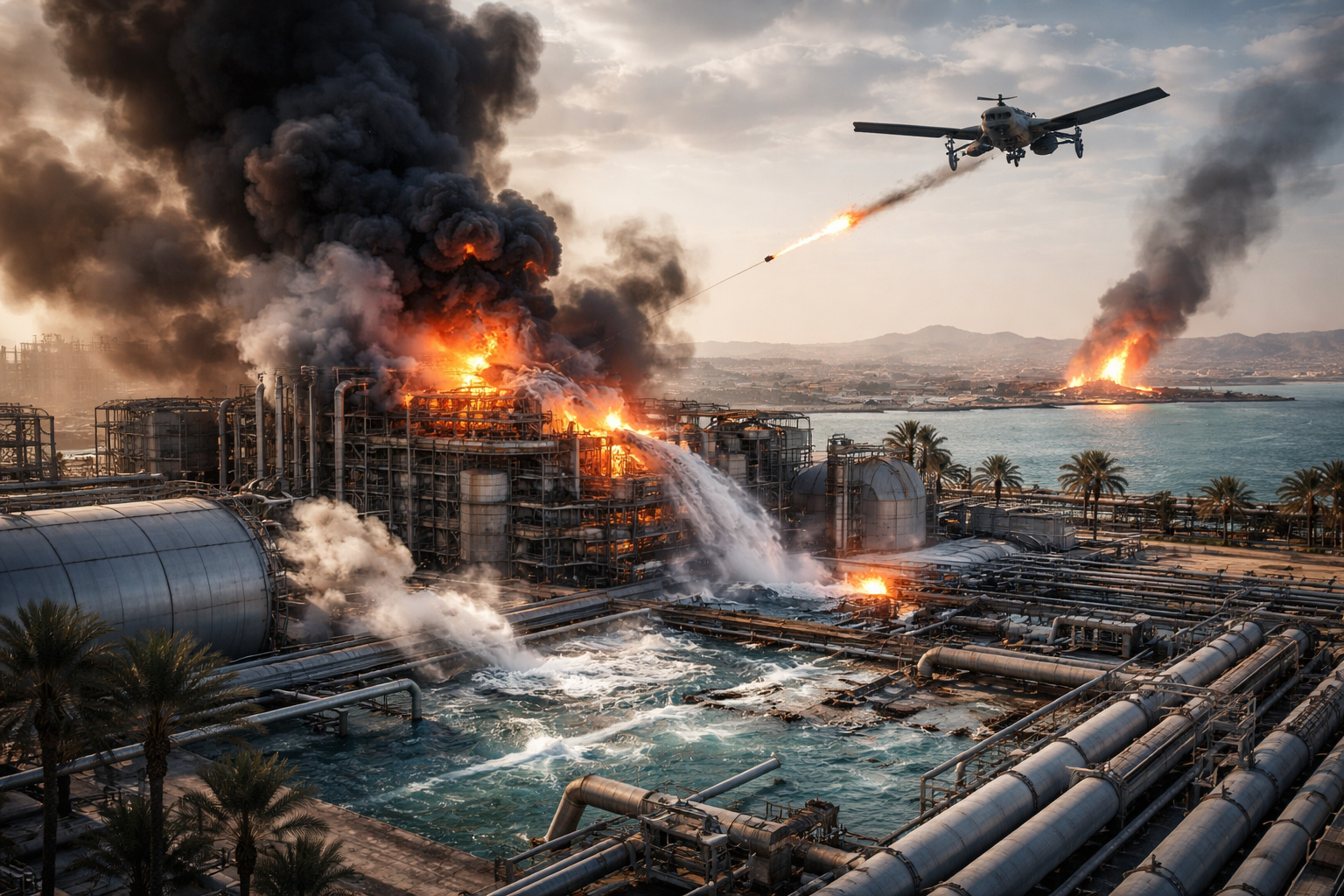
Essential Water Infrastructure Becomes Target in Recent Episodes, as Experts Warn of Humanitarian and Economic Impacts if Attacks Intensify
The ongoing conflict in the Middle East has revealed a growing concern among water security and geopolitical experts.
Recent attacks on desalination plants, responsible for ensuring potable water for millions of people, have raised alarms about a new type of strategic vulnerability in the region.
On Sunday, authorities in Bahrain reported that a desalination plant was damaged following an Iranian drone attack.
The episode occurred in March 2026 and took place just a day after Tehran accused Bahrain of a similar attack on the island of Qeshm, in Iran.
According to Iranian authorities, the incident compromised the water supply in about 30 villages, escalating tensions around critical infrastructures.
Even though these attacks are limited, experts argue that targeting water facilities can have far more severe consequences than attacks on other structures.
-
Spain challenges the USA and closes its airspace for operations against Iran, raising global tension and provoking the threat of a trade rupture.

-
While no other country manufactures tanks in Latin America, Argentina activates the TAM 2C-A2 and raises a curiosity about the technological lag in the region.
-
A Russian ship with 730,000 barrels of oil has just arrived in Cuba while Mexico negotiates fuel sales through private companies: the communist island is desperately seeking alternatives after losing its supply from Venezuela due to American military action.
-
Iranian drones and missiles destroyed a 270 million dollar American spy plane in Saudi Arabia, splitting the E-3 Sentry aircraft in half and injuring 12 military personnel in an attack that exposes the vulnerability of U.S. bases in the Persian Gulf.

Economist Esther Crauser-Delbourg, a water resources specialist, told AFP in March 2026 that water could become a decisive factor in regional conflicts.
According to her, “whoever attacks water could trigger a war even more devastating than the current one”.
Strategic Importance of Desalination in the Region
The Middle East faces some of the planet’s most challenging climatic conditions regarding water availability.
According to data from the World Bank, access to freshwater in the region is about ten times lower than the global average, making desalination indispensable for urban and economic survival.
In this context, the plants that convert seawater into drinking water have become an essential part of the regional infrastructure.
A study published in the scientific journal Nature indicated that approximately 42% of the world’s desalination capacity is located in the Middle East.
This dependence is evident in several Gulf countries.
A report released in 2022 by the French Institute of International Relations (Ifri) shows that desalinated water accounts for a large part of the supply in various nations.
Among the main examples are:
• United Arab Emirates, where about 42% of potable water comes from desalination
• Saudi Arabia, with approximately 70% of water dependent on these plants
• Oman, where 86% of the supply is produced by desalination
• Kuwait, with about 90% of water coming from this process
According to Crauser-Delbourg, without desalinated water many cities would simply cease to function.
Major urban centers like Dubai and Riyadh rely directly on these facilities to sustain their populations and economic activities.
Strategic Warnings Were Already Known
The vulnerability of this infrastructure had been discussed by international security analysts for over a decade.
In 2010, an analysis released by the CIA (Central Intelligence Agency of the United States) highlighted that the disruption of desalination facilities could have more severe consequences than the loss of any other strategic industry in the region.
Additionally, diplomatic documents revealed by WikiLeaks in 2008 pointed to a critical scenario for the Saudi capital.
According to the released telegram, Riyadh might need to be evacuated in about a week if the Jubail desalination plant were destroyed or severely damaged.
This facility is considered one of the main suppliers of water for the city.
Operational Threats Increase Concern
While military attacks receive greater attention, experts claim that desalination plants face other significant risks.
According to specialists consulted by AFP, power outages and seawater contamination can also affect the operation of these units.
Among the main threats identified are:
• Power outages, which interrupt the desalination process
• Seawater contamination, mainly from oil spills
• Drone or missile attacks, increasingly present in recent conflicts
In light of these threats, security measures have been reinforced at several facilities in the region.
The regional director of Veolia for Africa and the Middle East, Philippe Bourdeaux, told AFP that monitoring of facilities has been intensified following recent incidents.
The company operates desalination units in Jubail, Saudi Arabia, as well as facilities in the cities of Muscat, Sur, and Salalah, Oman.
According to Bourdeaux, some countries have begun positioning missile batteries near the largest plants for protection against drones and aerial attacks.
Additionally, operators utilize specific technologies to mitigate the effects of potential oil spills at sea.
History of Attacks on Water Infrastructure
Attacks on desalination plants remain relatively rare in modern conflicts.
However, records compiled by the Pacific Institute, a research center based in California, show that such episodes have occurred at various times over the past decade.
Among the cited cases are attacks between Yemen and Saudi Arabia during regional clashes, as well as bombings in Gaza that targeted water facilities.
Before these events, similar attacks had only been recorded in 1991, during the Gulf War.
Possible Impacts on Cities and Economy
Experts claim that prolonged disruption of desalination plants could have significant consequences for the region.
Initially, large cities could face interruptions in the supply of drinking water.
Subsequently, rationing could be implemented to preserve available reservoirs.
Crauser-Delbourg also warned that population exodus movements could occur in areas highly dependent on these facilities.
Moreover, various economic sectors would be impacted.
Among them are:
• Tourism, which relies on urban infrastructure
• Industry, which uses large volumes of water
• Data centers, which require water for cooling systems
Despite these risks, some measures may reduce immediate impacts.
According to Bourdeaux, many desalination plants operate in interconnected networks, allowing for partial compensation for the shutdown of a unit.
Additionally, these facilities typically maintain sufficient water reserves for periods between two and seven days, which can mitigate temporary supply interruptions.
However, if attacks or failures persist for extended periods, urban supply may be seriously compromised in various cities in the region.
In light of this growing tension, a strategically discussed question among international analysts arises: could water become one of the most contested resources in conflicts in the Middle East in the coming decades?







Seja o primeiro a reagir!