





 Portuguese
  English
  Spanish
  7 min of reading
  0 comments



Alaska, Which Once Belonged to Russia, Still Preserves Traces of That Era, Including Historical Architecture, Cultural Traditions, and Marked Religious Influences.
Alaska, with its vast frozen landscapes and rich biodiversity, has a history marked by Russian presence that left lasting influences on the region’s culture, architecture, religion, and toponymy.
Although Russian colonization ended in 1867, when the territory was sold to the United States, remnants of this period are still evident in contemporary Alaska.
The Russian Expansion and the Colonization of Alaska
The Russian expansion to the east began in the 16th century, culminating with the arrival at the Pacific Ocean in 1639. In the 18th century, explorers from Russia, led by Vitus Bering, initiated expeditions to map the Alaskan coast.
-
The Ukraine war exposes the strength of the M113 armored vehicle amid modern warfare with military drones.

-
Maritime geopolitics: China and the USA compete for strategic ports in Peru.

-
Iran shoots down two US aircraft: F-15 fighter crashes in mountainous area, one crew member is rescued and another is still missing; second crash in the Persian Gulf exposes still active air defense, says US intelligence.

-
USA and China compete for Brazil over resources that could be worth trillions — rare earths put the country at the center of a global dispute


In 1741, Bering and his crew landed in Alaska, establishing the first European contacts with the region.
From then on, Russian traders and hunters, known as promyshlenniki, established outposts along the coast, focused on the lucrative sea otter fur trade.
The Russian-American Company and Colonial Administration
In 1799, Tsar Paul I established the Russian-American Company (RAC), granting it the monopoly of the fur trade in Alaska and governmental authority over the settlements.
Under the leadership of Aleksandr Baranov, the company expanded its operations, founding the city of Novo-Arkhangelsk (now Sitka) as the capital of Russian America.
The RAC not only managed commercial activities but also implemented colonial policies, interacting with Indigenous populations and establishing infrastructure in the region.
Interactions with Indigenous Populations
Russian colonization significantly impacted the Indigenous populations of Alaska, including the Aleuts, Alutiiq, and Tlingit. Relations varied from commercial cooperation to armed conflicts. The Tlingit, for instance, resisted Russian occupation, resulting in the Battle of Sitka in 1804.
Besides conflicts, there was cultural and religious exchange. Missionaries from the Russian Orthodox Church evangelized thousands of Indigenous people, and Orthodox religion was incorporated into the cultural practices of some communities.

Louis S Glanzman/Public Domain
The Sale of Alaska to the United States
In the 19th century, the economic and strategic viability of the Russian colony in Alaska was questioned. The distance from Russia, high maintenance and defense costs, along with competition from other colonial powers, led the Russian government to consider selling the territory.
In 1867, Tsar Alexander II sold Alaska to the United States for 7.2 million dollars, a transaction known as the “Seward’s Folly,” referring to U.S. Secretary of State William H. Seward, who negotiated the purchase.
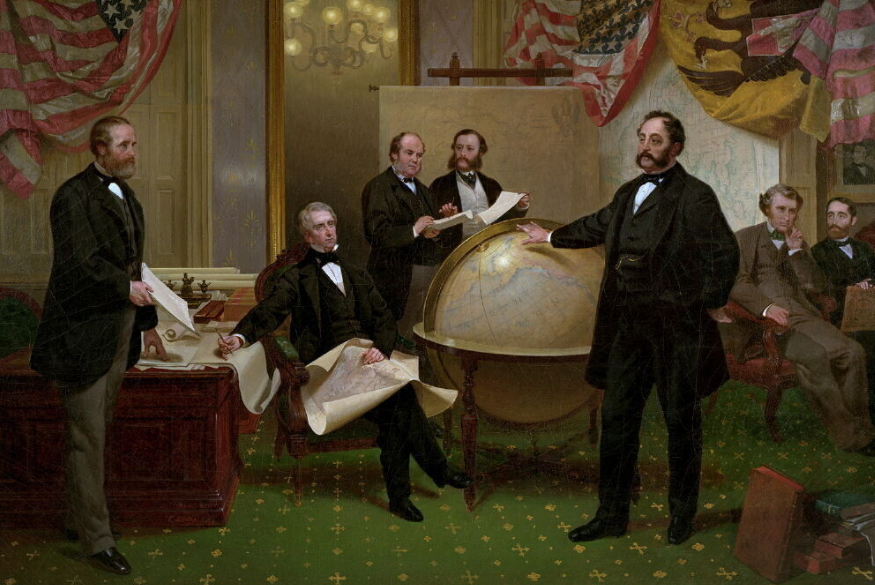
Emanuel Leutze
Russian Legacy in Modern Alaska
Although Russian colonization ended over 150 years ago, its legacy remains evident in contemporary Alaska. The Russian influence is particularly visible in the architecture, religion, toponymy, and culture of the region.
Saint Michael’s Cathedral
Several historic buildings in Alaska reflect Russian architecture. The Saint Michael’s Cathedral, located in Sitka, is an emblematic example.
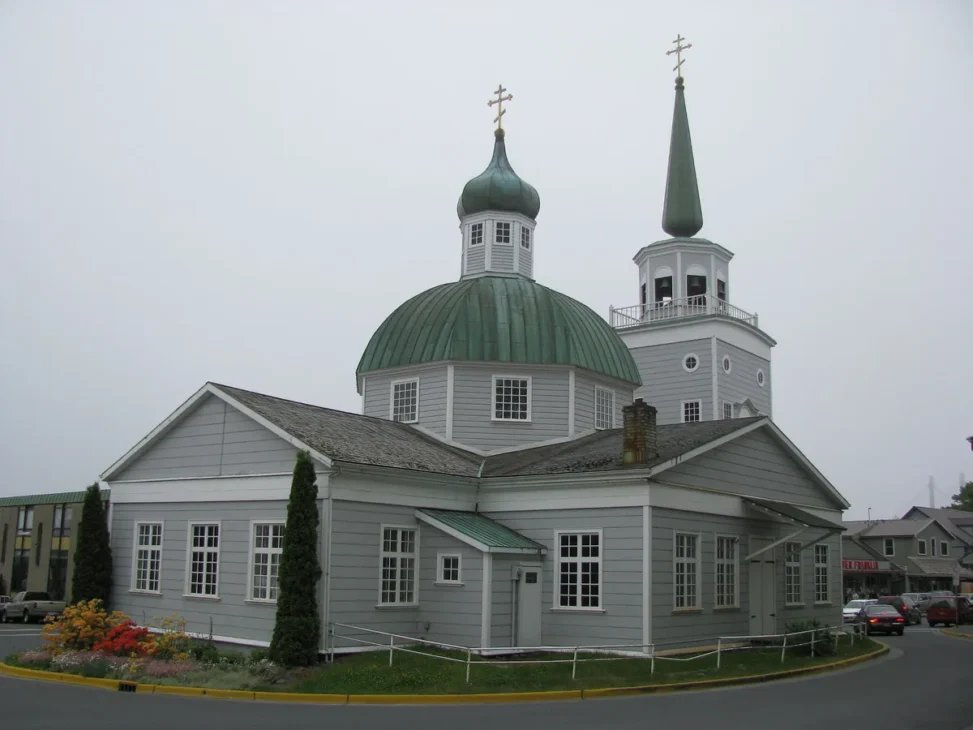
Originally built in 1848, the cathedral served as the spiritual center of the Russian Orthodox Church in North America.
Although it was destroyed by a fire in 1966, it was later rebuilt, maintaining its original architectural style.
In addition to the cathedral, other historical buildings and sites in Sitka and Kodiak preserve the Russian architectural heritage, attracting tourists and scholars interested in the region’s history.
Church of the Ascension of Our Lord – 1826
Another example is the Church of the Ascension of Our Lord, located in Unalaska, Alaska, being one of the oldest Russian Orthodox churches in North America.
Established in 1825, it played a fundamental role in the evangelization of Indigenous communities in the region.

Photo NPS/R. Hood
Father Ioann Veniaminov, who was later canonized as Saint Innocent of Alaska, led the parish of Unalaska from 1824. He trained local residents in Russian construction techniques and supervised the building of the original church in 1826.
The current structure of the church was built between 1894 and 1896, on the same site as the previous buildings from 1826 and 1858.
Wood from earlier churches was reused in the construction, following tradition. The church is recognized for its cruciform architectural style and characteristic domes, reflecting Russian influence in the region.
In 1970, it was designated as a National Historic Landmark of the United States, highlighting its cultural and historical significance.
Currently, the Church of the Ascension remains active, serving the local community and preserving Russian Orthodox heritage in the Aleutian Islands.
It houses significant religious artifacts and stands as a symbol of the faith and resilience of the Aleut population.
The church is also a point of interest for visitors looking to explore the history and culture of the region.
Religion and Cultural Traditions
The Russian Orthodox Church maintains a profound influence in Alaska, combining religious traditions with the local Indigenous culture. Since its arrival in 1794, Russian missionaries played an important role in evangelizing the region.
This interaction gave rise to a unique syncretism, uniting elements of Orthodox Christianity and Indigenous spiritual practices.
Today, Orthodox churches are present in various locations in Alaska, acting as religious and cultural centers. Religious celebrations, such as Christmas and Easter, are emblematic moments of this fusion.
The “Slaaviq,” for example, is a Christmas tradition in which groups visit homes singing religious hymns, a practice that incorporates Indigenous and Russian chants.
Other Russian Influences in Alaska
Place Names: Many place names in Alaska have Russian origins, reflecting the historical presence of the colonizers.
Cities like Sitka (originally Novo-Arkhangelsk) and Kodiak maintain names derived from the Russian colonial period. Additionally, Russian influence is evident in names of geographical features and other locations in the region.
Language and Dialects: In some communities in Alaska, especially in Ninilchik, a rare Russian dialect known as niniltchik has survived to this day. This dialect is a linguistic relic that testifies to the Russian presence in the region and the cultural exchange with local populations.
Influence on Culinary and Crafts: Alaskan cuisine also reflects Russian influences, with traditional dishes that incorporate techniques and ingredients introduced by Russian colonizers. One example is the use of smoked fish, rye bread, and soups like borscht, which are still found in communities with strong Russian roots.
The tradition of craftsmanship was also influenced by the Russians, especially in the making of religious icons and utensils that combine local and colonial techniques.
The Influence of Orthodox Churches
The Russian Orthodox Church played a central role during the colonization. In addition to evangelization, churches also served as community centers, educational places, and sources of social assistance.
The architecture of these churches, with their onion-shaped domes and characteristic crosses, is one of the most visible marks of the Russian period in Alaska.
In many Indigenous communities, Orthodox faith was adopted and adapted, resulting in a religious syncretism that combines Christian traditions and Indigenous spiritual practices.
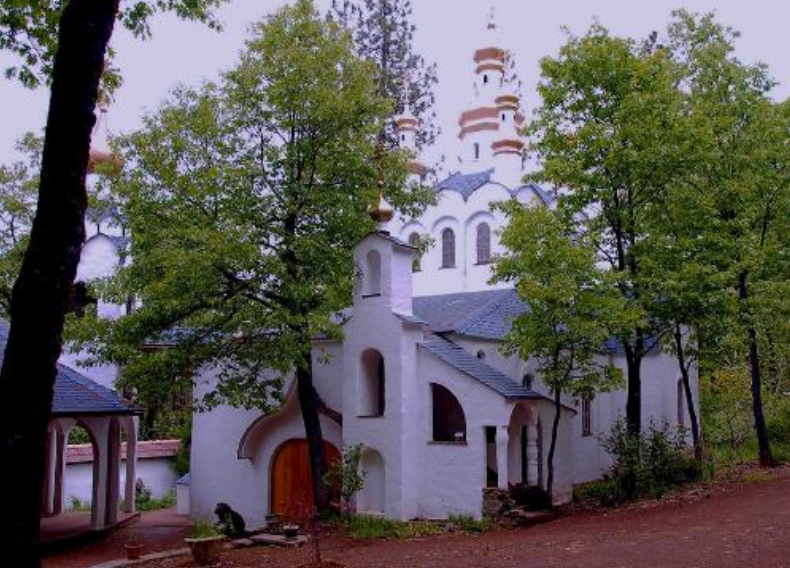
Notable examples include religious festivities, such as the celebration of the Orthodox New Year, which is observed with parades, music, and unique rituals. In Kodiak, where the Monastery of Saint Herman is located, there is particular veneration for this saint, who was one of the first Orthodox missionaries to arrive in Alaska.
Archaeological Remains and Museums
In addition to churches and historic buildings, there are archaeological sites that reveal the infrastructure of Russian colonization, including trading posts, forts, and settlements.
In Sitka, the Sitka National Historical Park preserves the remains of a Russian fort and other artifacts related to the colonial period.
Local museums, like the Alaska State Museum in Juneau and the Sheldon Jackson Museum in Sitka, exhibit documents, maps, utensils, and artworks that tell the story of the Russian presence.
Linguistic and Educational Impact
A less visible but important aspect is the impact of the Russian language in Alaska. Although most Russian speakers disappeared after the sale of the territory, small pockets of communities, such as in Ninilchik, have maintained unique dialects.
These dialects are being documented by linguists, who consider them cultural treasures and living examples of linguistic and cultural contact between Russians and Indigenous peoples.
Additionally, the Russians introduced educational systems that incorporated literacy in Russian, something rare for the period. Many Indigenous individuals had access to formal education through missionary schools.
The Sale of Alaska: Strategy or Loss?
The decision to sell Alaska was controversial. For Russia, the territory was difficult to defend and administer, especially with the growing threat from British powers in Canada.
For the United States, the purchase initially seemed like a waste, but the discovery of natural resources, such as gold and oil, transformed Alaska into one of the most strategic and valuable regions of the country. Today, many historians see the transaction as one of the greatest strategic successes for the U.S.
The Living Cultural Heritage
Although most Russian influences have been assimilated into American culture, some traditions remain alive.
Festivals like the Russian Alaska Day celebrate the shared history between the two countries. Local communities continue to preserve music, dances, and culinary practices inherited from colonization.
Tourism also plays a crucial role in maintaining the Russian heritage. Cities like Sitka attract thousands of visitors interested in exploring Alaska’s cultural and historical connections with Russia.
Guided tours, cultural events, and exhibitions are regularly organized to keep this part of history alive.
Alaska is a unique region that reflects a mosaic of cultural influences. The Russian presence, despite being brief in historical terms, has left deep marks that still resonate in the state’s identity.
From Orthodox churches to disappearing dialects, through cuisine and place names, Alaska continues to narrate the fascinating story of how two distant worlds met in the far north of America.
This cultural connection is a reminder of the complexity of human history and the importance of preserving our shared heritages.









-

-

-

-

12 pessoas reagiram a isso.