





 Portuguese
  English
  Spanish
  4 min of reading
  0 comments


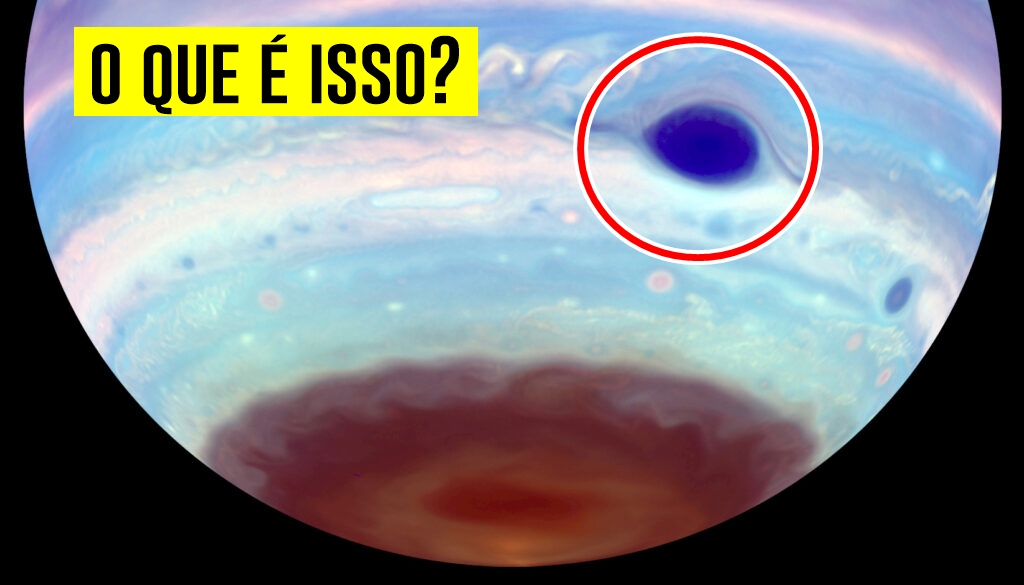
Scientists Are Trying to Unravel the Mystery Behind the Large Dark Shapes That Have Emerged on the Surface of Jupiter, Raising New Questions About What Is Happening on the Planet.
A group of scientists are intrigued after identifying mysterious dark spots at the poles of Jupiter, revealed by high-precision telescopes. These gigantic structures, visible only in ultraviolet wavelengths, are causing a stir in the scientific community as researchers try to unravel their origin and behavior.
Intriguing Discovery at the Poles of Jupiter
For decades, the Great Red Spot of Jupiter has been one of the planet’s greatest mysteries. However, astronomers from the University of California, Berkeley, have discovered something equally impressive: Earth-sized dark spots that appear and disappear at the north and south poles.
These spots, embedded in dense layers of stratospheric haze, often appear near Jupiter’s bright polar auroras, similar to the northern and southern lights on Earth.
-
A new technology attached to the helmet can detect motorcycle accidents in seconds, assess the severity, and send the location to emergency services; meet Quin, a small smart device.

-
The bizarre train that uses Cold War jet fighter engines to blast air at over 1,000 km/h, melting ice walls and freeing frozen tracks in minutes where ordinary machines would take hours.
-
Japan is transforming dirty diapers from babies and the elderly into an ambitious and surprising project that could forever change the way the world deals with one of the most difficult types of waste to dispose of.

-
Goodbye to waste: a Brazilian created a revolutionary brick that uses construction debris, has already entered the markets of the United Kingdom and the USA, and promises to shake up the global construction industry.


Images captured by the Hubble Space Telescope between 2015 and 2022 show that the dark spots absorb more ultraviolet light than the surrounding areas, making them appear even more prominent.
At the south pole, these spots appear in 75% of observations, while at the north pole, they are extremely rare, seen in only one of eight captured images.
Unknown Processes in the Magnetic Field
These spots suggest that something unusual is happening deep within Jupiter’s magnetic field. Unlike the auroras on Earth, caused by solar particles interacting with the magnetosphere, Jupiter’s dark spots indicate a deeper and more complex phenomenon.
“These structures seem to connect deep layers of Jupiter’s atmosphere to its magnetic field, something we have never seen before,” says Michael Wong, a researcher at UC Berkeley’s Space Sciences Lab.

A Discovery of the Hubble
The detection of these spots is not completely new. They were first observed by Hubble in the 1990s and later by the Cassini probe in 2000. However, only now has a systematic study of the images revealed their frequency and behavior at the south pole.
Troy Tsubota, an undergraduate student at UC Berkeley, led the most recent research. He identified eight spots at the south pole in images captured between 1994 and 2022, but only two at the north pole. “It was like finding a scientific gold mine,” said Tsubota. “These images contain valuable information that allows us to explore Jupiter’s dynamics in an unprecedented way.”
The Dynamics Behind the Spots
To better understand the phenomenon, Wong and Tsubota consulted experts in planetary atmospheres. Tom Stallard, from Northumbria University, suggested that the spots might be caused by vortices formed by the interaction of the planet’s magnetic field lines with different atmospheric layers.
These vortices seem to spin faster in the ionosphere and weaken as they reach deeper layers. Just like a tornado that touches the ground, these vortices stir the atmosphere, creating the dense areas of haze that appear as dark spots.
Xi Zhang, from UC Santa Cruz, adds that the haze in the spots is 50 times denser than the surrounding atmosphere. According to him, the formation of these spots is likely related to the dynamics of the vortices, rather than chemical reactions caused by energetic particles.
A Rapid and Mysterious Formation
Observations indicate that these spots take about a month to form and disappear in a few weeks. Despite their relatively short life cycle, the spots offer a unique opportunity to study the interaction between the magnetic field, the atmosphere, and the stratospheric hazes of Jupiter.
The OPAL project, responsible for capturing many of these images, aims to monitor the atmospheric dynamics of the giant planets in the solar system. Amy Simon, a planetary scientist at NASA and co-author of the study, emphasizes that these discoveries reinforce the importance of studying giant planets to understand atmospheric evolution on a global scale.
Connections Between Atmospheric Layers
The study of these spots goes beyond Jupiter. It helps scientists understand how different atmospheric layers interact, not only in the solar system but also in exoplanets.
“These spots show how processes occurring in deep layers can influence phenomena in the upper atmosphere,” explains Wong. “This is essential for understanding not only Jupiter but also how other planets function.”
A New Horizon of Studies
The dark spots at Jupiter’s poles represent a new field of research, connecting atmospheric and magnetic phenomena. For science, these discoveries offer a rare opportunity to explore the forces that shape not only Jupiter but the solar system itself.
Ongoing work with Hubble and other telescopes promises to reveal more secrets about the gas giant, keeping scientists and enthusiasts in suspense. After all, the universe is always ready to surprise.







-

-

-

-

-

-

29 pessoas reagiram a isso.