





 Portuguese
  English
  Spanish
  3 min of reading
  0 comments


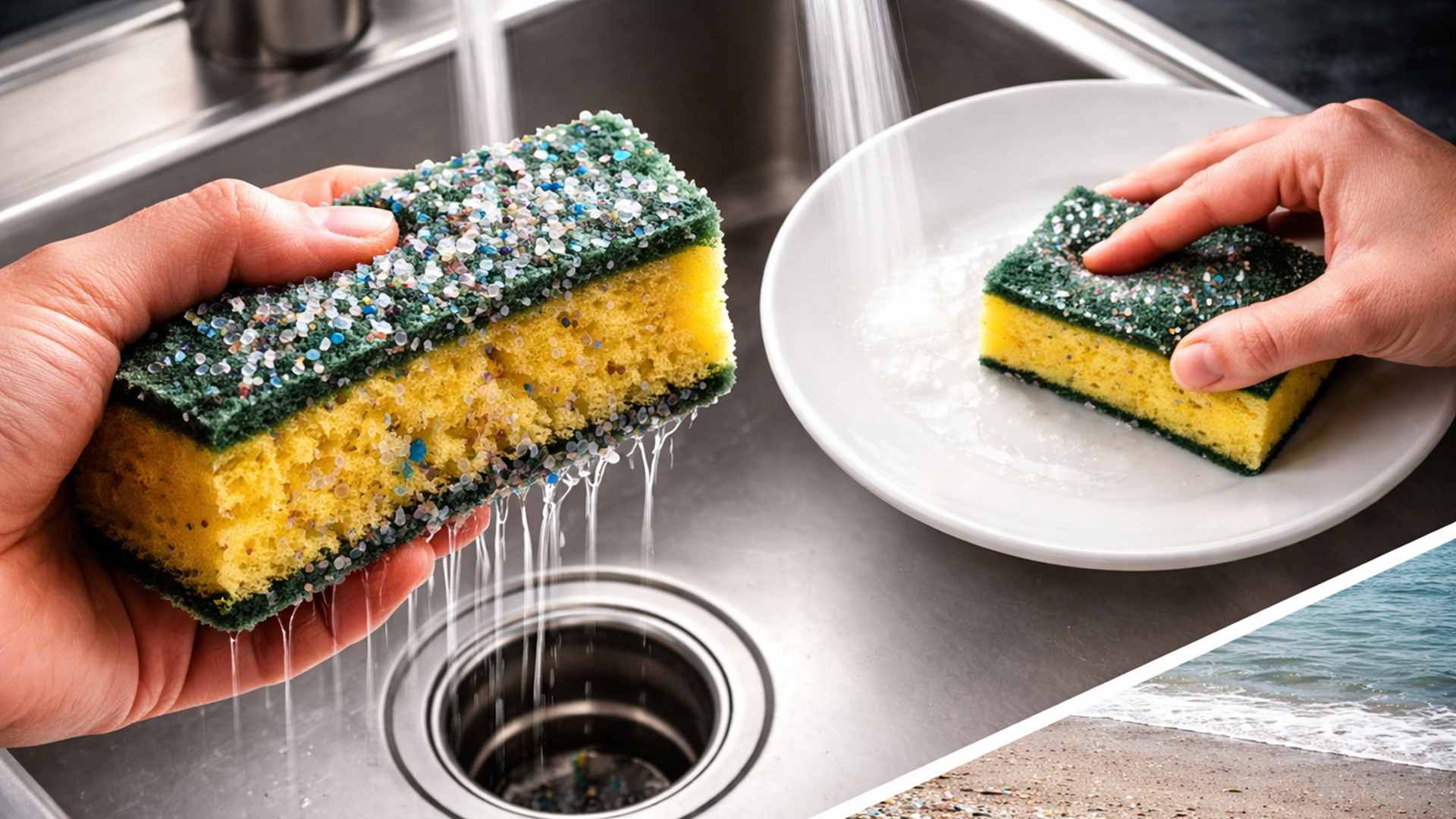
A study published in 2026 showed that washing dishes with kitchen sponges can release between 0.68 and 4.21 grams of microplastics per person per year, although water consumption still accounts for the majority of the total environmental impact of manual washing
Washing dishes with common sponges can release microplastics during daily use, according to a study published in the journal Environmental Advances, which analyzed the material loss from these items under real conditions as well as in automated laboratory tests.
The research investigated how many particles are released by kitchen sponges over time and what environmental impacts are associated with this process. The study also aimed to measure this wear in situations close to domestic routines, rather than being limited to controlled simulations.
The study is titled “From Sink to Sea: Release of Microplastics by Kitchen Sponges and Their Potential Environmental Effects.” The focus was to quantify the actual release of microplastics and assess the environmental effects based on a life cycle assessment.
-
Expedition 501: Scientists drill into the ocean floor and discover a giant reserve of fresh water hidden beneath the sea, extracting nearly 50,000 liters and revealing an invisible system that could reshape the map of water scarcity.

-
Archaeologists find an intact tomb over 2,500 years old, with more than 100 preserved objects, weapons, jewelry, and human remains never touched.

-
Volcanic lava transforms into threads as fine as human hair that travel over 30 kilometers by wind and fall like cutting rain on roofs and backyards in Hawaii and Iceland.

-
NASA issues a warning for the feared Godzilla El Niño that could change the planet’s climate in 2026 with extreme warming of the Pacific capable of causing devastating droughts in some regions and historic floods in others simultaneously.


Washing dishes with sponges results in material loss
The researchers found that all sponges analyzed lose material during use. This loss results in the release of microplastics, albeit in different volumes depending on the type of product used.
The annual estimate ranges from about 0.68 to 4.21 grams of microplastics per person per year, depending on the sponge. According to the study, sponges with lower plastic content release significantly smaller amounts.
To reach this result, the items were weighed before and after use. The comparison of weights allowed for measuring material wear and estimating the amount released during manual dishwashing.
Citizen science and laboratory were used in the sponge study
The research combined citizen science with laboratory experiments. Volunteer families in Germany and North America used three different types of sponges in their daily routines and recorded how they used these products.
According to the authors, the participation of volunteers was central to capturing real usage patterns and typical dishwashing habits. This made it possible to obtain a more realistic estimate of microplastic release than that obtained solely from laboratory tests.
In addition to the participant phase, the study included trials with an automated device called “SpongeBot.” This equipment simulates the mechanical stress applied to sponges during washing, allowing for a comparison of household routine data with conditions reproduced in the laboratory.
Greater environmental impact is from water consumption
Despite confirming that sponges release microplastics, the environmental analysis pointed to another factor as the main contributor to the total impacts of manual dishwashing. Water consumption accounted for the majority of the observed environmental load.
According to the life cycle assessment, between 85% and 97% of the total environmental impact of dishwashing is attributed to water use. The emissions of microplastics had a much smaller contribution to the overall damage to the ecosystem.
The authors emphasize that the release of microplastics was not the most relevant element when considering the overall environmental impact of the practice. Nevertheless, the study highlights the fact that these particles are indeed released during the everyday use of sponges.
National scale and pathways indicated by the research
Although the amount per person seems low, the study states that extrapolation for all of Germany indicates significant volumes. If a specific type of sponge were used in each household, the total could reach up to 355 metric tons of microplastics per year.
The researchers note that a large portion of these particles is retained in sewage treatment plants. Even so, several tons still reach aquatic environments or soils annually.
The work also points to measures to reduce this impact. Among them are using less water when washing dishes, choosing sponges with lower plastic content, and extending the lifespan of these items, as longer use reduces overall resource consumption.
The publication is authored by Leandra Hamann and other authors. The article was published in 2026 in the journal Environmental Advances, with DOI 10.1016/j.envadv.2026.100693.









Seja o primeiro a reagir!