





 Portuguese
  English
  Spanish
  5 min of reading
  0 comments


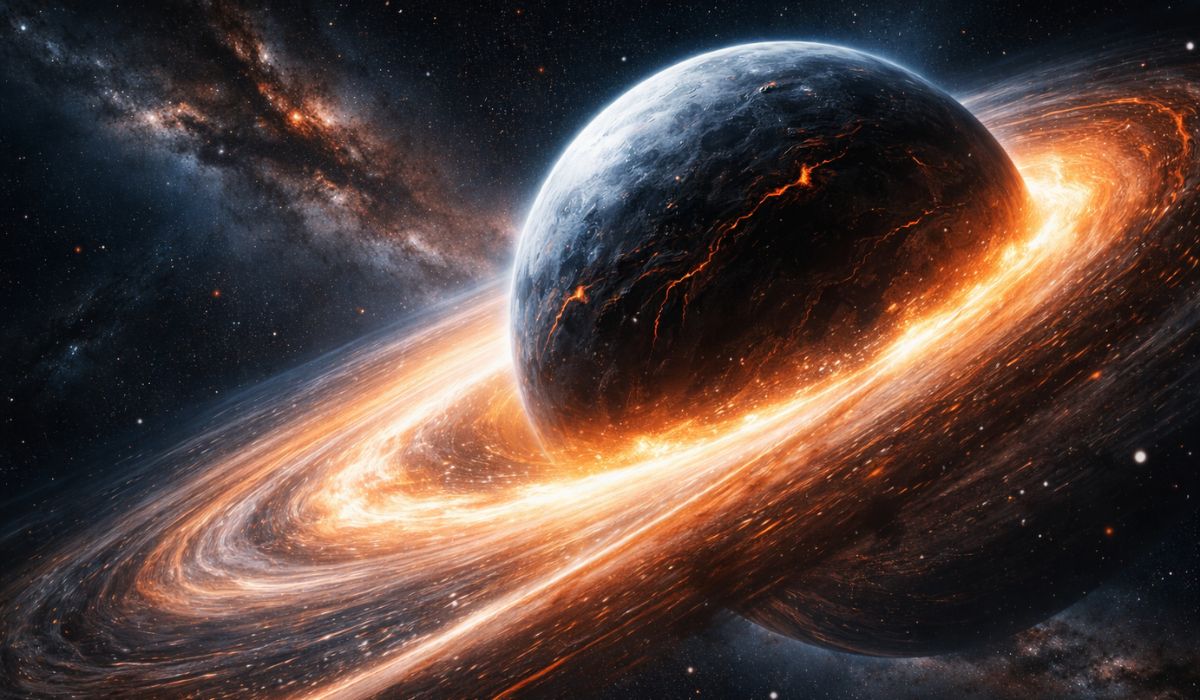
Planetary mass object observed without a host star entered a rare accretion episode and became the focus of astronomy by gathering unusual signals of activity, matter disk, and characteristics associated with very young celestial bodies.
A planetary mass object wandering without orbiting any star has been observed absorbing gas and dust at a rate of approximately 6 billion tons per second during an accretion episode recorded in 2025.
Officially known as Cha 1107-7626, it is located about 620 light-years from Earth, in the constellation Chamaeleon.
The observations were made with the Very Large Telescope from the European Southern Observatory and the James Webb Space Telescope.
-
Humanoid robots have already arrived in hospitals and are pushing wheelchairs, arranging beds, and interacting with patients. This advancement marks the shift of artificial intelligence from the digital world to direct physical care for human beings.

-
5 mysteries of the Moon that the Artemis missions could finally solve
-
Goodbye common charger: users around the world are replacing the old item with this more compact, powerful, and efficient GaN model that charges a phone, tablet, and laptop at the same time.

-
New high-end condominium in Campo Grande comes under scrutiny for being too close to an archaeological site and may have construction affected.
The data supported a study published in the scientific journal The Astrophysical Journal Letters.
According to the European Southern Observatory, the record corresponds to the highest value ever measured for a planetary mass object in an event of this kind.
The case has also been closely monitored because the celestial body exhibits characteristics associated with accretion disks, a common structure in very young objects.
For researchers, the data help examine how isolated low-mass bodies form and to what extent they share physical processes with young stars.
What astronomers observed in Cha 1107-7626
Cha 1107-7626 does not belong to a known planetary system and does not orbit a star.
Still, it appears surrounded by a disk of gas and dust that continues to feed its surface.
According to the ESO, the object has between five and ten times the mass of Jupiter and is in an early stage of evolution.
Measurements indicate that this feeding process did not occur steadily throughout the entire observed period.
Between April and May 2025, the activity was at a lower level.
However, between June and August of the same year, there was a significant increase in the accretion rate.
According to the authors, the jump was approximately six to eight times compared to the previous state.
At the peak of the episode, the rate reached the equivalent of 10⁻⁷ Jupiter masses per year.
In the study, the researchers classify this value as the highest ever obtained for an object of this category.
The work is authored by a team led by Víctor Almendros-Abad from the Palermo Astronomical Observatory, affiliated with the National Institute of Astrophysics of Italy.
How the VLT and James Webb measured the outburst
The ground observations were mainly made with the X-shooter, a spectrograph installed on the VLT in the Atacama Desert.
The equipment allows the decomposition of light into different wavelengths, which helps identify signatures of the material moving around the object.
The team also relied on data from the James Webb, obtained with the NIRSpec and MIRI instruments, in addition to previous records from the SINFONI spectrograph.
The comparison between these datasets allowed for the assessment of the object’s behavior change over time.
During the outburst, the H-alpha line began to exhibit a double profile with absorption shifted to the red.
According to the authors, this signal is consistent with magnetospheric accretion, a process already described in young stars and brown dwarfs.
At the same time, the optical continuum increased between three and six times, while the brightness in the R band rose about 1.5 to 2 magnitudes.
In the mid-infrared, the fluxes grew between 10% and 20%.
The study also recorded changes in emission lines associated with the matter disk surrounding the object.
Water vapor in the disk and magnetic field signals
Another result highlighted by the researchers was the detection of water vapor between 6.5 and 7 micrometers in the disk around Cha 1107-7626 during the outburst.
According to the study, this signature did not appear in the quiescent state.
According to the ESO, such changes had been observed in stars, but not in a planetary mass object with this profile.
The authors also associate the episode with the action of a magnetic field capable of channeling the material from the disk to the surface of the celestial body.
In this scenario, the gas does not fall diffusely but is directed by specific regions, altering the observed spectrum.
This mechanism is frequently described in studies of young stars and, according to the team, may also be present in much less massive objects.
This point gained relevance because the combination of active disk, chemical alteration, and signals of magnetically guided accretion expands the available data set on wandering planets or isolated planetary mass objects.
The observation does not redefine Cha 1107-7626’s classification by itself, but adds elements to the debate about its origin and evolution.
Formation of wandering planets and the scientific debate
One of the central questions in this area is whether objects like Cha 1107-7626 are planets expelled from their parent systems or if they can form in isolation, through gravitational collapse of gas, in a process similar to that of stars.
The new work does not provide a definitive answer but shows that at least part of the observed behavior approaches what has already been described in young stellar objects.
According to the authors, the episode also does not fully fit the variability considered more common in sources with continuous accretion.
By duration, amplitude, and spectral profile, the outburst was compared to the EXor pattern, a term used for recurrent accretion outbursts in forming stars.
However, the study emphasizes that this interpretation still depends on additional monitoring.
The researchers also note that a spectrum obtained in 2016 already indicated elevated levels of accretion.
This data, combined with the measurements from 2025, led the team to consider the possibility of recurrence.
So far, however, the work treats this hypothesis with caution and presents it as a topic for future observations, not as a closed conclusion.
What the case may reveal about isolated low-mass objects
Isolated and faint objects are often difficult to detect and monitor over long periods.
Therefore, part of this type of phenomenon may have gone unnoticed in previous surveys.
According to the ESO, the combination of space observatories and large ground-based telescopes tends to enhance the ability to locate more similar targets and better monitor their variability.
In this context, the Extremely Large Telescope, under construction in Chile, appears as one of the instruments aimed at this advancement.
The researchers’ expectation is that it will allow for more precise observations of faint and distant bodies, including planetary mass objects in active phases.
With this, it will be possible to verify more securely whether Cha 1107-7626’s behavior is rare or if other similar cases had not been documented with the same level of detail.
The data gathered so far place Cha 1107-7626 among the most relevant targets for this field of research.
The object combines planetary mass, isolation from host stars, active accretion disk, and an outburst associated with spectral signals that, according to the authors, resemble processes already observed in young stars.






Seja o primeiro a reagir!