






 Portuguese


Amazon Employee Uses Motorized Equipment to Move Trailers Without Conventional Trucks, Assisting in Cost Reduction and Logistics Operations
A scene captured inside an Amazon distribution center shows how a heavy task can be accomplished with a compact device.
In a video shared on social media, an employee uses a motorized device to maneuver a large semi-trailer around the company’s yard.
This operation occurs without the use of a conventional truck. The equipment connects to the trailer and provides the necessary power to move it during short internal shifts.
-
Company Ordered to Return $500M Treasure to Spain After Legal Battle
-
Transpetro Prepares Fleet of 25 Smart Ships with AI, Digital Twins, and Engines Ready for Ethanol and Methanol
-
Brazil’s Largest Beach Widening Nears Completion in Itapoá, with Major Dredging Progress in Babitonga Bay
-
Twin Brothers Search for Twin Brides for Nearly 3 Years, Meet 40 Pairs, and Marry Twin Sisters in a Rare Indian Ceremony with Identical Priests and Altar Servers
This solution transforms an activity that would traditionally rely on a powerful truck and a specialized driver.
Equipment Takes Over the Truck’s Role in the Yard
Distribution centers receive daily deliveries of trailers loaded with thousands of goods. After unloading, the semi-trailers need to be repositioned to free up docks and streamline internal flow.

Typically, this task requires a truck capable of hitching, towing, and repositioning each trailer.
The equipment shown in the video offers a more compact alternative. The employee is able to maneuver the semi-trailer within the private property without mobilizing a complete truck for each move.
The solution primarily caters to short operations, such as moving a semi-trailer from the dock, taking it to a waiting area, or positioning it at another point in the yard.
This way, conventional trucks can stay available for road trips and other tasks that truly require greater power and autonomy.
Internal operation simplifies requirements
The movement occurs within a private area, designated exclusively for the logistics activities of the distribution center.
For this reason, the equipment does not travel on highways nor transport the semi-trailer between cities. Its use remains confined to the controlled environment of the company.
This distinction can simplify certain requirements applicable to heavy vehicles that operate on public roads. These include licensing, documentation, and specific categories of driver’s licenses.
Internal safety and training regulations, however, remain essential. Workers must understand how to operate the device and follow the procedures adopted by the company.
The yard must also have adequate conditions for maneuvers to occur without putting employees, loads, or equipment at risk.
Cost reduction in logistics
The financial impact arises because the company does not have to mobilize a larger structure to perform a relatively short task.
A conventional truck incurs costs for fuel, maintenance, parts, documentation, and availability of qualified professionals. In contrast, the compact equipment was specifically developed for internal movements.
Trained employees operating in the yard can reposition the trailers according to the demand at the docks, reducing wait times during loading and unloading.
The technology also helps prevent a trailer from being idle due to the unavailability of a truck to perform a simple maneuver.
Every saved minute can make a difference in an operation that processes large volumes of goods and needs to meet tight deadlines.
Solution improves the flow of goods
The movement of semi-trailers represents merely a step in Amazon’s extensive logistics chain. The company also invests in technologies designed to enhance logistical efficiency, including automation, artificial intelligence, and robotics in distribution centers.
The motorized equipment allows for quicker reorganization of trailers. Thus, an occupied dock can be cleared rapidly to receive the next vehicle.
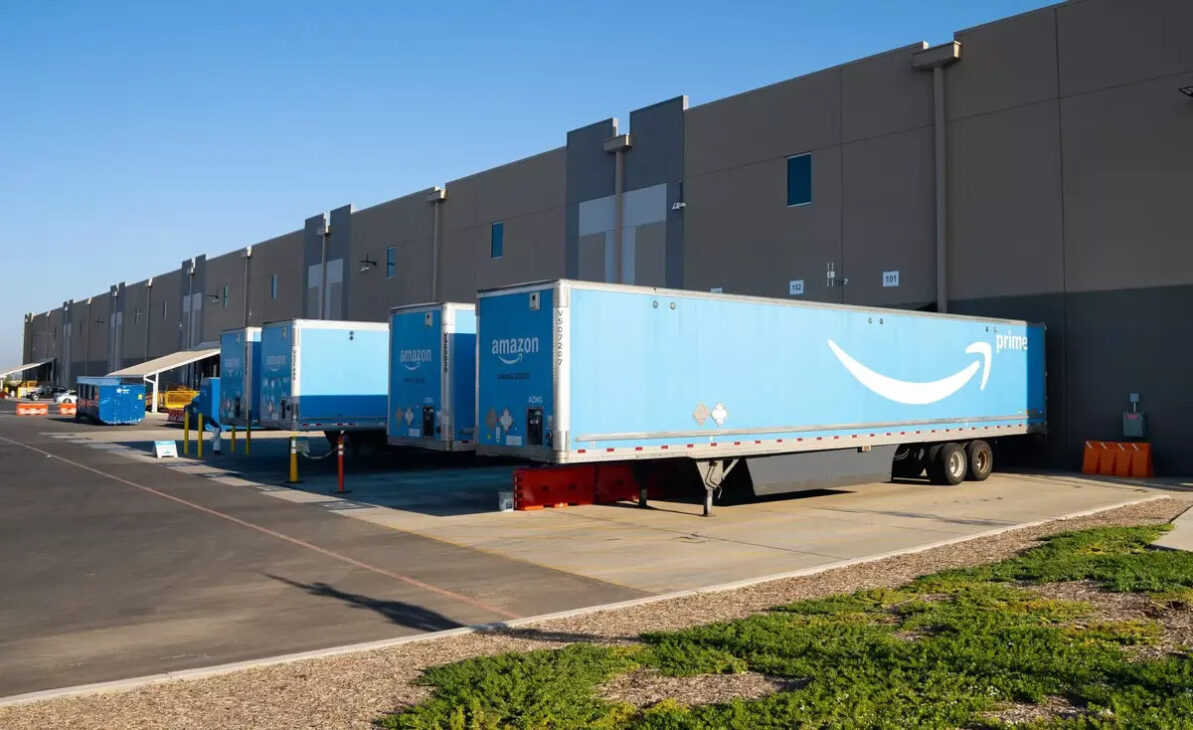
This flexibility helps the distribution center better utilize its infrastructure and reduce operational bottlenecks.
The solution does not replace the trucks used for road transport. Its goal is to undertake internal tasks that do not require the complete structure provided by a conventional tractor.
This scene illustrates how specialized equipment can reduce costs without relying on a complete overhaul of operations. Often, a change applied in just a few meters of the logistical process can yield benefits across various stages of distribution.
In your opinion, will equipment like this become common in Brazilian distribution centers? Leave your comments below.


