





 Portuguese
  English
  Spanish
  5 min of reading
  0 comments


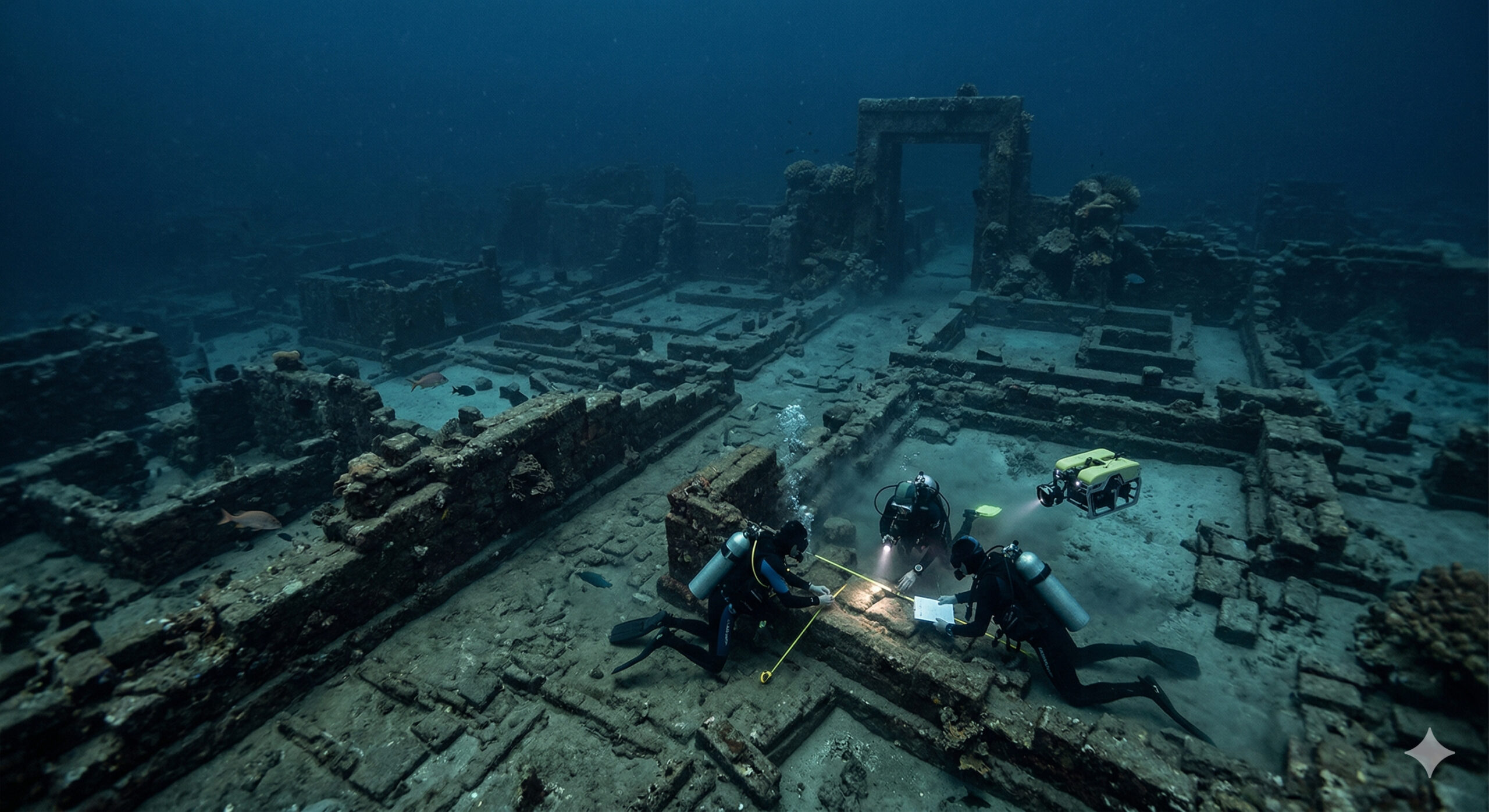
Sunken city in the Arabian Sea may be up to 9,500 years old; discovery in the Gulf of Cambay challenges archaeology and raises connection with Dwarka
In 2001, oceanographers from the National Institute of Ocean Technology (NIOT) in India identified submerged structures in the Gulf of Cambay in the Arabian Sea during a routine scan for marine pollution analysis. According to a BBC report and data released by the institute itself, sonar revealed geometric formations at a depth of 36 meters, spread over an area of up to 8 kilometers. Samples collected at the site and analyzed by carbon-14 indicated ages between 7,500 and 9,500 years. If confirmed, this sunken city would be older than any known urban civilization, surpassing timelines of Sumer and Ancient Egypt.
Dwarka in Hindu texts: sunken city described in the Mahabharata and Bhagavata Purana
Dwarka is not just a potential archaeological site. In sacred Hindu texts, such as the Mahabharata, the Bhagavata Purana, and the Harivamsa, the city is described as the capital of Krishna’s kingdom.


According to these narratives, Dwarka was built where the Gomti River meets the Arabian Sea, in an area of land reclaimed from the ocean, covering about 96 square kilometers. The texts report a fortified city with walls, palaces, temples, gardens, and an active port.
-
Roman game becomes an enigma for 40 years in the Netherlands, until AI and 3D scanning test 100 rules, run 1,000 simulations, and identify a “blocking game” that no one has been able to decipher since 1984.

-
A scientist proved with a thermal camera that the fan does not cool the environment but reduces the temperature of your skin by up to 6 degrees thanks to a natural mechanism of the human body that almost no one understands how it really works.

-
Scientists find a new explanation for the origin of Earth, which may have formed solely from material close to the Sun, changing an old theory and indicating that Jupiter may have been the cause of it all.

-
Brazilian beaches are among the most contaminated in the world by cigarette butts, with levels up to 40 times above the global average and areas where this waste already represents the majority of all the trash found.

After Krishna’s death, the city is said to have been submerged by the sea. For centuries, this description was treated as mythology. The discovery of structures on the seabed exactly in the region described reopened the debate between myth and historical reality.
Archaeological excavations in Dwarka between 1930 and 1990 revealed an ancient port
The search for Dwarka began in the 1930s, with excavations on Bet Dwarka Island in the state of Gujarat. In the following decades, new expeditions identified relevant archaeological artifacts.
Between 1983 and 1990, the Archaeological Survey of India conducted excavations that revealed walls, bastions, port structures, and more than 120 triangular stone anchors with three holes.
These anchors indicate intense and organized maritime activity. Archaeologist S.R. Rao concluded that there was an active city-state around 1500 B.C. This proven phase positions Dwarka as an important port center of antiquity.
Discovery of 2001 in the Gulf of Cambay revealed older submerged structures
The discovery made by NIOT in 2001 radically expanded the historical scale of the site. Side-scan sonar identified rectangular and semicircular structures incompatible with natural formations.
Submersibles were sent to the site and found worked stone blocks, possible walls, roads, and organized architectural elements. Collected artifacts included pottery, beads, human bones, and construction fragments.
Carbon-14 dating pointed to up to 9,500 years. This data directly challenges the accepted chronology of human civilization, which considers the emergence of the first organized cities around 5,500 years ago.
Wall of more than 500 meters strengthens hypothesis of sunken city in the Arabian Sea
In addition to the deep structures, researchers identified a stone wall approximately 550 meters long, visible during low tides near Bet Dwarka.

This structure reinforces the hypothesis of a coastal defensive system. Studies indicate that the region was submerged at different periods, with shallower parts sinking between 3,500 and 1,500 B.C., while deeper areas may be significantly older.
This pattern suggests a gradual process of submersion, compatible with rising sea levels after the last ice age.
Archaeological debate over dating of 9,500 years divides experts
The oldest dating is widely debated. Part of the scientific community questions the reliability of carbon-14 data, arguing that the analyzed materials were not necessarily directly linked to the structures.
There is a possibility of contamination or displacement of artifacts on the seabed. Additionally, the absence of complete excavations and extensive publications in peer-reviewed journals limits definitive validation.
Even so, the findings have not been dismissed and continue to be considered relevant within underwater archaeology.
Geology of the Arabian Sea confirms submersion of habitable areas 10 thousand years ago
Geological studies indicate that sea levels were more than 100 meters lower than today during the last glacial maximum, about 20,000 years ago.
With the melting of glaciers, sea levels gradually rose, flooding coastal areas. The west coast of India was heavily affected by this process.
This means that areas now submerged could have been habitable in the past. The presence of human settlements in this region is considered plausible from a geological perspective.
Stone anchors in Dwarka prove intense historical port activity
The more than 120 stone anchors found in Dwarka are concrete evidence of maritime activity over several historical periods.
Documents such as the Periplus Maris Erythraei, from the 1st century A.D., mention a port called “Baraca,” associated with the region of Dwarka. UNESCO recognizes the site as part of the historical trade routes of Asia. These evidences reinforce Dwarka’s strategic role as a port center throughout history.

One of the biggest limitations in studying the sunken city is the interruption of research initiated in 2002 by the Indian government. These investigations used advanced sonar and sub-bottom profiling technologies capable of mapping structures buried under marine sediments.
Despite promising results, the project was halted without detailed explanations. The halt prevents advances in the definitive confirmation of the site’s age and structure.
Dwarka as a layered city follows the pattern of great historical centers
Researchers believe that Dwarka may be an archaeological site with multiple layers, similar to cities like Jerusalem and Troy.
The current city rests on medieval structures, which in turn are on even older layers. Part of these layers is submerged, making excavations difficult. This historical overlap is common in large ancient urban centers and reinforces the complexity of the site.
In February 2024, India’s Prime Minister, Narendra Modi, performed a dive at the site to participate in an underwater religious ritual.
The gesture had symbolic and political impact, associating the historical narrative with Indian cultural identity. The event also boosted public interest in new research.
Hindu texts present technical descriptions compatible with structures found
The ancient texts describe Dwarka with details that approach modern concepts of coastal engineering.
Accounts mention land reclamation from the sea, defensive bastions, moats, and port infrastructure. These elements coincide with structures found on the seabed of the Arabian Sea. The convergence between textual narrative and physical evidence is one of the most discussed points among researchers.
The deeper layers of the site remain inaccessible due to marine sediment cover. Technologies such as 3D sonar, robotic excavation, luminescence dating, and environmental DNA analysis may reveal even older structures.
Currently, the main obstacle is not technological, but financial and political. The definitive confirmation of the sunken city may depend on future expeditions that have not yet been authorized.







Seja o primeiro a reagir!