





 Portuguese
  English
  Spanish
  3 min of reading
  0 comments


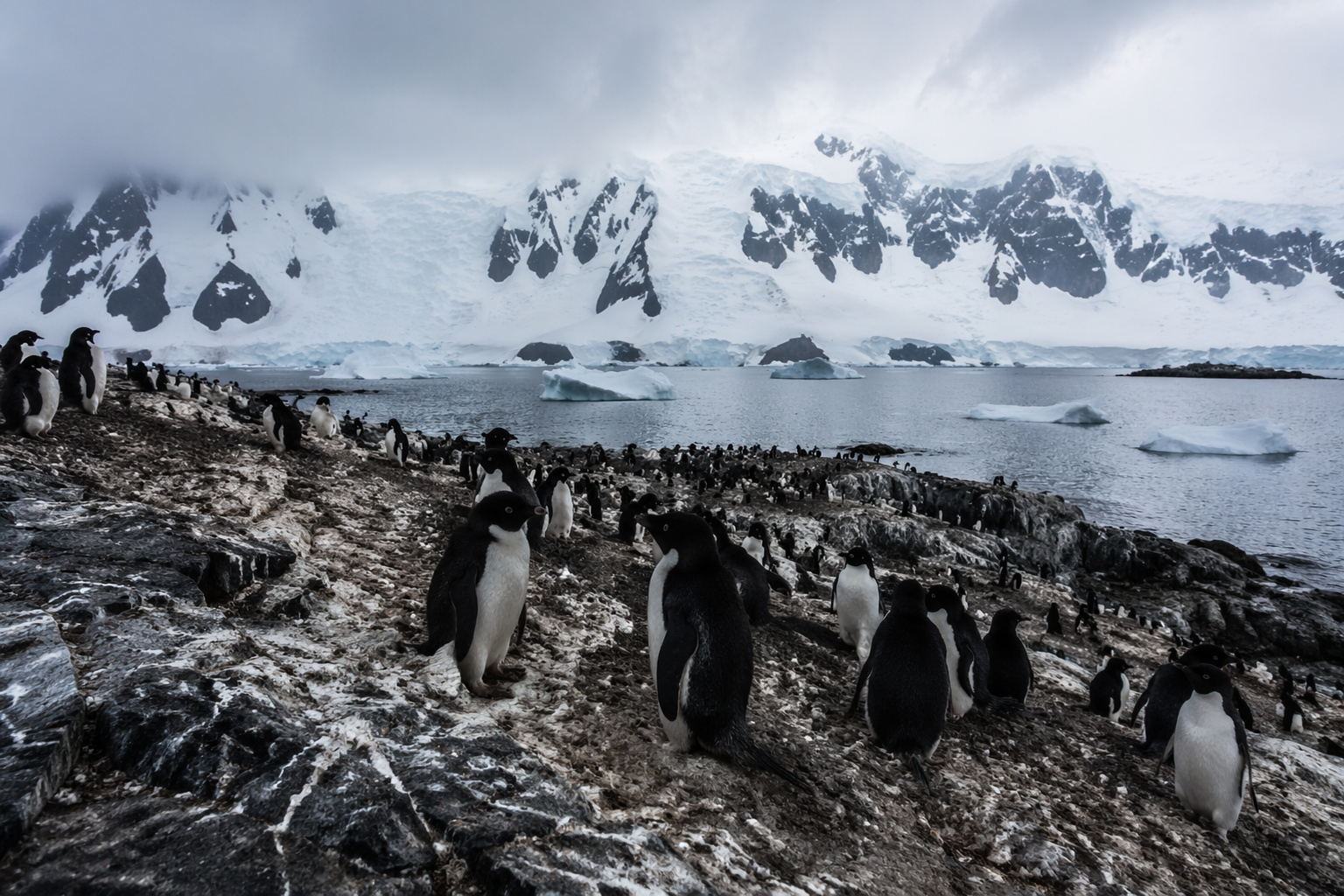
Recent studies show how penguin guano releases ammonia, forms aerosols, and influences clouds and climate balance in Antarctica
A significant scientific discovery was recently recorded in Antarctica and has drawn the attention of the international scientific community. According to studies published between 2024 and 2025, the ammonia released by penguin feces directly contributes to cloud formation in the region. This phenomenon shows that biological processes exert a direct influence on the atmosphere, even in an extreme environment considered to be little altered over time.
The interaction between fauna, ice, and ocean alters the energy balance over the continent and challenges the idea that Antarctica is a completely static system. Recent research indicates that penguin guano plays an active role in polar atmospheric chemistry. This understanding broadens the view of how natural elements influence regional climate.
Scientific investigation highlights the role of guano in the polar atmosphere
The penguin guano, that is, the excrement of these seabirds, accumulates on the frozen ground and interacts with the surrounding air. This material releases chemical compounds that alter the composition of the local atmosphere. The region has a low concentration of suspended particles and little dust.
-
A rare phenomenon of silent electric flashes in trees on the east coast of the United States intrigues researchers, confirms a century-old suspicion, and raises concerns about invisible environmental impacts.
-
5,000-year-old bacteria found frozen in a cave in Romania already shows resistance to modern antibiotics and raises a global scientific alert about the future of infections.
-
5,000-year-old bacteria found frozen in a cave in Romania already shows resistance to modern antibiotics and raises a global scientific alert about the future of infections.
-
Scientists thaw microbes trapped in Alaska for 40,000 years, discovering that they reorganize, become active again, and start releasing greenhouse gases in a troubling climate alert.
In this scenario, any new emission, such as ammonia, begins to have a significant impact on cloud formation. Recent studies demonstrate that this factor has transformed guano into an important element of Antarctica’s atmospheric chemistry. This process reinforces the link between biodiversity and climate dynamics.

Formation of aerosols and clouds from ammonia
Ammonia (NH₃) is released during the decomposition of guano, when the nitrogen present in the feces converts to gas. This gas disperses into the atmosphere and intensifies during the Antarctic summer. During this period, large colonies of penguins concentrate in specific areas.
Studies conducted in 2024 and 2025 show that concentrations near the colonies can be thousands of times higher than the regional average. This gas reacts with sulfuric acid and organic vapors present in the atmosphere. As a result, atmospheric aerosols are formed that act as cloud condensation nuclei.
Persistence of ammonia and chemical reactions in the atmosphere
Recent measurements indicate that ammonia emission does not end with the migration of the penguins. The guano-saturated soil continues to release the gas for more than a month after the end of the breeding period. This process keeps particle formation active in the atmosphere.
Marine phytoplankton emits dimethyl sulfide, which transforms into sulfuric acid in the atmosphere. This compound encounters ammonia and dimethylamine from guano. The reaction generates stable salts, such as ammonium sulfate, forming ultrafine particles.
These particles progressively grow and begin to act as nuclei for cloud formation. This growth occurs continuously in the local atmosphere. The result is an intensification of cloud formation in certain areas.
Climatic impacts and possible cooling effect
Air masses that pass through dense colonies of penguins show a significant increase in atmospheric particle concentration. These levels approach those of more polluted regions, although they have a natural origin. This phenomenon highlights the intensity of the process.
The aerosols act as seeds for cloud droplets, favoring the formation of dense fog. The clouds generated tend to be more numerous and brighter. This behavior increases the reflectivity of the atmosphere.
The increase in reflectivity contributes to a slight local cooling, especially in coastal areas of Antarctica. This mechanism has been pointed out as a possible natural climatic feedback. This balance depends on the preservation of penguin colonies and polar biodiversity.
To what extent will the conservation of these ecosystems be crucial in maintaining this active climatic effect in Antarctica?








Seja o primeiro a reagir!