





 Portuguese
  English
  Spanish
  4 min of reading
  0 comments


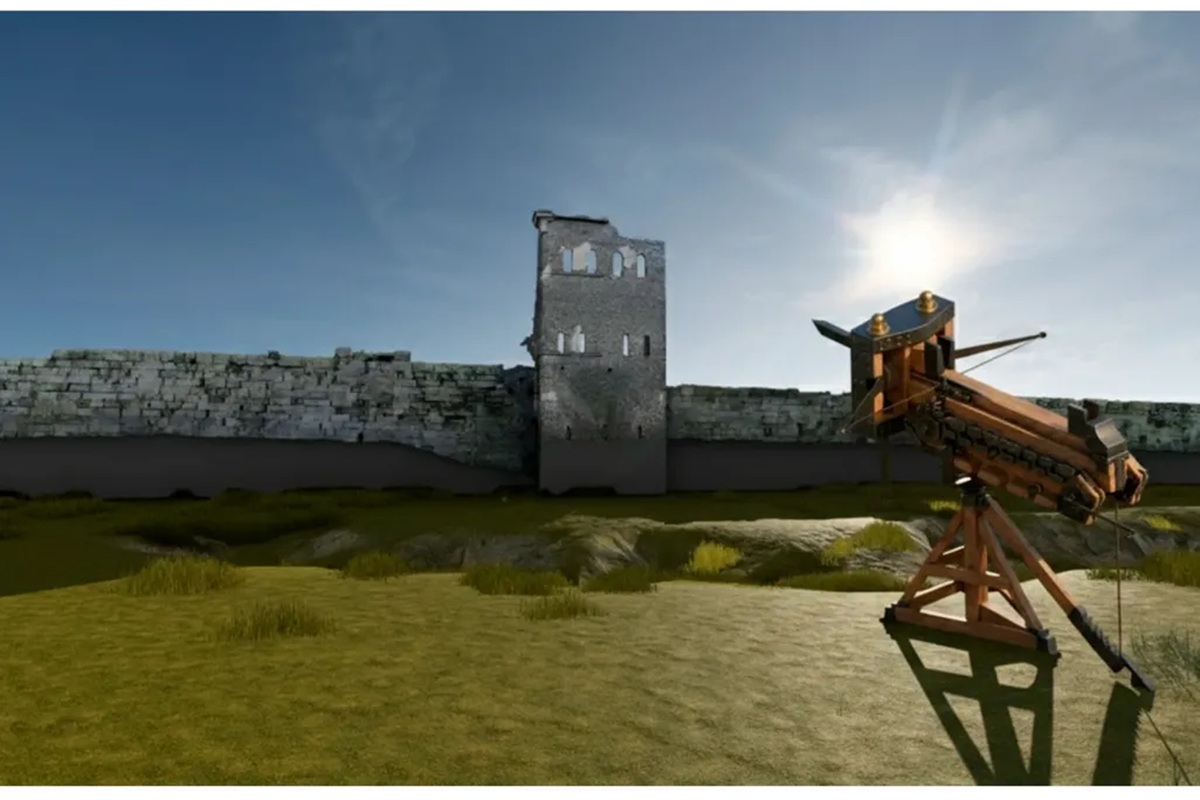
A new research raises the hypothesis that Ancient Rome may have used in Pompeii, during the siege of 89 BC, a rapid-fire weapon described in ancient texts, following the identification of unusual marks on the city walls associated with the possible use of the polybolos
Ancient Rome may have resorted to a rapid-fire weapon during the siege of Pompeii in 89 BC, according to new research that associates unusual marks on the city walls with the possible use of the polybolos. The hypothesis arises from the analysis of cavities different from those produced by ballistae and other known weapons in the attack led by Lucius Cornelius Sulla’s troops.
That year, the inhabitants of Pompeii joined ancient Italian allies in a revolt against the advance of Roman power. The reaction was swift, and the forces led by Sulla were sent to regain control of the city.
The fighting left visible marks on the northern walls of Pompeii, an area that still bears scars from the Roman offensive. In addition to the large round holes associated with ballistae and projectiles launched by scorpions, researchers identified another set of depressions with different shapes and distributions.
-
The archaeologists did not expect to find anything at this archaeological site – Then, they came across a Roman village and a bronze artifact.
-
They saw an aluminum can coming out of a stone wall in the forest, opened the container, and found 598 gold coins worth more than $330,000.

-
Historian and archaeologist and specialist in pyramids: “If someone were to excavate our society 4,000 years from now, what would probably surprise them the most would be the lack of data.”

-
For the first time in over half a century, humans have seen the Moon up close and returned to tell the tale, and the technology that brought them back makes Apollo look like a toy.

Marks on the walls raise a new hypothesis about Ancient Rome
These four-sided cavities appear at short and regular intervals, often in a fan-shaped arrangement. Generally, they are only a few centimeters deep, which drew attention for not matching the expected pattern of known weapons during the siege.
To investigate the origin of these damages, Adriana Rossi, Silvia Bertacchi, and Veronica Casadei employed high-resolution laser scanning, detailed image analysis, and 3D modeling. From this data, they retrospectively reconstructed the size, shape, and force of the weapon capable of producing the observed marks.
The conclusion proposed by the researchers points to metal-tipped projectiles fired in rapid succession by a repeating weapon. In this scenario, the main candidate would be the polybolos, a mechanical device described as capable of firing multiple projectiles continuously.
The polybolos and the connection between Sulla and Rhodes
No specimen of the polybolos has been found to date by archaeologists. Still, the weapon appears in historical texts, including detailed descriptions made by Philo of Byzantium in the 3rd century BC, who attributed its invention to the Greek engineer Dionysius of Alexandria, in Rhodes.
The research also highlights a chronological detail involving Sulla. In 96 BC, he served as governor of Cilicia, the province where Rhodes was located, which reinforces the possibility of contact with military innovations associated with the island.
Based on this coincidence, the authors of the study consider it plausible that Sulla acquired or encouraged the use of Rhodian technology during the siege of Pompeii. The interpretation presented is that a politically astute and technically informed commander could have resorted to an enhanced multiple-shot engine to increase pressure on the defenders.
How the weapon may have been used in Pompeii
The hypothesis suggests that Roman troops of Ancient Rome may have utilized the rapid-fire capability of the polybolos to target Pompeian defenders at moments of movement or brief exposure. On some occasions, however, the soldiers may have missed their target, and the projectiles ended up leaving marks directly on the walls.
The researchers emphasize that the idea remains a theory, not a definitive certainty. Even without physical traces of the weapon, the formal and functional compatibility between the recorded damages on the northern section of the walls and the ancient descriptions is treated as an important supporting element for the hypothesis.
The temporal coincidence between the military operations preceding the siege of 89 BC and the history of Rhodes is also pointed out as a factor that enhances the plausibility of the proposed scenario. Thus, the study suggests that Ancient Rome may have employed in Pompeii a military technology far more sophisticated than is commonly imagined.
Pompeii continues revealing layers prior to the eruption
Pompeii became world-renowned for the preservation caused by the eruption of Vesuvius in 79 AD, but its earlier history continues to pose new questions for archaeologists. The ruins were discovered in the 16th century, and systematic excavations began in 1738.
Since then, the city has been observed not only as a portrait of the volcanic disaster but also as a space marked by transformations and conflicts prior. Current interest includes understanding the urban development of Pompeii and reconstructing how it reached the point of destruction, keeping alive the investigation into Ancient Rome and its methods of warfare.







Seja o primeiro a reagir!