





 Portuguese
  English
  Spanish
  5 min of reading
  1 comment


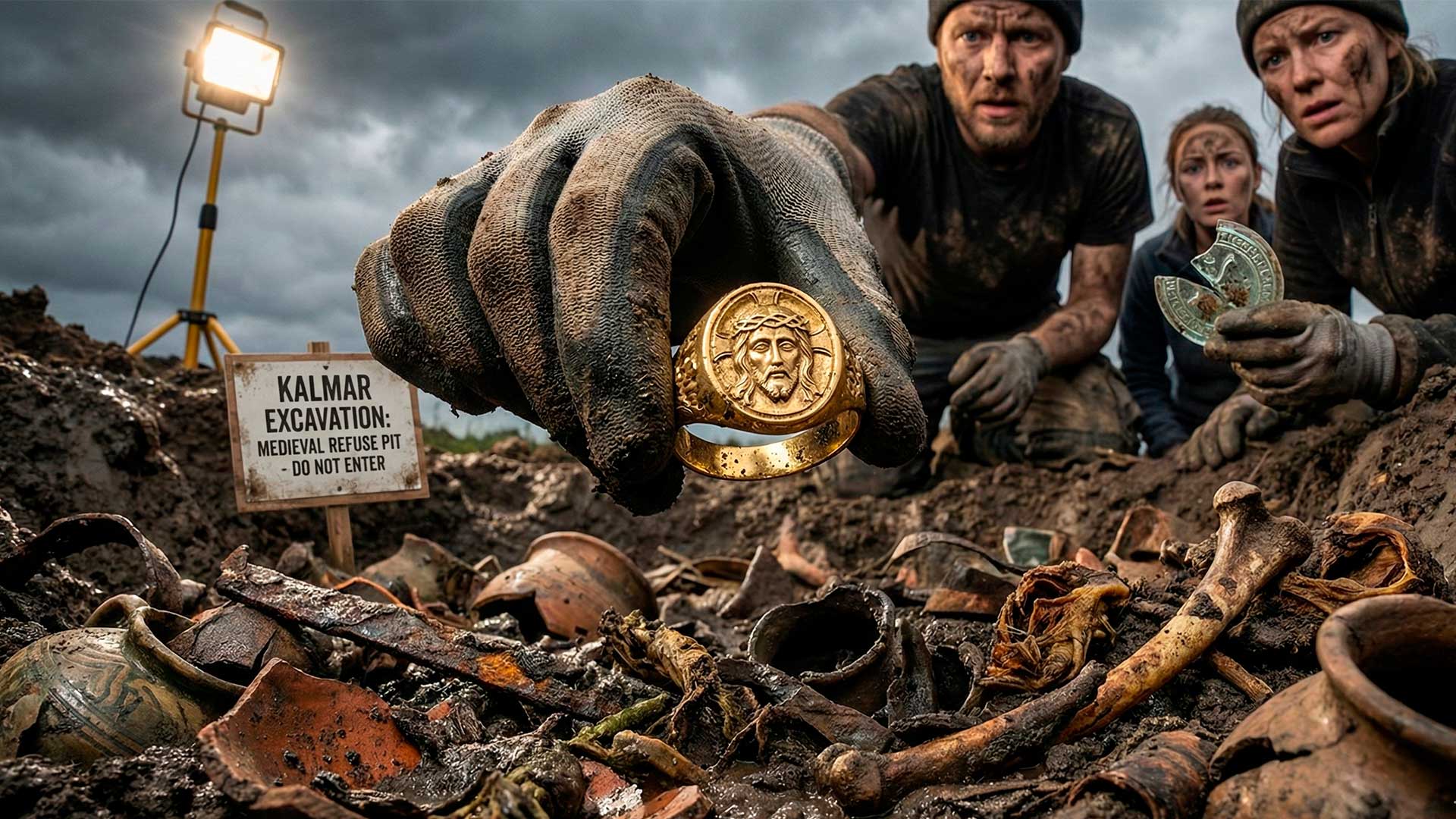


Gold Jewel Dated To The 15th Century Found In An Ancient Dump In Kalmar And Stands Out Among More Than 30 Thousand Finds From The Archaeological Site
Archaeologists working on excavations in the city of Kalmar, in southeastern Sweden, have found a 15th-century gold ring with an image of Christ engraved on it. The piece was dated between 1401 and 1500 and drew attention for its good state of preservation, despite being buried for centuries.
The ring appeared in an unexpected context: a layer interpreted as a waste disposal area, something akin to an ancient urban “dump.” The site suggests that the object may have been lost accidentally or thrown away along with other materials.
According to information released by the team responsible for the investigation, the size of the ring is small. This led researchers to consider the possibility that it may have been used by a woman, although this interpretation is not conclusive.
-
Tourists on Everest were poisoned by guides who mixed substances in food to provoke false symptoms of altitude sickness while helicopter operators and hospitals charged inflated rescue fees to insurance companies.

-
Few people know this, but Neil Armstrong, one of the most famous NASA astronauts in history, survived the Korean War after jumping from the plane during his seventh combat mission aboard the USS Essex aircraft carrier of the United States.

-
Diving with a camera in Lake Furnas reveals a submerged city with an entire street, almost intact houses, a preserved bridge, a wood stove, a Kombi, and even a bus at the bottom of the largest lake in the Southeast.

-
Iceland accidentally drilled into a magma pocket at 2,100 meters and revealed that the extreme heat beneath the crust could pave the way for a new source of continuous energy.


The discovery has drawn attention outside academic circles, with headlines calling the piece the “Jesus ring.” In practice, however, specialists treat the object as a Christian devotion artifact typical of the time, and not something directly linked to the historical figure of Jesus.
What The Ring Reveals About Devotion In The 15th Century
According to the archaeologists involved in the project, the significance of the find is not only in the value of the gold but in its cultural meaning. A ring with an image of Christ serves as an indication of religiosity in everyday life, in addition to suggesting forms of symbolic protection and faith identity.
This type of jewelry indicates that devotion was not limited to churches or liturgical objects. In many cases, faith also appeared in personal items, used daily and carried as a sign of belief and belonging.
Experts also note that rings with religious motifs have parallels in other regions of Northern Europe. This reinforces the idea of the circulation of styles, symbols, and practices, especially during periods of active trade in the Baltic.
Why Would A Gold Object End Up In An Ancient Dump
The location of the find is one of the points that generates the most debate. Given that it is a gold ring, the common expectation would be to find it in a residential context, hidden treasure, or burial site, and not in a disposal area.
A plausible explanation is the simplest: someone lost the ring amidst their routine, and the piece ended up buried with the trash and soil moved over time. In urban excavations, this happens frequently, especially in areas used for centuries.
Another hypothesis is that the ring may have been discarded after breaking, losing its stone, or sustaining damage, although there is no public confirmation that the piece was unusable. In ancient objects, disposal does not always have a direct relation to “lack of value,” and can involve changes in ownership, fear of theft, or even haste during crises.
The context may also indicate that the item belonged to someone outside of the elite. In medieval cities, lower-class layers would circulate through disposal areas and coexist in mixed environments, where objects could be lost or thrown away for practical reasons.
Still, archaeologists treat these interpretations with caution. A single find, in isolation, does not “prove” social class, but helps build a more realistic picture of how valuable objects could also disappear from history by mere chance.
Pilgrim Amulet Found Next To The Ring Reinforces The Religious Context
The excavations revealed more than just the ring. The team also found an alsengem, a type of amulet associated with pilgrims, made of glass and engraved with figures, although in a fragmented state.
Even broken, the object adds an important layer to the context. It points to popular religious practices and suggests that Kalmar received or connected to routes of people, goods, and faith symbols in the Middle Ages.
Excavations In Kalmar Have Already Summed More Than 30 Thousand Finds And Redraw The Local History
The ring is one of the most striking pieces among more than 30 thousand cataloged objects in the archaeological project. The investigation took place over about two years and focused on the area of the old town, near Kalmar Castle, a strategic point in Swedish history.
In addition to small objects, the excavations identified remnants that help reconstruct urban life between approximately 1250 and 1650. This type of material allows for the understanding of dietary habits, consumption, work, and changes over several centuries.
Among the historical elements associated with the region is the period of conflicts in the early 17th century, such as the Kalmar War (1611 to 1613), often cited when describing the military and political importance of the area.
In practice, the value of these excavations lies in connecting major historical events to concrete traces of daily life. This is how archaeology transforms “distant history” into tangible evidence, with layers, objects, and signs of real use.
Caution With Rumors And The Idea Of Miracle In Archaeology
The repercussions of the find have generated emotional interpretations, including the word “miracle” in some posts and headlines. For science, however, what exists is a set of data that needs to be analyzed methodically and comparatively.
The most impressive point, according to the team itself, is the state of preservation and the context of the dump, which helps explain how the object remained protected from wear for so long. This may seem extraordinary, but it is still compatible with known processes of burial.
It is also important to separate the symbol from the historical affirmation. The ring features an image of Christ and is from the 15th century, so calling it the “Jesus ring” is more of a sensational tactic than a conclusion supported by evidence.
If you think such a piece should be in a treasure or palace, why do you believe that? Does this type of discovery change your view on who had access to symbols of faith and valuable objects in the Middle Ages? Share your opinion in the comments and let us know if this story is pure science or if the internet is exaggerating.






Pelo título publicado pelo estagiário, dá a impressão que o anel pertenceu a Jesus Cristo.