





 Portuguese
  English
  Spanish
  2 min of reading
  0 comments


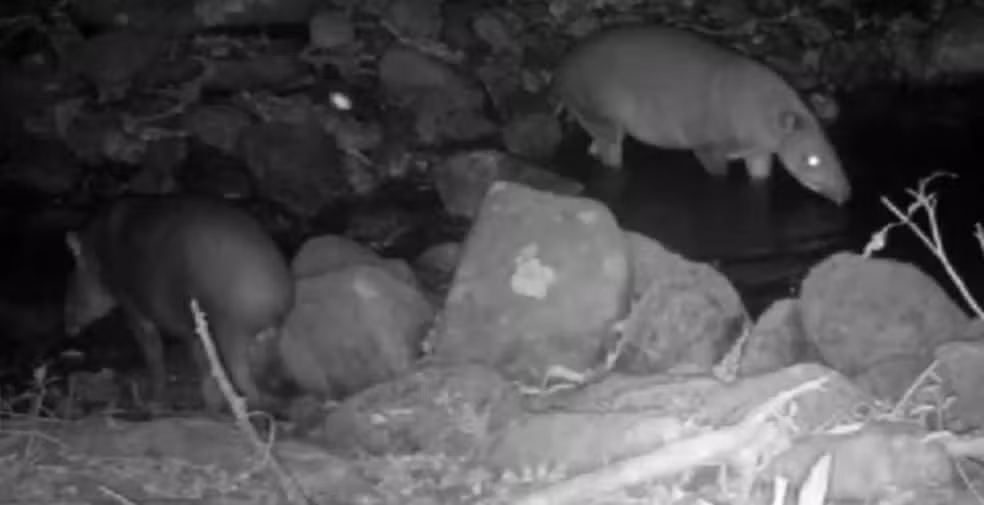
Rare Species, Considered Locally Extinct, Spotted After More Than a Century, Surprising Scientists and Driving Environmental Conservation Initiatives.
In November of last year, after more than 100 years without records, the tapir (Tapirus terrestris) was spotted again in the state of Rio de Janeiro. The images, which quickly went viral on the internet, show a mother and two calves walking through the Atlantic Forest. The records were made in January by hidden cameras installed by the State Institute for the Environment of Rio de Janeiro (INEA).
The sighting of the tapir is considered a milestone in the history of environmental conservation. The last time this herbivore was seen in the region was in 1914, in the Serra dos Órgãos National Park.
Since then, it was believed that the species was locally extinct. Urbanization, deforestation, and illegal hunting were some of the factors that threatened its survival.
-
These living root bridges and ladders are over 700 years old and help indigenous people survive in one of the rainiest regions in the world.

-
From sertanejo star to international investor: Ana Castela invests millions in a mansion in the USA, creates a themed accommodation in Orlando, and shows that the “boiadeira” also wants to grow away from the stage.

-
The 10 most stunning motorhomes in the world: a $3 million trailer with a rooftop nightclub and garage for a Ferrari, “palaces on wheels” with Italian marble, private cinema, and five-star hotel luxury for billionaires.

-
Trump wanted to spend $400 million on the White House, but the courts prohibited the million-dollar construction.


The cameras captured 108 photos and videos of the animals in the Cunhambebe State Park (PEC). Established in 2008, the park covers 38,000 hectares and aims to preserve endangered species. The images, published on the park’s Instagram, show the tapirs approaching the cameras at night.
Marcelo Cupello, a biologist from INEA, highlighted the significance of the event. “The spontaneous return of the tapirs shows that the forests of Rio de Janeiro can still sustain large mammals, ”he said. He explained that this indicates the existence of natural forest corridors, which allow the movement and dispersal of local fauna.
The tapir, also known as the Brazilian tapir, is the largest land animal in South America. It can weigh up to 317 kg and plays a fundamental role in tropical forest ecosystems. Nicknamed “gardeners of the forest,” they help in seed dispersal by consuming plants and spreading them through their feces.
Another curious aspect of the species is its ability to use its prehensile trunk as a snorkel while swimming. This skill facilitates its adaptation to the flooded environments of the forest.
The resurgence of the tapir is seen as a positive sign for the region’s biodiversity. Ecologists and conservationists celebrate the event as proof of the success of conservation projects. The sighting reinforces the importance of protected areas and environmental conservation for the recovery of endangered species.
With information from G1.








-

Uma pessoa reagiu a isso.