





 Portuguese
  English
  Spanish
  5 min of reading
  0 comments


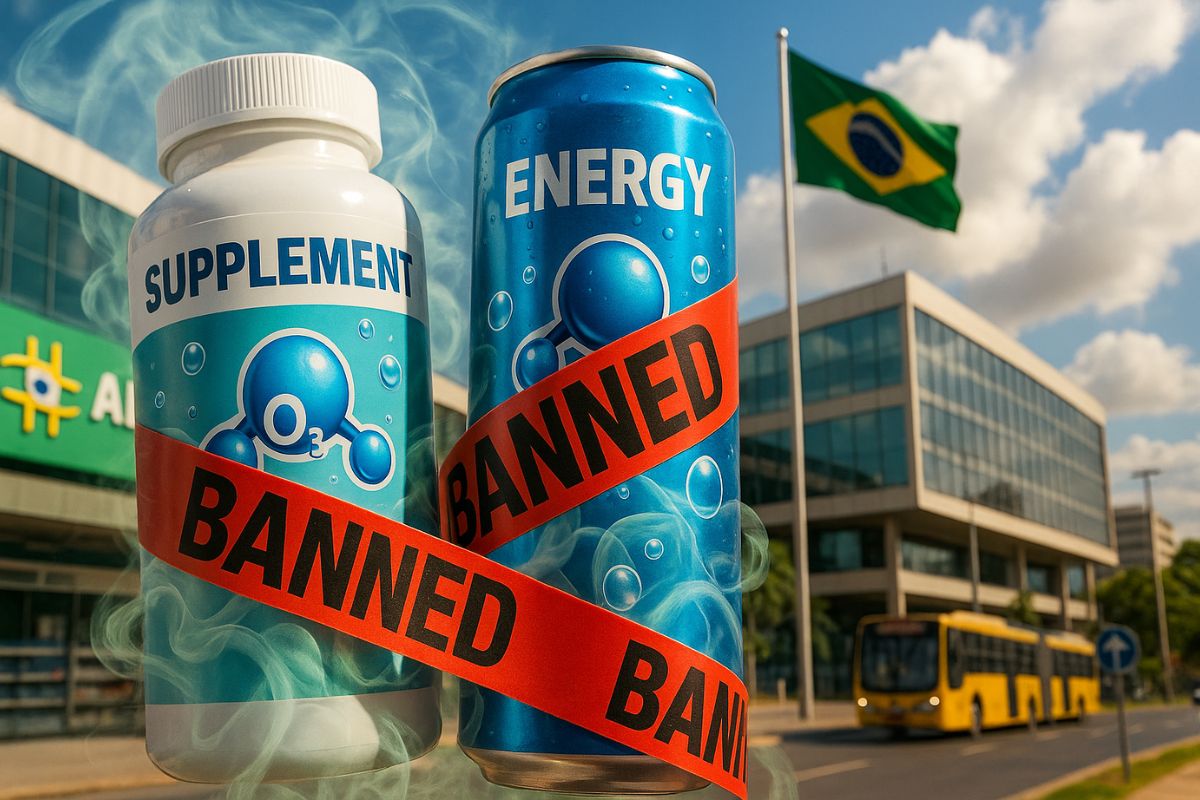
The Health Agency’s Decision Affects Dietary Supplements and Energy Drinks That Use Ozone as an Ingredient in Their Formulation, Reinforcing That the Gas Has No Proven Safety for Use in Foods and Is Only Authorized in the Country as a Disinfection Agent in Water Treatment, Raising the Regulatory Alert Level for Manufacturers and Consumers
The National Health Surveillance Agency determined the prohibition of manufacturing, marketing, distribution, advertising, and use of products from the company OZT Comércio Atacadista Especializado em Produtos Ozonizados, which added ozone to ready-to-consume dietary and energy supplements, claiming health benefits without technical support.
The measure also includes the seizure of items considered irregular for using ozone outside the authorized scope and for making therapeutic promises typical of medications, not food.
What Exactly Did Anvisa Prohibit Regarding Ozone
The decision covers all dietary and energy supplements from the company in question that contain ozone in their composition.
-
Excavations for a highway uncovered an intact Celtic city with gold, jewelry, and ancient production structures.

-
Every pineapple you eat is actually up to 200 different fruits fused into one: discover the fascinating process in which each flower opens for just one day and produces the pieces that form the whole fruit over the course of 3 weeks.

-
Giant from Germany will land in China with a record investment in a 4 km² complex, with up to 32 production lines and 70 products, targeting a market that could reach 70% of the world by 2030.

-
Brazilian regions will suffer from the heat: the first heatwave of 2026 raises temperatures to up to 38°C for 5 consecutive days, driven by a heat bubble between Paraguay and Argentina that blocks cold fronts and intensifies dry air.


In practice, Anvisa prevents these products from being produced, distributed, advertised, or sold in national territory, ending the regular circulation of the company’s ozonized portfolio in the market.
In addition to the prohibition, the agency ordered the seizure of available batches, precisely because the items incorporated ozone as part of the formulation intended for ingestion.
The gas was used in ready-to-consume supplements and liquid compounds, which contradicts the current classification that allows the use of ozone only for another function and in a different regulatory context.
Why Ozone Is Not Considered Safe in Foods
In the position disclosed, Anvisa was clear in stating that ozone has no safety assessment for use in foods, dietary supplements, or ready-to-consume energy products.
This means that there is no approved safety dossier that demonstrates, under the required parameters, that the ingestion of the gas, under the conditions proposed by the products, is safe for the population.
Currently, the use of ozone is authorized exclusively as a disinfection agent in water treatment.
In this context, ozone acts as a sanitizing agent, not as an ingredient with functional or therapeutic claims, and its use is limited by specific water quality standards.
Any expansion of scope, including supplements and beverages, depends on formal technical assessment and explicit approval, which does not currently exist for the food use of the gas.
Undue Therapeutic Claims in Ozone Supplements
Another central point for the prohibition was the content of the advertisements associated with the products.
According to Anvisa, the company promoted supplements with ozone attributing to them unapproved therapeutic and health claims, such as promises of support for the healthy functioning of digestive, hepatic, ocular, and cardiovascular systems, among others.
In this scenario, the agency reinforced that the authorizations granted for dietary supplements refer to specific metabolic roles of nutrients or substances in the body, within a balanced diet, and not to promises of treatment or disease prevention.
Claims of medicinal purpose are exclusive to medications, requiring robust clinical studies and their own regulatory evaluation, which makes it irregular to attempt to attribute such effects to food products with ozone.
How Regulation of Supplements and Health Claims Works
Under current rules, dietary supplements must be formulated with recognized ingredients and within defined usage limits, always based on safety and efficacy compatible with daily consumption.
The approved claims are restricted to general nutritional or physiological functions, without extending to the therapeutic field.
When a company crosses this line, the regulatory framework changes from that of foods to that of medications, with much stricter requirements.
In the case of ozone products, Anvisa emphasized that none of the approved claims for foods are associated with medicinal or therapeutic purposes, and that this type of messaging is incompatible with the classification as a dietary supplement.
By promising effects on specific organs and systems without approval, the company placed the products out of compliance with the regulatory framework, contributing to the decision for banning and seizure.
Recent History: Prohibition of Hair Cosmetics with Ozone
The measure against ozone supplements and energy drinks adds to another recent decision by Anvisa involving the same gas.
The previous month, the agency had already prohibited the sale and use of 69 ozone-based hair cosmetics from the brand Ozonteck, precisely because the manufacturer attributed pharmacological activity to these products, which is not allowed for items classified as cosmetics.
In that case, the issue was not only the use of ozone but mainly the fact that cosmetics cannot claim actions typical of medications, such as treatment of diseases or specific pharmacological effects.
The recurrence of cases involving ozone, now in different product categories, indicates that the agency is more strictly monitoring the use of the gas and the claims associated with it in the Brazilian market.
Impacts on the Market for Supplements and Energizers
For the dietary and energy supplement segment, the prohibition has a direct effect on the targeted company, but it also serves as a regulatory signal for the rest of the market.
Manufacturers considering using ozone in ingestible formulas or associating the gas with health benefits now have a clear warning that this type of strategy has no support in current regulation.
From a competitive standpoint, the removal of these products from the market reduces the risk of asymmetry between companies that strictly follow safety and labeling regulations and those that try to exploit unverified therapeutic claims.
The decision is expected to reinforce an environment where communication with consumers must align with what has been effectively approved by Anvisa, both in terms of composition and marketing messages.
What Consumers Need to Observe in Products with Health Claims
For the final consumer, the case of ozone supplements and energy drinks highlights the importance of checking whether health or performance promises are compatible with the product category.
Items classified as food or supplements cannot, under the general rule, promise treatment, cure, or prevention of diseases, nor can they replace medications prescribed by health professionals.
It is also relevant to follow official communications from Anvisa about prohibited products, recalls, and risk alerts.
When an ingredient like ozone does not have an approved safety assessment for use in foods, consumption exceeds what has been tested and validated, increasing uncertainty regarding potential short- and long-term adverse effects.
In such situations, the regulatory guidance serves as a central reference for purchasing decisions.
In a scenario where ozone remains authorized only for specific uses, such as water disinfection, and continues to lack proven safety for foods, the discussion about limits and responsibilities among industry, regulator, and consumers gains weight.
And you, when faced with health claims in supplements or energizers, do you usually check for Anvisa’s approval, or do you still trust advertising more than the available regulatory information?








-

-

2 pessoas reagiram a isso.