





 Portuguese
  English
  Spanish
  6 min of reading
  0 comments


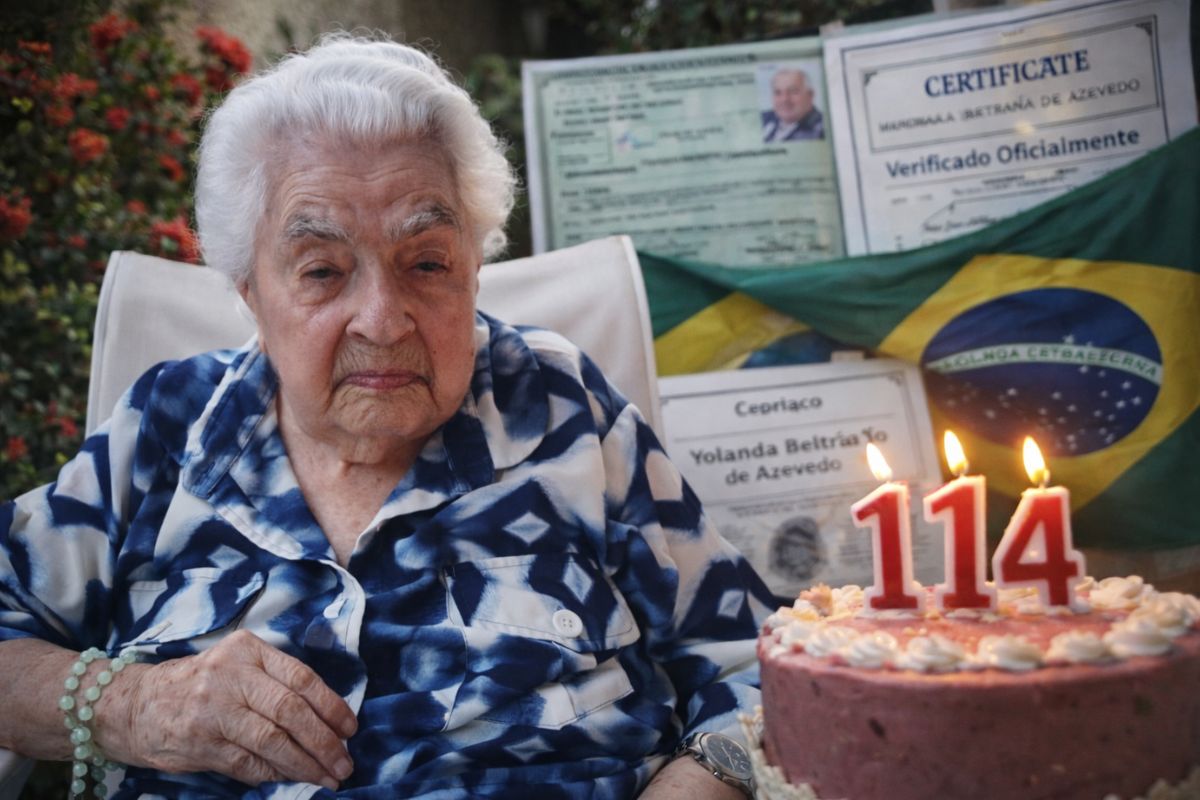
Resident of Maceió and born in Coruripe on January 13, 1911, Yolanda Beltrão de Azevedo had her documentation researched and validated rigorously, inherited the title after the death of Izabel Rosa Pereira, and became one of the most notable cases of Brazilian longevity still alive.
Yolanda Beltrão de Azevedo reached 114 years surrounded by a type of recognition that goes far beyond the declared age: that of meticulous verification. In a country where many old records require careful cross-referencing of documents, she has come to be treated as the oldest person in Brazil with fully researched, documented, and confirmed age.
This recognition gained additional weight because it did not arise from family estimation or isolated oral tradition. It came after a detailed validation process and was officially acknowledged on September 24, after the death of Izabel Rosa Pereira, also at 114 years old. What is confirmed in this case is not just a number, but an entire trajectory that crossed more than a century of Brazilian history.
The Confirmed Age That Changes the Value of Recognition

At 114 years, Yolanda Beltrão de Azevedo occupies a rare place in the field of validated longevity. The difference is significant because, in this type of recognition, it is not enough to have been born a long time ago.
-
The narrowest house in the world is only 63 centimeters wide, but inside it can accommodate a bathroom, kitchen, bedroom, office, and even two staircases.

-
In the middle of the sea, these enormous concrete and steel structures, built by the British Navy to protect strategic maritime routes, look like they came straight out of a Star Wars movie.

-
For years, no one could cross a neighborhood in Tokyo because of the tracks, but an impressive solution changed mobility and completely transformed the local routine.

-
With 15 floors, an unusual building in Curitiba uses concrete, pilasters, and exposed roofs to create the effect of stacked houses.


It is necessary that the age be meticulously researched, documented, and fully verified, a step that transforms a biographical fact into a reliable record.
This care explains why her case gained prominence. For people born in the early 20th century, especially outside the major centers, confirmation depends on documentary consistency and a rigorous reconstruction of civil trajectory.
When the age withstands this type of cross-checking, the recognition ceases to be symbolic and gains historical weight.
In the case of Yolanda Beltrão de Azevedo, the process solidified her name as the oldest validated resident of Brazil.
This means not only national leadership at a given moment but also entry into a very restricted group of elderly individuals with documentation strong enough to sustain comparison at an international level.
The natural consequence of this type of validation is the broader reach of the title. At 114 years, she ceases to be just a local or family reference and becomes seen as one of the oldest living persons with confirmed age, a segment that interests both social memory and studies on extreme aging.
From Coruripe to Maceió, a Life That Crossed Generations

Yolanda Beltrão de Azevedo was born in Coruripe, Alagoas, on January 13, 1911. She was the first of 15 children, a fact that alone suggests the extent of the familial journey her life has achieved.
Between the early 20th century and the present, she transitioned from being the eldest daughter of a large family to a central figure in an extensive family tree, marked by children, grandchildren, and accumulated memories.
She later married and had four children: Maria Isa Beltrão de Azevedo Cavalcanti, born in 1929 and passed away in 2016; João Beltrão de Azevedo, born in 1932 and passed away in 2025; Sister Yolanda Maria Beltrão de Azevedo, born on July 17, 1933; and José Beltrão de Azevedo, who passed away in 2005.
This sequence of dates helps measure the temporal span of a life that began even before radio became popular in the country and continues to be present in 2025.
Resident of Maceió, Yolanda Beltrão de Azevedo was described as a dedicated housewife, who concentrated her life on taking care of her family.
This detail may seem simple, but it reveals a profile common to many women of her generation, whose everyday contribution became less associated with public office or formal careers and more linked to the quiet sustenance of the home, children, and domestic routine.
This type of biography also helps explain why cases like hers garner so much attention.
It is not just about someone who lived long, but someone who accumulated time within a long family structure, crossing losses, births, changes of city, and profound transformations in the way of living in Brazil.
Longevity here appears inseparable from emotional permanence.
Simple Habits, Constant Routine, and an Engaged Mind
When asked about the secret to her longevity, Yolanda Beltrão de Azevedo did not point to extraordinary formulas. She said she consumed a variety of foods but avoided passion fruit juice because it caused her stomach discomfort.
The response stands out precisely for its simplicity, almost domestic, without grand promises or miraculous explanations.
She also reported enjoying crochet, an activity that, according to Yolanda herself, helped keep her mind focused. This detail is small only in appearance.
By speaking of crochet as a form of concentration, she provides a concrete clue of routine, discipline, and cognitive permanence, elements often linked to the preservation of ties, memory, and attention at very advanced ages.
In stories of extreme longevity, simple habits often gain significance because they are the only aspects of life that remain visible when time has erased almost everything circumstantial.
In the case of Yolanda Beltrão de Azevedo, varied diet, sensitivity to a specific food, and manual dedication to crochet construct a much more realistic portrait than any ready-made explanation.
The image that emerges is that of a woman who aged without turning her own age into a spectacle. Instead, she is connected to everyday practices, common discomforts, personal tastes, and a manual occupation that demands patience and repetition.
It is precisely this normality that makes the mark of 114 years even more impressive.
The Symbolic Weight of a Family That Still Accompanies Her
The longevity of Yolanda Beltrão de Azevedo gains another dimension when observing who is still around her.
She has a living sister, Salete Beltrão, and a living daughter, Sister Yolanda Maria Beltrão de Azevedo, both 92 years old. Few images sum up the magnitude of this journey as well as the coexistence of three female generations still connected by direct presence and shared memory.
This fact changes the meaning of recognition. It is not just the age of a woman that stands out, but the continuity of a family that can still look at someone born in 1911 as a real presence, not as a distant character.
When a 92-year-old daughter still lives with her mother, time ceases to be abstraction and becomes something almost tangible.
Also, for this reason, the name of Yolanda Beltrão de Azevedo transcends the field of statistical curiosity. At 114 years, she becomes a symbol of permanence in a country where much of family memory tends to be lost rapidly between generations.
Her case brings together confirmed documentation, extreme longevity, and a still-living affective network, a combination that rarely appears so clearly.
This symbolic weight helps explain the interest provoked by the case. The validation of age matters, but what captures attention is the feeling of being in the presence of a life that has crossed the Old Republic, the New State, the post-war period, accelerated urbanization, television, the internet, and is still present.
It is a biographical body that carries, alone, over a century of Brazil.
In the end, the recognition of Yolanda Beltrão de Azevedo at 114 years is not just about a national title. It speaks of memory, documentation, family, and permanence, all gathered in a single trajectory that has withstood the test of time with rare consistency.
Among confirmed records, family losses, simple habits, and an active presence in the daily lives of her loved ones, she becomes much more than an age marker.
If you had to point out what impresses you most about this story, would you choose the rigorous validation of age, the journey of 114 years, or the fact that Yolanda still has a sister and a daughter alive at 92 years? And within your own family, what is the oldest memory still circulating from generation to generation as proof of permanence?








-

-

-

6 pessoas reagiram a isso.