





 Portuguese
  English
  Spanish
  6 min of reading
  0 comments


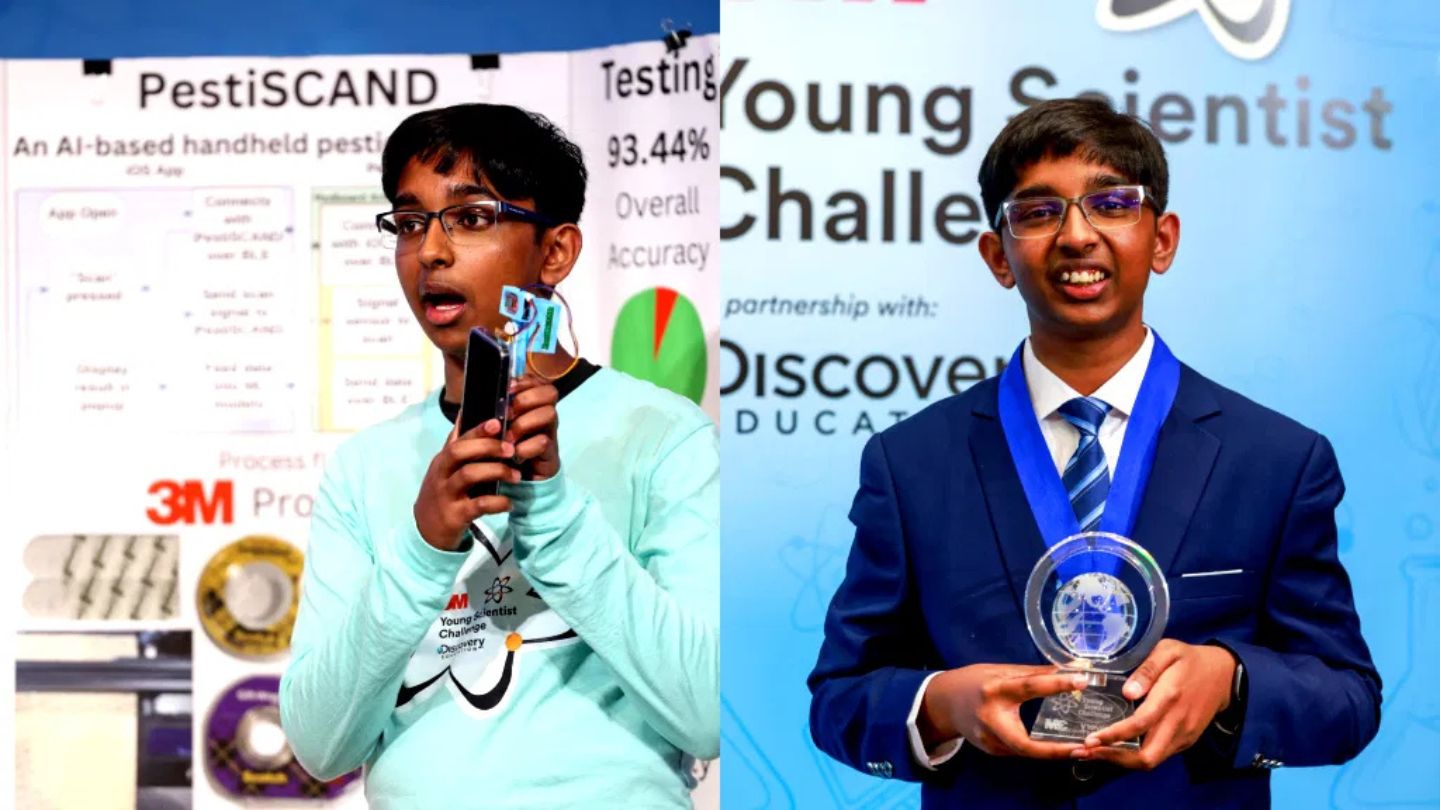
14-Year-Old Student Creates Device Called PestiSCAND Capable of Detecting Pesticides in Food Using Light and Artificial Intelligence and Wins Main Science Competition for Young People in the United States
How a Simple Question About Washing Fruits Led to the Creation of a Portable Pesticide Detector The question started at the kitchen sink. Sirish Subash was helping his mother wash vegetables when he decided to question a daily habit that practically no one usually investigates deeply. Why do people wash fruits and vegetables? What exactly does water remove from the surface of food? And if the pesticides used in agriculture have penetrated the skin or outer layer of the food — is washing still capable of eliminating these chemical residues? It was the kind of doubt that most people simply ignore or answer with quick assumptions. Sirish, however, decided to investigate the issue more deeply and create the PestiSCAND.
While researching scientific data and official reports on food safety, he found information released by the FDA, the food and drug regulatory agency of the United States. According to the agency, about 70.6% of food sold in American supermarkets has detectable pesticide residues.
These chemical residues do not necessarily disappear after a simple wash with water. In many cases, agricultural compounds can remain adhered to the surface of food or partially penetrate the outer layers of the skin. From that moment on, the daily question transformed into a scientific problem.
-
What if the Sun disappeared suddenly? Simulation shows Earth in darkness within minutes, extreme cold, and rapid collapse of life on the planet.

-
A 2,400-year-old iron foundry has been discovered in Senegal with 100 tons of slag, 35 furnace bases, and signs of nearly eight centuries of continuous metallurgical activity.

-
Four humans are flying towards the Moon inside the Orion capsule launched by the SLS rocket, and on April 6, Artemis II will disappear behind the far side of the Moon without communication with Earth for nearly an hour.

-
Worlds covered by water, atmospheres filled with hydrogen, and the possibility of life beyond Earth: ocean planets are rewriting the map of cosmic search and forcing scientists to rethink where to look.


What Started as a Domestic Curiosity Ended Up Transforming into a Complete Scientific Project
Son of Subhash Arumugam, a software engineer who immigrated from the state of Tamil Nadu, India, to the United States, Sirish grew up in Snellville, a town of about 20,000 residents located approximately 40 kilometers from Atlanta, Georgia.
In 2024, at 14 years old, he was in the ninth grade at Gwinnett School of Mathematics, Science, and Technology, an American public school known for its focus on advanced teaching of science, technology, and engineering.


What started as a domestic curiosity ended up transforming into a complete scientific project. This project turned into a functional device. And the device ended up winning the main science competition for young students in the United States.
Why Detecting Pesticides in Food Still Depends on Expensive Laboratories
Detecting pesticides in food is not a simple task. The scientific methods currently used by laboratories, food industries, and regulatory agencies involve highly sophisticated equipment.
Among the most commonly used techniques are:
- High-Performance Liquid Chromatography
- Gas Chromatography
- Mass Spectrometry
This equipment can cost between US$ 150,000 and US$ 350,000 per unit, requires specialized laboratories, trained technicians, and specific chemical reagents for each type of analysis. In addition, the time required to obtain laboratory results usually varies between 48 and 72 hours, depending on the complexity of the sample and the amount of pesticides investigated.
In commercial laboratories, the cost per sample can reach hundreds of dollars. For average consumers, this system simply does not exist as a practical option. No one takes a tomato or a handful of spinach for laboratory analysis before buying it at the supermarket.

There are some quick tests on the market based on chemical immunoassay, but these solutions have significant limitations. Many only work for specific classes of pesticides and produce qualitative results, without high precision.
These tests are also not suitable for continuous monitoring or for analyzing different types of food. It was exactly this technological gap that Sirish noticed.
How the PestiSCAND Device Created by Sirish Subash Works
The solution developed by the student was named PestiSCAND. The device utilizes a scientific principle known as spectrophotometry, a technique that analyzes how different substances interact with light.
Each chemical compound has a unique spectral signature. In other words, different molecules absorb and reflect wavelengths of light in distinct ways.
Organophosphate pesticides reflect light in a specific manner. Pyrethroids present a different pattern. Meanwhile, the clean surface of foods like tomatoes, spinach, or apples has another spectral signature.
The PestiSCAND Emits Light in Three Ranges of the Electromagnetic Spectrum
- Ultraviolet
- Visible Light
- Infrared
These lights hit the surface of the food. Sensors in the device measure how much of each wavelength is reflected back.
The collected data is sent via Bluetooth to a mobile app also developed by Sirish. The app uses machine learning to interpret the spectral signatures.

The algorithm was trained using samples of food with and without pesticide residues. Based on this data, the system learns to recognize patterns associated with the presence of chemical contaminants. In tests conducted with tomatoes and spinach, the device achieved an accuracy rate of over 85% in identifying pesticide residues.
One of the main advantages of the method is that it is non-destructive. The food does not need to be cut, crushed, or subjected to chemical reagents. The reading occurs directly on the surface of the whole product and takes only a few seconds.
The Challenge of the 3M Young Scientist Challenge
The 3M Young Scientist Challenge is considered the premier science competition for middle school students in the United States. The competition has been around for 17 years and accepts entries only from students in grades five through eight.
This short window almost prevented Sirish from participating. In fifth grade, he advanced a grade and ended up out of the eligible range. In sixth grade, his family spent several months in India and the project was not ready in time. In seventh grade, he applied but was not selected.
Eighth grade represented his last chance. Sirish decided he needed to try again. Among thousands of projects submitted from across the country, only ten were selected for the finals. The finalists spent the summer working directly with scientists from 3M to turn their ideas into functional prototypes.
Sirish was mentored by Aditya Banerji, a senior research engineer at the 3M Corporate Process Laboratory. During this time, the concept of PestiSCAND was refined and transformed into a functional device capable of conducting spectral tests and interpreting results with the help of artificial intelligence.
In October 2024, the finalists presented their projects at 3M’s global headquarters in St. Paul, Minnesota. The evaluation criteria included scientific innovation, application of engineering principles, communication skills, and potential impact on society.
Sirish Subash won the competition and received a prize of US$ 25,000, along with the title of America’s Top Young Scientist 2024.
Who is Sirish Subash Besides the Pesticide Detector
The student has also developed other scientific and educational projects. At 14 years old, he published two books:
Carbon Block Puzzle, focused on climate change, which entered the Asia and India Book of Records.
Biochemistry the Fun Way, a book that explains basic concepts of biochemistry to children.
He also runs a science outreach channel called SciKid Sirish, where he produced educational videos before dedicating more time to scientific projects. Before winning the 3M Young Scientist Challenge, Sirish had already received the Agricultural Research Service Excellence Award at the Georgia Science and Engineering Fair in 2024.
He also represented Gwinnett County at the national Thermo Fisher Junior Innovators Challenge.
The Future of Portable Food Contaminant Detection Technology
According to Sirish himself, his future goal is to continue working on technologies that have a direct impact on people’s daily lives. The area that attracts him the most is applied physics in the development of scientific devices.
Part of the US$ 25,000 prize he won in the competition will be reserved for his future college education. The question that started at the kitchen sink still does not have all the answers. But now there is a device capable of investigating it. And a young scientist who decided to turn a domestic doubt into a scientific innovation.










-

-

-

5 pessoas reagiram a isso.