





 Portuguese
  English
  Spanish
  6 min of reading
  1 comment


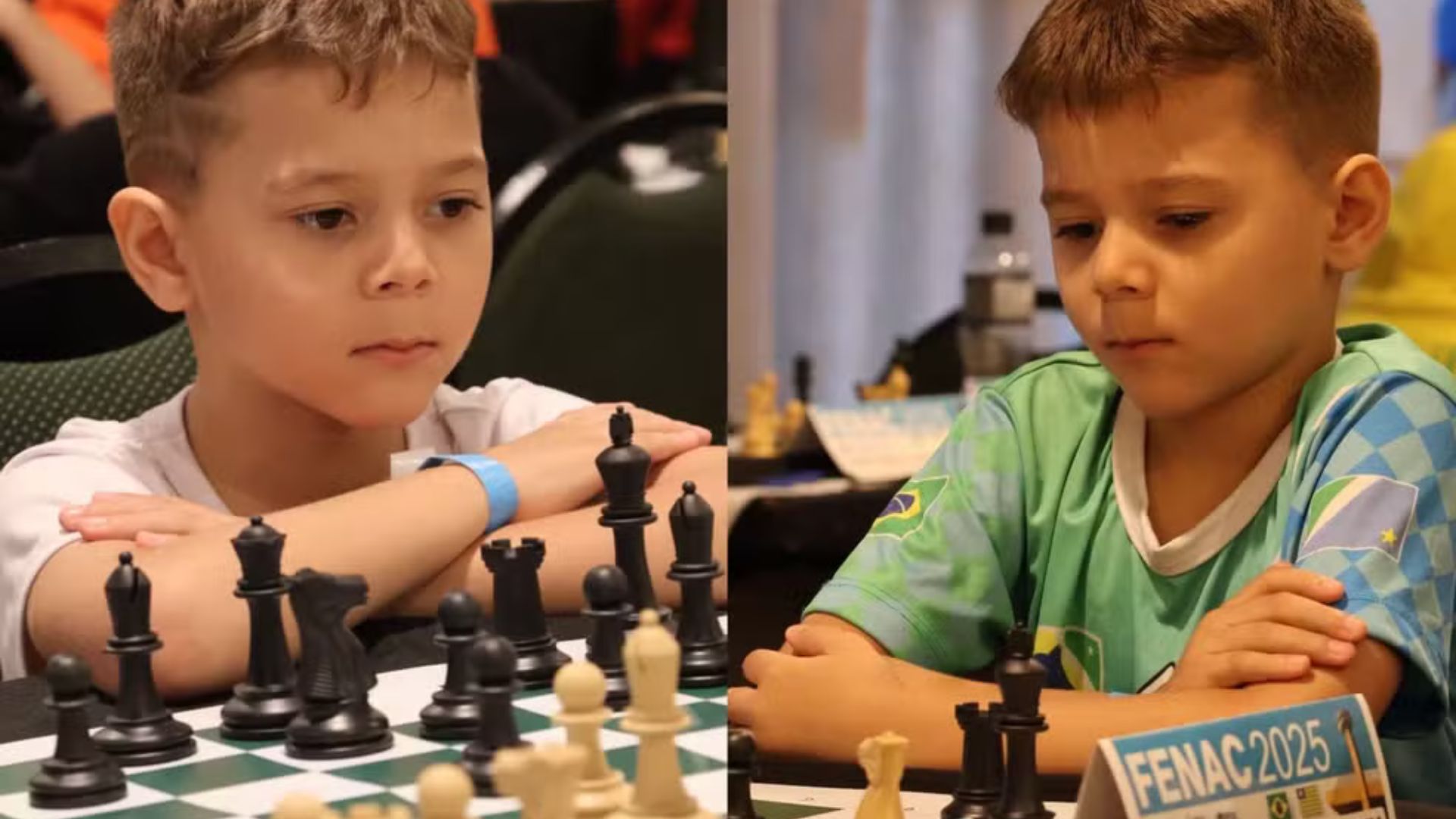


Brazilian Chess Prodigy Gains Recognition After Undefeated Campaign in National Children’s Tournament Held in Teresina, Where Young Player from Campo Grande Won Three Different Formats and Secured a Spot to Represent Brazil in International Base Competitions, Including the Cadet World Championship.
At the age of 6, Campo-grandense Vitor Gabriel Vilela achieved a rare feat even among experienced chess players by simultaneously winning the national titles in blitz, rapid, and classical during the National Children’s Festival, a competition that gathers young talents from the country.
Held in Teresina, Piauí, the tournament brought together chess players from various Brazilian regions and concluded with the dominance of the young player from Mato Grosso do Sul, who secured the so-called triple crown in the Sub-8 absolute category and ensured a spot to represent Brazil in international competitions.
Over five intense days of matches, the young player finished the tournament undefeated, with 16 wins and two draws in 18 games, a performance that caught the attention of coaches, officials, and family members involved in the Brazilian youth chess circuit.
-
According to an analysis by NASA, only one human-made structure is visible from space, and it is not the Great Wall of China or the Pyramids of Egypt.

-
After 377 years of history, the Brazilian Army will have its first female general: Colonel Claudia Cacho has been promoted to brigadier general by Lula and will receive the sword and command baton this Wednesday in Brasília.
-
A Mercado Livre customer opened their package and found 32 resumes of people looking for jobs crumpled as protective paper inside the box, exposing names, addresses, documents, and phone numbers of dozens of candidates.

-
Iceberg A23a, one of the largest in the world, is undergoing accelerated collapse and may disappear: what explains the end of the ice giant?

Results at FENAC and Dominance in the Three Formats of Chess

Within the classical system, a format that requires deep calculation, strategic planning, and greater emotional control throughout the match, public records from Chess-Results show Vitor Gabriel Felix Vilela leading the Sub-8 category after six rounds, with 5.5 points.
Right in the rapid format, where players need to balance precise analysis and efficient time management, the chess player repeated his consistent performance and also ended the tournament with 5.5 points, maintaining first place among competitors.
When the competition moved to the blitz, the faster-paced rhythm of competitive chess, the athlete again stood out and finished with six points, reaffirming his leadership and consolidating the campaign that resulted in the so-called national triple crown.
This expression is used to describe the title obtained in three official formats within the same season and category, something considered uncommon in competitive chess, especially in base tournaments that usually gather players with different styles of play.
Understanding the differences between these rhythms helps to measure the significance of the achievement obtained by the young Brazilian chess player at FENAC held in Teresina.
According to the rating rules of the International Chess Federation, rapid games are played with more than ten and less than sixty minutes for each player, while blitz uses controls of over three and up to ten minutes per participant.
This variation in time profoundly alters the dynamics of the game, influencing the type of calculation used, the management of the clock, and even the nature of errors that arise during each phase of the game.
Spot at the Cadet World Championship and Challenges of the International Calendar

As a direct consequence of the titles obtained at the national festival, Vitor secured the right to join the Brazilian delegation in international base competitions, including the Cadet World Championship scheduled to take place in Almaty, Kazakhstan.
The international competition gathers young chess players from various countries and represents one of the main showcases of world chess in the initial categories, bringing together athletes who often begin their first experiences in large-scale events there.
Despite the sports highlight, the qualification also brought logistical challenges for the athlete’s family, as international tournaments usually occur in succession and require financial planning, school organization, and adequate sports preparation.
In this context, family members evaluate which commitments can be taken on in the international calendar, considering travel distances, costs involved, and the need to balance sports routines with school activities.
Similar situations are common in youth chess, especially when significant results arise very early in a player’s developing career.
How Vitor Gabriel’s Journey in Chess Began
Unlike many young athletes who discover sports in clubs or school projects, Vitor’s first contact with chess happened at home, when he began to learn the basic moves of the game from his own father.

Over time, the initial curiosity evolved into a more structured training routine, which began to include participation in school projects, technical guidance, and frequent practice aimed at competitive development.
Reports published by sports media indicate that the boy quickly demonstrated an ability to understand the strategic patterns of the game, as well as competitive spirit in different game rhythms, an uncommon trait in such young categories.
In an interview with ge, the young boy summarized his tournament experience by stating that “it was very difficult” and that none of the opponents encountered throughout the competition could be considered weak.
This statement reinforces an important aspect of the campaign, as the national title was won in a tournament with representatives from various Brazilian states, bringing together players active in the official youth chess circuit.
Coverage published by Campo Grande News also highlighted that the victory in classical earned the athlete a second norm towards the title of National Master, a recognition outlined in the rules of the Brazilian Chess Confederation for performances achieved in sanctioned competitions.
Nevertheless, the confirmation of such a title depends on the full compliance with the technical criteria defined by the body’s rules governing the sport in the country.

Why Winning the Triple Crown in Chess is So Rare
Although winning a national championship already represents a significant milestone for any player starting their career, winning three titles in different rhythms during the same competition significantly amplifies the sports weight of the result.
This happens because each format requires specific mental skills, from the ability to calculate complex variations to the skill of making quick decisions under strong time pressure.
During blitz games, for example, any hesitation can cost a favorable position in a matter of seconds, while in rapid, the chess player must balance tactical precision with time control.
In classical chess, the traditional format of competitive chess, the player faces longer games and must demonstrate strategic patience, positional planning, and mental endurance over dozens of moves.
This diversity of requirements explains why few athletes can simultaneously master all three formats within the same national championship.
In the case of the young Brazilian champion, the highlight came precisely from his ability to maintain a high performance across all these fronts, remaining undefeated throughout the entire marathon of games played in the festival.
Besides the immediate sports result, the journey also highlights a frequent challenge in the development of early talents within competitive chess.
Transforming early achievements into consistent evolution over the years often depends on factors such as family support, appropriate technical guidance, participation in strong tournaments, and balance between academic formation and sports career.
These elements, often invisible to the audience that only follows the results of the matches, typically determine whether a promising talent will be able to sustain competitive growth through the following stages of their career.








Estou muito orgulhoso de saber que temos grandes intelectuais em nosso Brasil. Meus parabéns à todos vocês meus conterrâneo de C.Grande M.S. prossigam firmes .
Não desistam. Deus vos abençoe sempre.