





 Portuguese
  English
  Spanish
  9 min of reading
  0 comments


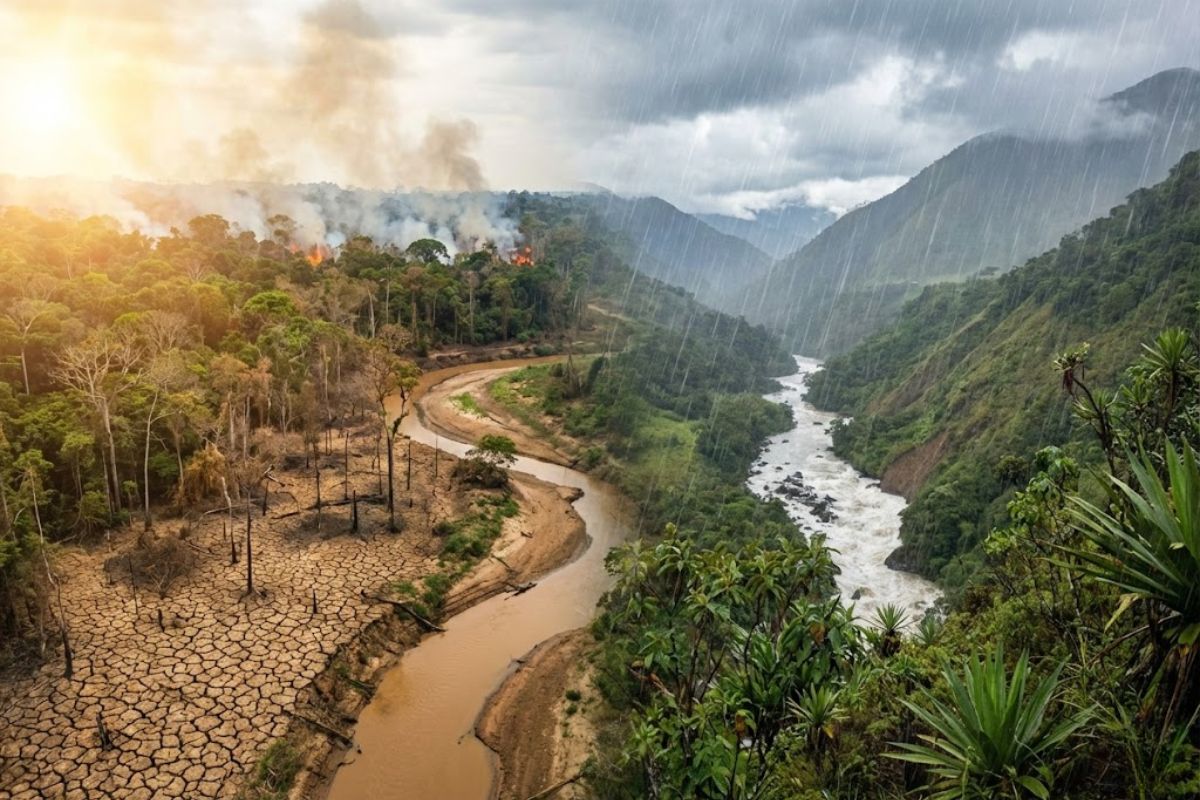
Four Decades Of Forest Plot Records Show The Amazon And Andes Changing Unequally: Warmer And Drier Areas Lose Species, Others Gain, And Precipitation And Its Seasonality Appear As Decisive As Temperature In Defining The New Pattern Of Tropical Tree Diversity.
The Amazon is already being reshaped by climate change, according to a rare set of 40 years of detailed tree records collected in long-term forest plots in the Amazon and the Andes. The analysis reveals an unequal scenario, where some regions consistently lose species, others record gains, and above all, rainfall emerges as a decisive factor, with precipitation and seasonality directly influencing the new map of tropical biodiversity.
The study, published in the journal Nature Ecology and Evolution, shows that the apparent stability in the total species richness in South America hides profound changes at the regional scale. Heat, drought, and more pronounced seasonal changes increase the likelihood of losses, while areas with naturally dynamic conditions and healthier ecosystems tend to gain species, reinforcing that the Amazon is changing silently, plot by plot, over decades.
A Portrait Constructed With 40 Years Of Repeated Measurements

The strength of the survey lies in its time and consistency. Instead of photographing the forest at a single moment, the researchers gathered four decades of repeated measurements in long-term forest plots, with detailed records of trees collected since the 1970s and 1980s.
-
Brazil has quietly developed an electric tactical drone that takes off and lands vertically without needing a runway, flies at 140 km/h in a fully autonomous manner, and can operate in forests, conflict zones, and remote areas.

-
Novo drone Guardian debuts in the United States with an 8-mile range, robotic battery swapping, and Starlink connectivity for continuous response.

-
100 kW megalasers are already pointing to a new industrial phase, with enough power to cut thick steel, drill through rocks, accelerate mining, and increase productivity in operations previously considered too difficult.

-
Thousands of people in poor countries are paid cents to film household tasks, label images, and operate systems remotely all day long, and this invisible work fuels a $17 billion market that trains the artificial intelligences of Google, Tesla, and Meta.


This type of data is rare because it requires continuity, consistent methodology, and teams willing to return to the same points over the years, repeating the work rigorously.
These plots were repeatedly measured by hundreds of botanists and ecologists, allowing for tracking changes in tree species richness and detecting gradual trends that do not appear in short studies.
The Amazon enters here as a living laboratory monitored over decades, offering a level of detail capable of revealing subtle changes that, accumulated, become structural transformations.
The Continental Scale Of The Study And The Size Of The Ecological Challenge
The work covers the tropics of South America, a region that contains over 20,000 tree species.
To support conclusions on such a broad scale, scientists analyzed data from ten countries, gathering a set of 406 long-term floristic plots.
These consistent and repeated records allowed for comparing changes over time in some of the biologically richest forests on Earth.
With this scope, the research stands as one of the most comprehensive assessments ever made on how tree diversity is changing in the Amazon and the Andes, connecting local patterns, such as what happens in a specific plot, to regional and continental trends.
What Appears Stable On The Surface But Is Changing From Within
When observing tree diversity across South America, researchers found a total species richness that is practically stable.
This result, at first glance, could suggest balance. But in practice, it works as a misleading average: overall stability masks consistent losses in some regions and gains in others, creating a mosaic of results.
In several large areas, diversity has declined over time. In other regions, there has been an increase in the number of species.
The central message is that climate change is not producing a uniform effect in the Amazon and the Andes. Instead, it is redistributing diversity, altering the “where” and “how” species are organized in the landscape.
Where Diversity Falls Most Strongly: Heat, Drought, And Seasonality

The pattern most associated with losses was clear: forests exposed to higher temperatures, drier conditions, and more pronounced seasonal changes had a greater likelihood of losing tree species.
This suggests that heat and drought act as environmental pressures capable of eliminating less tolerant species to new extremes, reducing local variety over time.
The greatest losses were observed in the Central Andes, the Guiana Shield, and the forests of the Central-Eastern Amazon.
In these areas, most long-term monitoring plots recorded declines, indicating that the reduction in diversity was not an isolated event, but a continued process, year after year, measurement after measurement.
The Central-Eastern Amazon appears as one of the most sensitive points in this redesign, with plots indicating declines in diversity associated with warmer and drier conditions.
Where The Forest Gains Species And Why That Matters
The study also identified regions with an opposite trend. The Northern Andes and Western Amazon stood out as areas where the number of tree species increased in most of the analyzed plots.
This finding is crucial because it shows that the system is not just about loss. There is also recomposition and local gain, depending on environmental context.
The ecological reading of these gains is that certain regions may be providing more favorable conditions for the entry of new species, whether due to climate changes that make the environment compatible with other trees or broader natural dynamics.
This changes the debate because the question is not just “how many species exist,” but “where they are and which ones are coming and going.”
Rain Becomes The Protagonist: Precipitation And Seasonality Define The New Map
Although rising temperatures have broad influence, the study showed that precipitation levels and seasonal rainfall patterns played a fundamental role in forming regional trends.
In other words, rain is not just a supporting actor to warming, but a decisive factor in the reorganization of tree diversity.
This point changes the simple understanding that “the forest only responds to heat.” Research indicates that precipitation and seasonality can separate regional destinies: in some places, changes in rainfall may accelerate losses; in others, precipitation regimes can sustain gains.
The Amazon, in this scenario, begins to be interpreted as a system in which available water, rainfall distribution, and variations throughout the year weigh as heavily as temperature.
The Concept Of “Unequal Impact” And The Amazon As A Mosaic Of Responses
By revealing losses in warmer and drier areas and gains in regions with other conditions, the study reinforces that climate impact is unequal.
This means that there is not one single Amazon reacting in the same way, but several regional Amazons, with different responses depending on local climate, ecological dynamics, and rainfall patterns.
This mosaic has direct consequences for conservation and environmental policies: one-size-fits-all strategies may fail if they ignore that pressures and outcomes change from region to region.
What works for an area with continuous loss may not be the priority in an area that is gaining species, and vice versa.
Northern Andes As A Potential Climate Refuge
One of the most notable discoveries is that the Northern Andes emerge as a potential climate refuge for tree species affected by climate change.
The idea is that as environmental conditions worsen in other areas, this region may provide shelter for species displaced from surrounding forests.
This refuge concept is critical because it suggests a strategic role in maintaining regional diversity. If species are losing suitable conditions in some places, they may persist in others, if there are areas capable of offering a more compatible environment.
The Amazon-Andes connection, in this context, appears as a crucial ecological corridor for the future of tropical biodiversity.
How Plant Species Try To Survive When The Climate Changes
Plant species have limited paths in the face of climate change. They can shift their geographic distribution areas as conditions change or they can adapt to new environments where they already grow.
When they cannot shift or adjust, their populations decrease, increasing the risk of extinction.
In practice, this means that gradual changes in temperature and rainfall can reorganize the forest over time: some species manage to persist and even expand, while others lose space, disappear from specific areas, or decline in abundance.
The Amazon, due to its enormous diversity, becomes especially sensitive, as small climate changes can affect species with very specific tolerances.
Who Led The Research And How It Was Constructed
The study was led by Dr. Belen Fadrique from the University of Liverpool and is based on 40 years of detailed tree records.
She is a Dorothy Hodgkin Fellow from the Royal Society and the University of Liverpool, and conducted the research while a Marie Curie Fellow at the University of Leeds.
The research was published in Nature Ecology and Evolution and constructed from fieldwork and the continuity of scientific networks.
The principal author highlighted that assessing species responses to climate change points to profound changes in forest composition and species richness at multiple scales, reinforcing that it is not a point effect, but broad reconfigurations over time.
The Role Of Institutions And Brazilian Presence In The Debate
The analysis benefited from contributions from scientists connected to leading institutions. Flavia Costa, a professor at INPA in Brazil, emphasized that the impacts of climate change are unequal in tree diversity across different tropical forests, reinforcing the need for specific monitoring and conservation efforts targeted at each region.
This message is essential because a forest with continuous loss may require immediate priority, while another gaining may need monitoring to understand if the increase in species is stable, temporary, or associated with rainfall changes that may reverse.
The Additional Threat Of Deforestation In The Background
Professor Oliver Phillips from the University of Leeds, who leads the pan-Amazonian network RAINFOR, emphasized that there is an additional threat to the climate scenario: deforestation.
He highlighted the vital links between forest preservation, biodiversity protection, and combating climate change, with special attention to the remaining areas where the Amazon meets the Andes.
The central idea is that these transition forests need to remain standing to provide a long-term home for displaced species, especially from adjacent lowlands. If the climate pushes species into new areas, but deforestation breaks these paths, the risk of loss intensifies.
The Research Networks That Sustain Decade-Long Monitoring
The research was the result of international collaboration involving over 160 researchers from 20 countries. Many contributions came from South American universities and partners, supported by networks such as RAINFOR, Red de Bosques Andinos, Projeto Madidi, and PPBio.
These networks are vital because long-term monitoring depends on continuity. Without teams returning to the same plots over decades, data fragment and trends become invisible. What makes it possible to talk about “silent changes” in the Amazon is precisely the persistence of this type of repeated and standardized measurement.
What Scientists Want To Understand Now: Species That Disappear, Species That Enter, And Homogenization
The researchers plan to continue investigating how climate change is reshaping tropical tree diversity.
The future focus includes composition questions, such as the taxonomic and functional identities of the species that are being lost or recruited, and whether this points to a large-scale homogenization process in the Andes-Amazon region.
Homogenization, in this context, means the possibility that different forests start to look more alike, losing regional uniqueness.
Even if total richness seems stable, the forest may be trading rare and specific species for more generalist species, altering the ecosystem’s functioning.
The Amazon may maintain “similar” numbers, but with a different composition, and that changes everything.
Why This Finding Changes The Way We See The Amazon
The main turning point brought by 40 years of data is that transformation is already underway and is not uniform. The Amazon appears as a system in reconfiguration, where losses in warm and dry areas, gains in others, and the decisive role of rainfall point to a new tropical biodiversity map.
The message is one of scientific and strategic urgency: understanding where diversity is falling, where it is rising, and which environmental factors explain these differences is what allows for directing monitoring and conservation. The forest is not paralyzed. It is rearranging itself, and rain is one of the keys to this rearrangement.
Do you think the Amazon can turn into a mosaic of “biodiversity islands” with refuges in the Andes, or can we still avoid this accelerated reorganization caused by heat, drought, and changes in rainfall?








-

-

-

5 pessoas reagiram a isso.