





 Portuguese
  English
  Spanish
  4 min of reading
  0 comments



Saudi Arabia Invests Billions in Intercontinental Railway to Connect the Red Sea to the Persian Gulf, Reduce Logistics Time, and Compete for Global Routes Dominated by Suez and Panama.
For decades, global trade has relied almost exclusively on strategic maritime chokepoints. The Suez Canal, Strait of Hormuz, Strait of Malacca, and Panama Canal concentrate a huge share of the world’s goods flow. Now, Saudi Arabia has decided to confront this model head-on. The country has launched one of the most ambitious logistical ventures of the century: crossing the desert with a continental-scale freight railway capable of connecting the Red Sea to the Persian Gulf in less than 24 hours. The project, known as Saudi Landbridge, is not just an infrastructure project. It is part of a national strategy to reposition the country at the center of global trade, reduce dependence on crude oil, and transform Saudi territory into a logistics corridor between three continents.
The logic is simple, yet powerful: what today takes days or weeks navigating oceans can be moved overland in a matter of hours.
What Is the Saudi Landbridge and Why Is It Strategic
The Saudi Landbridge includes the construction and modernization of over 1,300 kilometers of railways, connecting the port of Jeddah on the Red Sea to Riyadh and, from there, to the eastern coast of the country in the Persian Gulf, where major industrial and energy terminals are located.
-
In A European City, The Country’s Largest Railway Junction Was Modernized Without Closing Its Doors, Kept Trains Running During Years Of Construction, Now Serves Up To 60,000 Passengers Per Day, And Installed Solar Panels That Generate About 30% Of Its Energy
-
Famous Brazilian Railway May Become a Parking Lot
-
The Country of “Punctual As a Train” Admits It Has Lost Control: High-Speed Trains Delay, Stop, Disappear from the Map and Turn 6-Hour Trips into 10, While Deutsche Bahn Promises Restructuring in 2026 But Faces 19th Century Infrastructure, Staff Shortages and Sections Closed for Months
-
With an Investment of R$ 700 Million in One of the Country’s Main Rail Networks, VLI Reinforces Infrastructure, Receives 8 New Locomotives, and Expands the Corridor Connecting 7 States, Boosting Jobs and the Transportation of Grains, Ore, and Oil Products to the Port of Santos


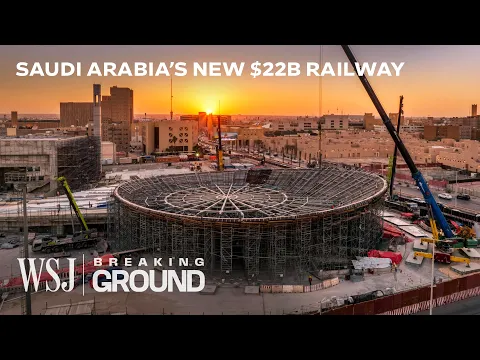

In practice, the railway creates a land shortcut between the Atlantic and the Indian Ocean, allowing goods unloaded in the Red Sea to quickly traverse the country and head to Asia without depending on congested maritime routes.
For Saudi Arabia, this means turning the desert into a logistical asset. For global trade, it means a real alternative to historical bottlenecks.
Monumental Scale: Billions Invested and Industrial Capacity
The project involves estimated investments of tens of billions of dollars, including high-capacity tracks, intermodal terminals, distribution centers, and integration with modernized ports.
The railway is designed to transport millions of tons of cargo per year, including containers, grains, ores, industrial products, and energy derivatives. Long, heavy trains operating continuously will allow a flow that rivals major rail corridors in Eurasia.
Moreover, the system has been designed to operate in extreme environments, with high temperatures, sand, long distances without urban centers, and maximum reliability demands.
Less Than 24 Hours Between Two Seas
One of the most impressive aspects of the Saudi Landbridge is the crossing time. While a ship can take several days to navigate around the Arabian Peninsula or face queues in canals and straits, the railway promises to connect the Red Sea to the Gulf in less than a day.
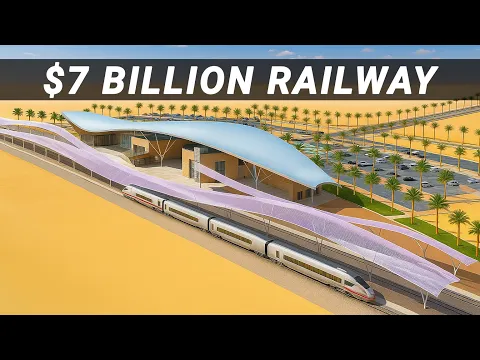
This drastic reduction in logistics time is crucial for high-value cargo, industries sensitive to delays, and companies that operate with lean inventories. In a world where hours can represent millions in losses, speed becomes a competitive advantage.
Direct Competition with Historic Maritime Routes
Although it will not completely replace maritime transport, the Saudi project enters into direct competition with established routes, especially the Suez Canal.
Whenever there are geopolitical crises, accidents, or blockages like the grounding of the Ever Given in 2021 — global trade feels the immediate impact. A stable land corridor in the Middle East offers a strategic alternative for shippers, governments, and large corporations.
Moreover, the railway reduces exposure to maritime risks, such as piracy, naval conflicts, and extreme fluctuations in freight costs.
Integration with Vision 2030 and the End of Oil Dependence
The Saudi Landbridge is part of the Vision 2030 plan, the largest economic transformation initiative in the country’s history. The goal is clear: reduce dependence on crude oil and create new revenue sources based on logistics, industry, technology, and services.
By becoming a railway and port hub between Europe, Africa, and Asia, Saudi Arabia starts to capture value not only from the energy it extracts but also from the global flow of goods.
Modernized ports, industrial zones, logistics cities, and associated services emerge as direct developments from the railway.
Geopolitical Impact: More Than Tracks, Power
Infrastructure of this scale is never neutral. By controlling a strategic land corridor between two seas, Saudi Arabia expands its regional and global influence.
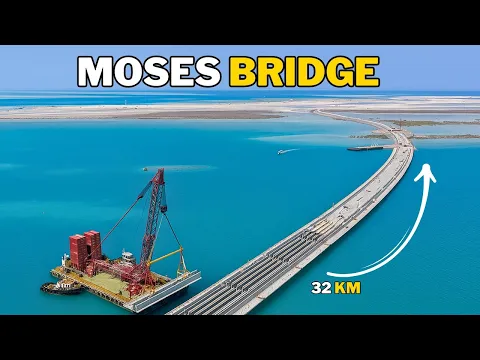
The country now plays a significant role in international supply chains, trade negotiations, and logistical decisions that previously depended almost exclusively on maritime routes controlled by other actors.
In a scenario of disputes among major powers, who controls the route controls part of the game.
Desert as an Asset and Not an Obstacle
Historically, the desert has been seen as a barrier. The Saudi Landbridge reverses this logic. With heavy engineering, advanced rail technology, and abundant capital, the geographical void transforms into an advantage.
Long stretches without urban areas reduce interferences, allow for high average speeds, and continuous operation, something difficult in densely populated rail corridors.
What was once isolation becomes fluidity.
A New Axis in Global Trade
If fully implemented, the Saudi Landbridge will not just be a national railway. It will become part of a new global logistics axis, connecting continents, shortening distances, and providing real alternatives to century-old routes.
This is not just about tracks in the desert. It is a clear attempt to reorganize the map of global trade, using infrastructure, speed, and scale as instruments of economic power.
The question that remains is not whether the project is ambitious. It is whether the world is ready for a new corridor capable of changing the game.








-

2 pessoas reagiram a isso.