





 Portuguese
  English
  Spanish
  7 min of reading
  1 comment


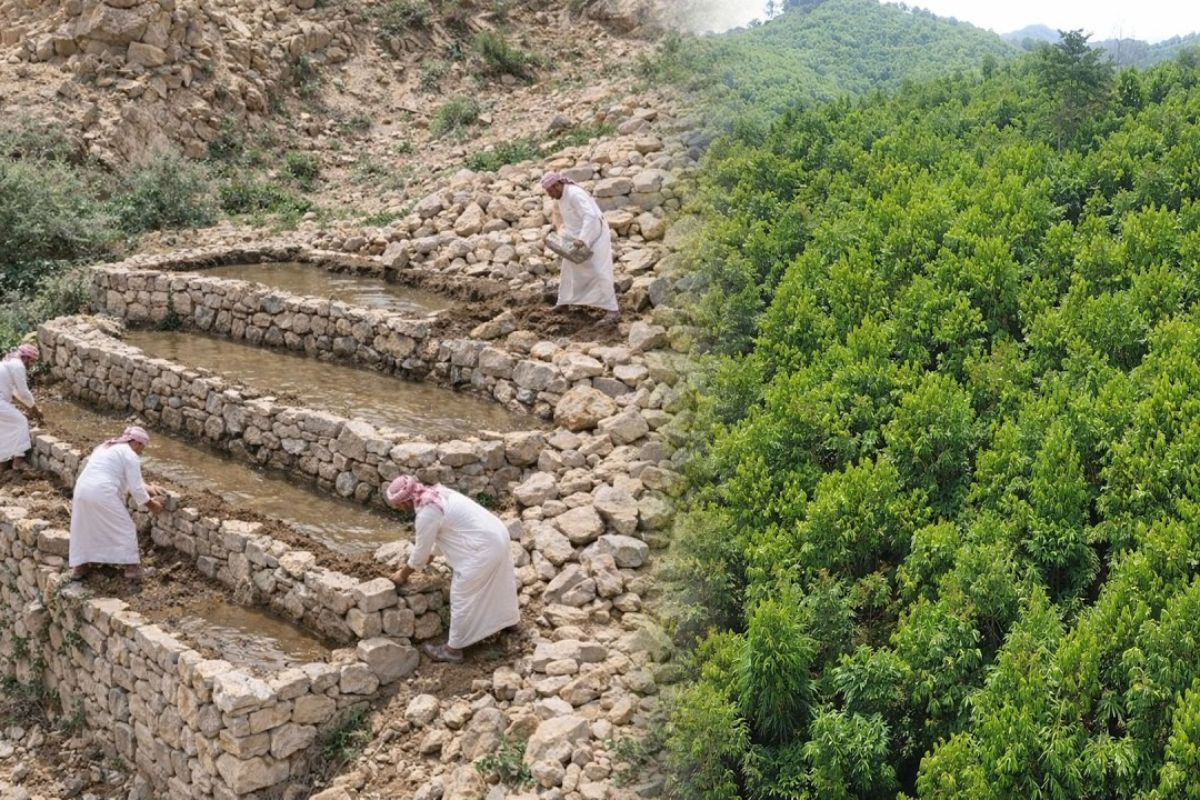


The Desert Valley of Albaida, in western Saudi Arabia, was regenerated with detention channels, stone dams, and passive runoff harvesting, allowing an area degraded by overgrazing and 60 mm of annual rainfall to return to storing water, forming humus, sustaining native trees, and resisting extreme local drought.
The Desert Valley of Albaida, about 50 km south of Mecca, became a rare case of ecological recovery in an area where heat reaches 50 ºC, humidity often drops below 10%, and average annual rainfall barely reaches 60 mm. The change did not come from deep wells, billion-dollar desalination, or permanent irrigation, but from a system designed to capture the only water that was truly available: that from runoff.
The turning point came when the team stopped treating drought as the sole problem and began to address the behavior of water on dead, compacted soil that could hardly infiltrate anything. Instead of rushing to the Red Sea carrying sediment and destroying what remained of the fertile surface, the rain began to be slowed down, spread out, and pushed into the ground.
Where The Desert Valley Collapsed And Why It Happened
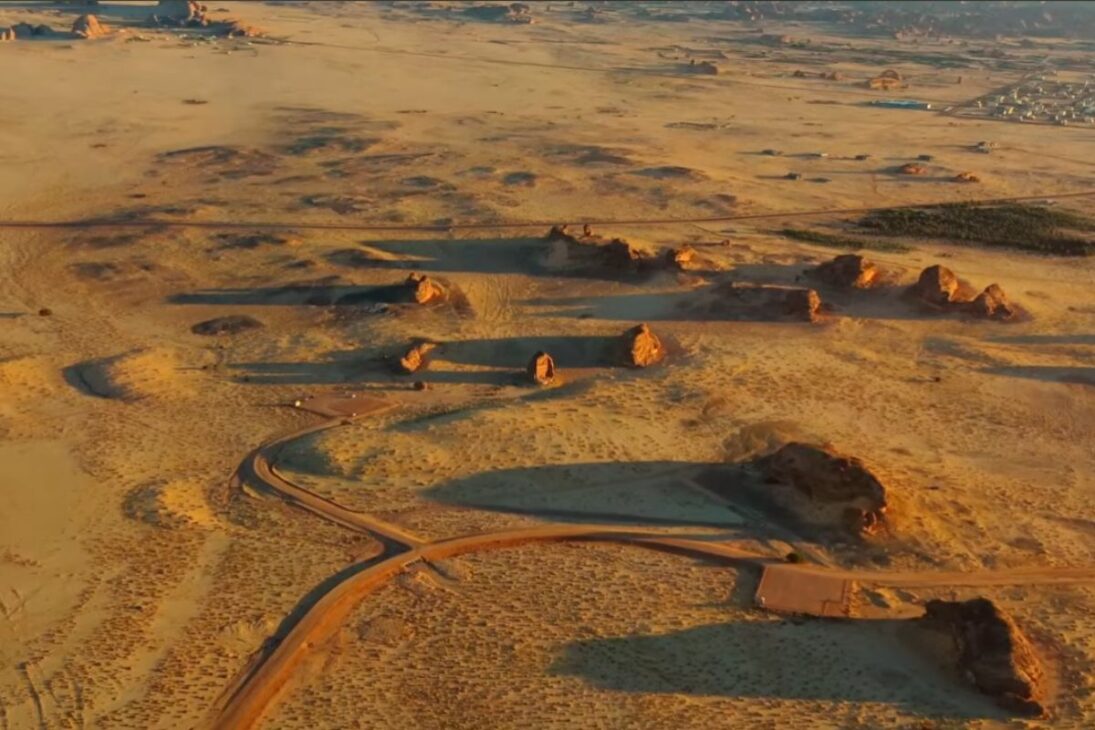
The Desert Valley was not naturally empty by absolute nature. According to the project’s base material, the region once had smarter ecological management supported by a community-based rotational grazing protection system.
-
The Brazilian city has 319 crooked buildings built on sandy soil without proper deep foundations, houses the largest beach garden in the world, with over 5 km, and is still considered the birthplace of surfing — meet Santos, in São Paulo.
-
New Zealand builds a shimmering building that vibrates, featuring a 62-seat cinema, moving sculptures, and an environment where sound, light, and energy are felt in the body.
-
Two colored cubes of 2.5 m transform a public bathroom into a selfie spot in Western Australia, costing up to 75% less than traditional construction and helping to reduce vandalism in public spaces.
-
Santa Catarina produces up to 7 times more than it consumes in some sectors, and its century-old industries founded by grandparents and great-grandparents now compete on equal footing with Germany and the United States in the international market.


This arrangement allowed native vegetation to rest, regrow, and maintain soil cover, which was crucial in such a severe climate.
When the roots remain protected, the soil stays alive; when they disappear, desertification accelerates.
The rupture began in the 1950s with the abolition of this local model and the loss of community borders that organized land use.
Overgrazing advanced, remaining shrubs were cut for firewood, and vegetation cover was eliminated. Without plants to cushion impact, shade the surface, and open pores in the ground, the soil compacted, lost structure, and ceased to absorb water.
This process created a brutal paradox. In a desert valley with scarce rainfall, the little available water ceased to be an automatic blessing and instead acted as a destructive force.
When precipitation arrived, it did not penetrate the ground; it rushed over the already hardened surface, tearing away the last fertile layer and transporting sediments away at high speed.
The estimate presented by the team was that over 90% of the rainwater was lost in this way.
The central problem, therefore, was not just the lack of rain but the inability to retain the rain that was already falling. This distinction changed the entire logic of the project and also explains why previous attempts failed so quickly.
How Engineering Transformed Runoff Into Groundwater
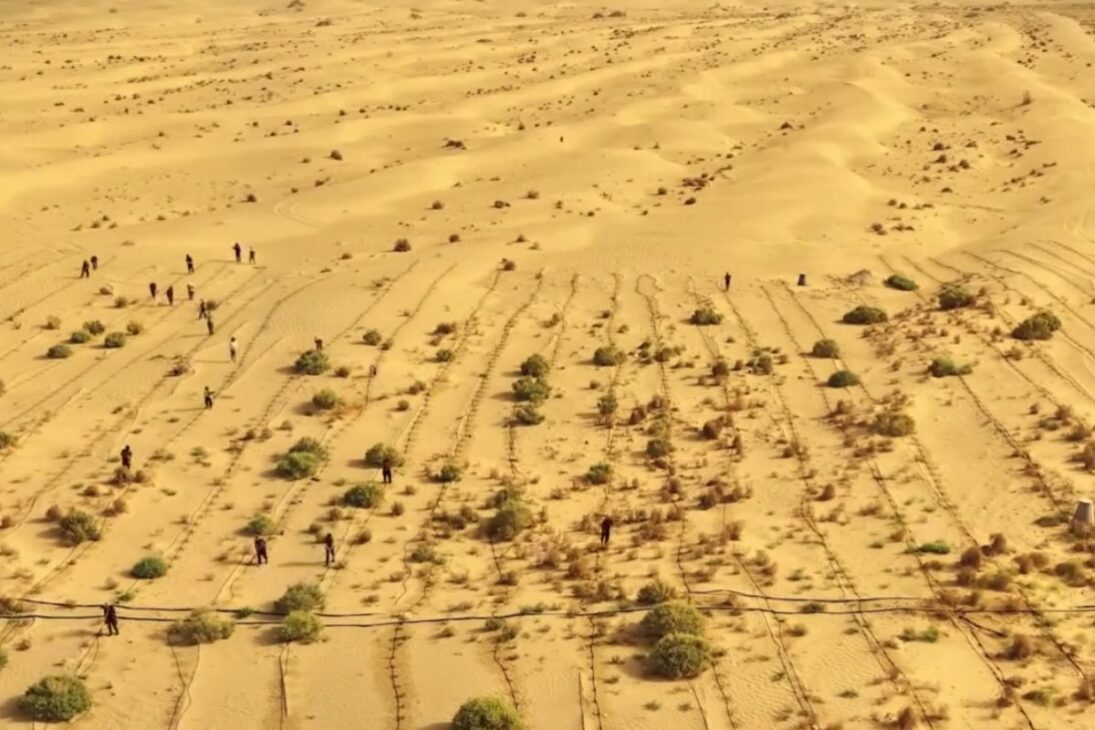
Before the regenerative strategy, there were attempts based on conventional irrigation, water trucks, and application of inputs to sustain seedlings in extreme environments.
The result was artificial and unstable. Trees survived as long as there was external support; once funding ran out or water transport ceased, they dried up within weeks.
The system kept plants alive but did not heal the soil.
The change began in 2010 when a group of regenerative agriculture specialists led by Neil Specman began to see the Desert Valley of Albaida as a natural catchment structure.
The team studied ancient water harvesting techniques used in dry regions by other civilizations and came to an objective conclusion: the mountain was not the enemy; it was the collection area; the runoff was not just a threat; it was a resource.
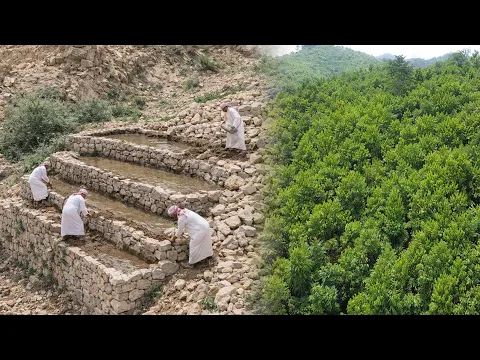
The solution was designed as a passive system. Instead of pumps, engines, and heavy permanent irrigation infrastructure, there were detention channels and small stone dams shaped along the contour lines.
The goal was to slow the water descending from the mountains, fragment the flow, and reduce its speed from around 100 km/h to less than 5 km/h. Slow water infiltrates; violent water tears everything away.
This deceleration changed the fate of the land. With less speed, the runoff began to deposit minerals-rich sediments and infiltrate deeply.
The Desert Valley began to function as an underground sponge, storing water beneath the surface to get through the dry season. This required fine calculations of topography, hydraulics, and channel angles, with adjustments made even to variations of 5 degrees to optimize flow direction.
The Real Test Came With Little Rain, Broken Structures, And Night Work
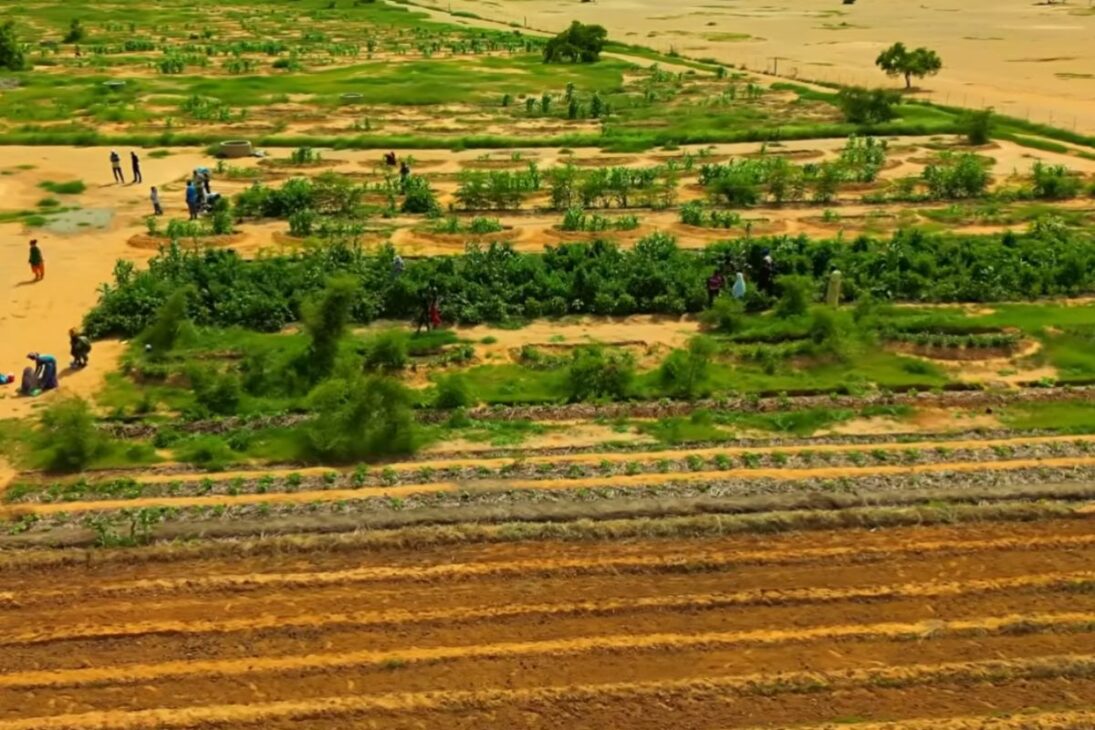
On paper, the system seemed elegant. In practice, the implementation was tough. During the first 1,000 days, the region received only four rains, and each episode served as an extreme test for the newly constructed structures.
There were times when the runoff came down with enough energy to drag tons of earth and rocks, destroying dams in minutes.
Nature was showing where the project still failed.
Instead of treating each rupture as a defeat, the team began to use the collapse of structures as technical data.
Dams were reinforced, bases gained new layers of self-locking stacking, and the layout of the channels was corrected until the water began to lose energy at the right point.
This learning was crucial because the Desert Valley required more than good intention: it demanded precise reading of the terrain and hydrological force.
The construction effort also had a social scale. In an area of about 90 acres, the project technically trained over 100 Bedouins from local tribes, transforming nomadic shepherds into workers capable of operating a complex network of water harvesting and agroforestry.
As the heat frequently reached 50 ºC, much of the heavy work was done at night, under lanterns and moonlight, with the manual movement of millions of stones.
At the same time, the first plantings began. The team introduced about 4,000 trees of species chosen for resistance, root depth, and ecological and economic function. Among them were Acacia tortilis, Ziziphus spina-christi, and Moringa peregrina.
They were not ornamental trees placed to appear visually successful, but species capable of sustaining soil, food, nectar, and long-term stability.
When The Desert Valley Began To Function Without Irrigation

The hydrological data measured by the team showed a decisive turning point. To initiate the ecosystem, the project used about 20,000 m³ of water brought by water trucks.
Then, with just a few heavy rains, the system of channels and dams managed to capture and infiltrate back into the soil more than 50,000 m³ of rainwater.
In practical terms, the land returned two and a half times more water than it had artificially received at the start.
This result gave the project what the responsible parties called a positive water footprint. Agriculture ceased to function as an extractive activity on a dry area and began to regenerate the groundwater stock.
The Desert Valley no longer depended on the logic of continuous external supply; it started to operate with a rebuilt water bank in its own subsoil.
In 2016, however, came the riskiest test. Funding was abruptly cut off, and Neil Specman decided to completely disconnect the artificial irrigation support.
This was a radical decision because it definitively separated two hypotheses: either the ecosystem sustained itself with the water stored by the runoff, or everything that had been done until then would continue to rely on permanent human assistance.
Soon after, the region faced three consecutive years without receiving rain. Even so, the project area remained green, while neighboring zones became arid again.
Native species absent for decades began to reappear spontaneously, and fauna returned along with vegetation cover.
It was the moment when the desert valley stopped looking like a controlled experiment and began to behave like a functional ecosystem.
What Albaida Teaches And What Are The Real Limits Of The Model
The case of Albaida is relevant because it suggests that regeneration in arid areas does not depend solely on “planting trees,” but on reprogramming the relationship between water, soil, relief, and human use.
The Desert Valley changed when the team began to work with the natural dynamics of runoff instead of against it.
The forest did not arise from continuous irrigation; it was born from the recovery of the terrain’s infiltration and retention capacity.
This point is very important because it avoids simplistic readings. The success of Albaida does not mean that any dry area can be converted into a stable ecosystem with a few dams and a symbolic planting.
The project required detailed topographic reading, maintenance, social mobilization, correct species selection, and continuous protection against new cycles of degradation. Without management, the desert returns.
The clearest threat, according to the project’s own basis, is no longer just climate-related.
It is uncontrolled grazing. If herds consume young vegetation on a large scale, the recovery process can be quickly reversed.
This puts the human factor back at the center of the equation. The challenge is not just technical; it is institutional, cultural, and economic.
Even so, Albaida opened up a hypothesis of much larger scale.
The project material argues that similar regions along the western coast of the Arabian Peninsula could absorb part of this model and, on a larger scale, affect economy, carbon stored in the soil, and even local moisture regimes. This projection needs to be viewed with caution but reveals the magnitude of the bet.
The desert valley ceased to be merely a local case and began to be seen as a potential model for climate restoration in arid zones.
The transformation of Albaida shows that a desert valley can again store water, rebuild soil, and sustain trees when the right project addresses the real cause of ecological collapse.
It was not a victory of technology against nature, but a technical rearrangement to allow the landscape itself to start functioning again.
In the end, perhaps the most important question is not whether the desert can bloom, but whether entire societies are willing to protect what has been regenerated after the initial enthusiasm passes.
In your view, models like Albaida can be replicated in other dry areas of the planet or depend on such specific conditions that they would hardly move from where they were born?







De que va servir si en breve Israel y EEUU van a destruir todo…