





 Portuguese
  English
  Spanish
  4 min of reading
  0 comments


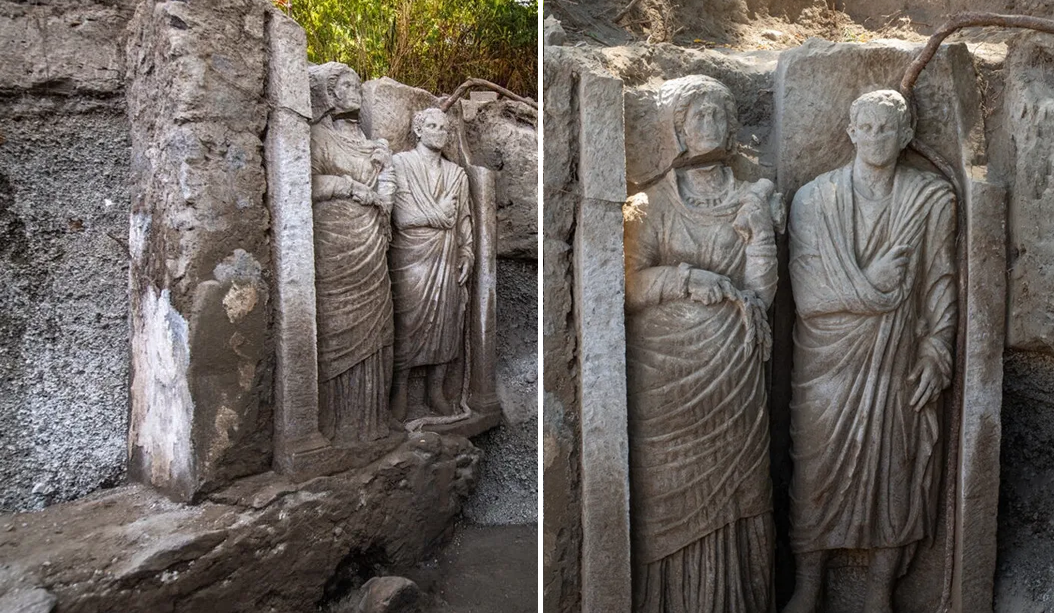
The Ruins of the Ancient City of Pompeii Continue to Reveal Treasures of the Past. Archaeologists Discovered Two Statues of Nearly 2,000 Years Carved Directly into the Wall of a Tomb.
Two almost life-size statues were found in a tomb in Pompeii, a Roman city buried by the eruption of Mount Vesuvius in 79 A.D., nearly 2,000 years ago.
The discovery was made by archaeologists in the cemetery near the Porta Sarno, one of the gates of the ancient city. The figures carved into the wall of the tomb impress with their wealth of detail and preservation.
Discovery of the Rare Statues in the Necropolis
The tomb is part of a necropolis with cremation burials. At the site, researchers found niches that held urns.
-
Untouched for 2,200 years, the tomb of China’s first emperor hides up to 100 tons of mercury, lethal traps designed to kill invaders, and a mystery so dangerous that archaeology still refuses to uncover it.

-
With 220 meters, 721 feet, and 25 thousand gross tons, the world’s largest sailing cruise ship sets a record before its debut and promises to reinvent luxury at sea with giant sails and futuristic engineering.

-
A Brazilian city is being invaded by the sea, buildings are leaning, and the solution could cost R$ 200 million with support from BNDES to prevent flooding, modernize drainage, and protect more than 200,000 residents within 5 years.

-
Lula’s government puts R$ 1 billion on the table to revitalize watersheds with 60 projects, including the São Francisco and Parnaíba rivers, sanitation, navigation, urban drainage, pollution control, and actions in strategic areas of Furnas.

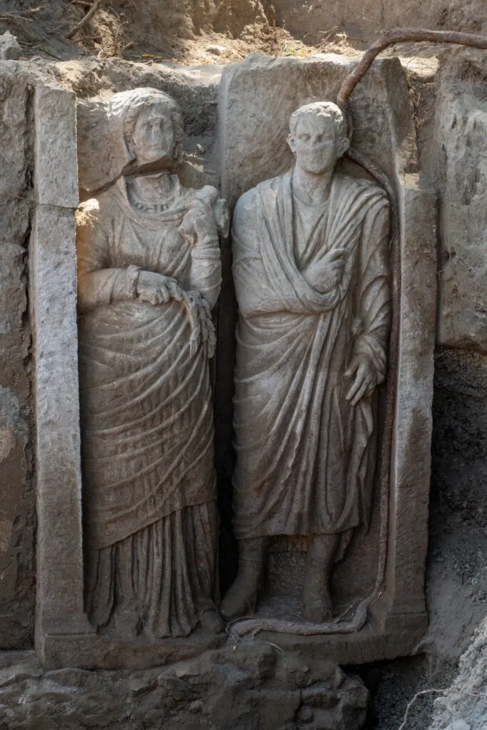
Among them, emerged the relief carved with two human figures: a man and a woman, side by side. The sculptures appear to form a funerary portrait of the couple who may have been buried there.
Although they seem to be a couple, experts say it is not possible to say for sure. There are no inscriptions identifying the characters. “This could be her husband, but it could also be her son,” explained Gabriel Zuchtriegel, director of the Archaeological Park of Pompeii, to the newspaper The Guardian.
Archaeological Park of Pompeii
Style and Epoch of the Sculptures
Researchers believe the reliefs were made between the 2nd and 1st centuries B.C., during the late Roman republican period.
This type of tomb with sculptures carved directly into the wall is rare in southern Italy, which makes the discovery even more valuable.
The male figure wears a simple toga, typical of the time. The woman appears in sophisticated clothing and accessories.
She wears a tunic covered by a mantle, as well as intricately carved jewelry: amphora-shaped earrings, a necklace with a lunula pendant, a ring, and bracelets. These elements suggest that she belonged to the local elite.
Archaeological Park of Pompeii
Indications of a Priestess
The crescent moon-shaped pendant, known as a lunula, was worn by Roman girls until marriage as a symbol of protection.
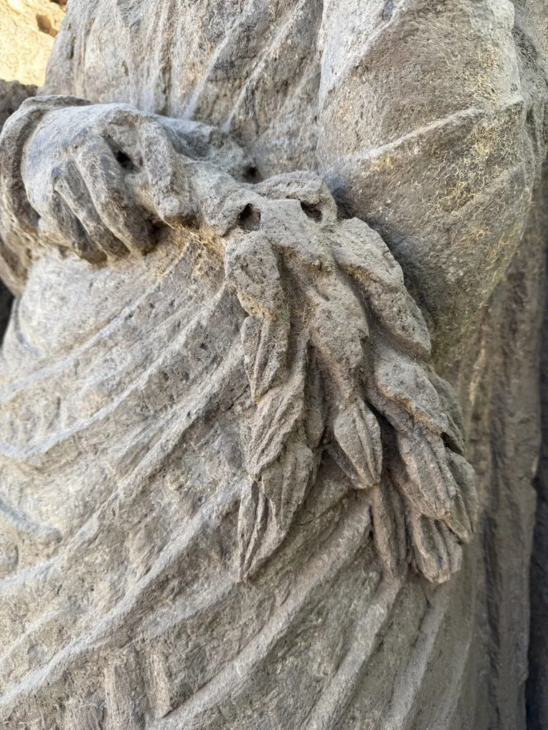
The female statue holds laurel leaves in one hand and a cylindrical object, possibly a scroll, in the other.
These details led archaeologists to raise a hypothesis: the woman depicted may have been a priestess of the goddess Ceres.
In Roman religion, Ceres was associated with agriculture, fertility, and motherhood. The use of symbols like laurel and papyrus would indicate her connection with religious rituals.
“She really seems like a very important woman in the local elite.” said Zuchtriegel to the Guardian. For scholars, the presence of these religious objects and the lunula pendant reinforces the possibility that she held prominent religious functions.
The Position of Women in Ancient Rome
In Roman society, most women had limited roles confined to the domestic sphere. Being a priestess was one of the few ways to achieve social prestige. Therefore, the statue provides a rare and valuable portrait of a woman with a significant religious role.
According to British archaeologist Sophie Hay, who has worked on excavations in Pompeii, priestesses participated in rituals at temples and led processions.
Ceres was a widely revered goddess linked to the cycle of life and harvest. Therefore, having a dedicated priestess for her was symbolic for the community.
The Finding Will Be Exhibited to the Public
In addition to its artistic and historical value, the discovery provides new clues about religious life in Pompeii before the tragedy.
Scholars state that the reliefs indicate that the worship of Ceres was part of the city’s official religion, with confirmed presence of a priestess.
Later this month, the sculptures will be displayed in a new exhibition at the archaeological park called “Being a Woman in Ancient Pompeii.” During the exhibition, visitors will be able to follow the restoration work of the figures, which will be cleaned and preserved by specialists.
This rare discovery sheds new light on the role of women in ancient Rome—and shows that, even buried for nearly two thousand years, Pompeii still has many stories to tell.







-

Uma pessoa reagiu a isso.