





 Portuguese
  English
  Spanish
  5 min of reading
  4 comments


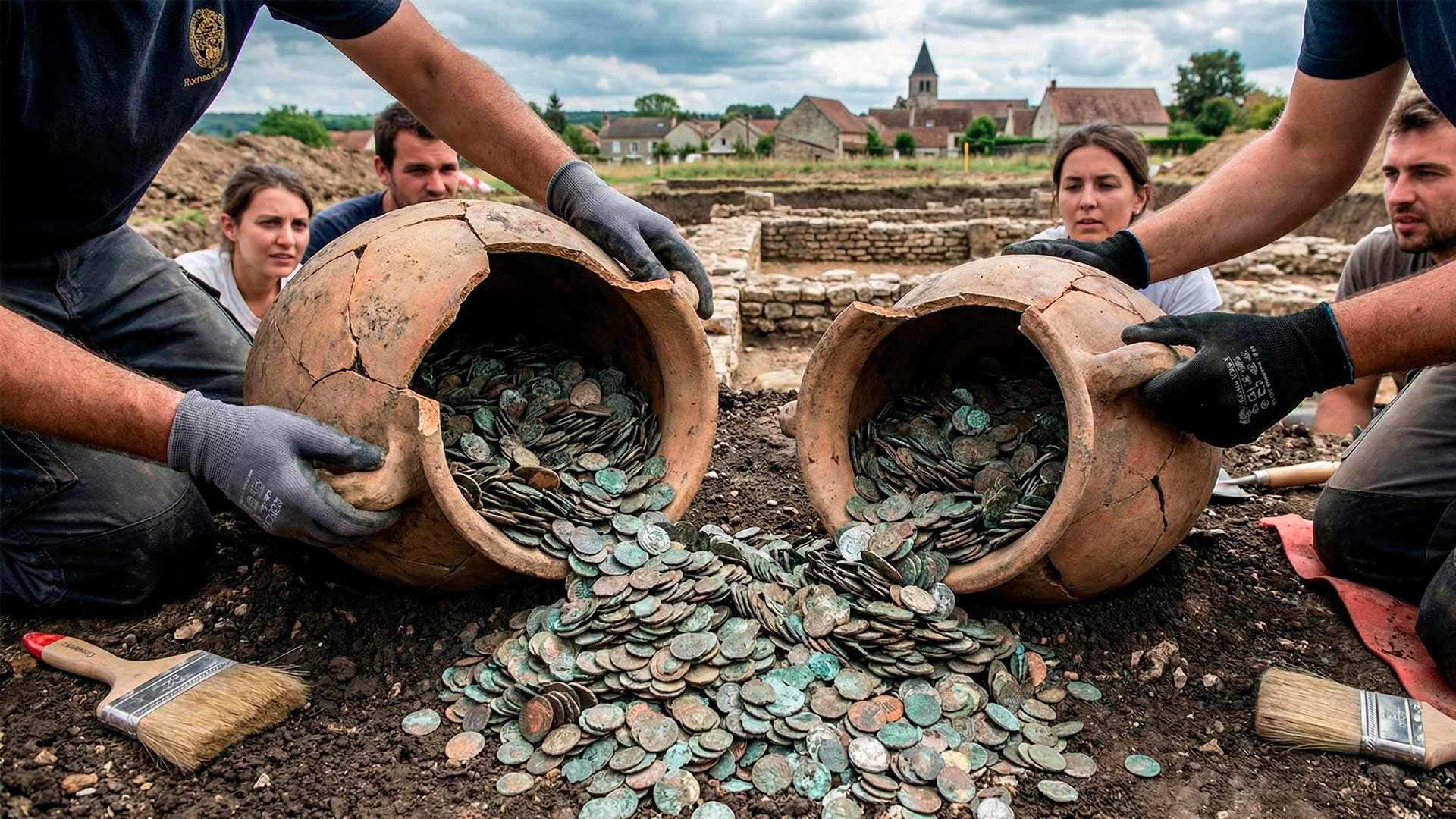


Discovery In A Village In Northeast France Exposes Three Jars 1,800 Years Old Filled With Roman Coins. Find Reinforces The Idea Of A Sophisticated Savings System Among Romanized Gauls And Helps Reconstruct Everyday Economic Life On The Border Of The Ancient Roman Empire.
The French archaeologists have just revealed a find that seems straight out of a movie, but it is pure history. Three ceramic jars buried about 1,800 years ago, beneath the floor of a house, were found filled with Roman coins in the village of Senon, in northeast France.
The pieces were so compacted that specialists compared the containers to true “Roman piggy banks”, used to store savings over many years. Initial estimates indicate that the total may exceed 40,000 coins, a volume rarely documented in domestic contexts.
The excavation was conducted by the French National Institute for Preventive Archaeological Research (Inrap), a public body responsible for investigating archaeological sites before infrastructure works. According to Inrap, the treasure was found in a Roman residential area, in communal use environments, reinforcing the hypothesis of a daily use of the amphorae, rather than an emergency hideout.
-
Heading to Brazil in a Bonanza F33 single-engine aircraft: a couple departs from Florida on a visual flight, makes technical stops in the Caribbean to refuel and organize paperwork, and begins the staged crossing until they reach the country.

-
Unknown Brazilian rewrites one of the pillars of physics and gains global prominence: discovery made in Rio becomes central theme of the 2027 Nobel Prize.

-
Brazilian city neighboring Paraguay becomes a ‘magnet’ for people seeking quality of life and high standards with exceptional growth and commutes of up to 15 minutes.

-
A rare storm transformed part of the Gulf into an unlikely scene of hail, extreme rain, and tornado risk in the middle of the desert, with volumes that exceeded the annual average in a single day.


The discovery, reported between late November and early December 2025 by outlets such as Live Science and GreekReporter, is already considered a key piece for understanding the economy and the circulation of money in a region that was, above all, Gallic territory.
Jars 1,800 Years Old And More Than 40 Thousand Roman Coins In Senon

The three amphorae were found carefully fitted in rectangular pits under the floor of a Roman-era house in Senon, in the Meuse department. According to Inrap, the dating of the coins indicates that the deposits were made between approximately 280 and 310 A.D., already at the end of the 3rd century and the beginning of the 4th century.
These storage jars, common in the Greco-Roman world, were usually used to transport wine, olive oil, and other products. In this case, however, they acted as densely filled monetary deposits, with layers of coins stacked up to the neck, which requires specific excavation and conservation techniques to study the set without falling apart.
According to numismatist Vincent Geneviève from Inrap, the first jar contained about 38 kilograms of coins, around 23,000 to 24,000 pieces.
The second, weighing approximately 50 kilograms, is expected to hold between 18,000 and 19,000 coins, based on the initial sampling done at the broken neck. The third jar, it seems, was removed during Antiquity, leaving only three coins in the original hole.
The coins largely represent the period of the so-called Gallic Empire, a “parallel state” that separated from Rome between 260 and 274 A.D. and minted its own issues. Among the identified portraits are those of Victorinus, Tetricus I, and Tetricus II, rulers of this regional political structure, which helps to fix the chronology of savings in the midst of imperial instability.
Gauls, Romanization, And The Ancient Settlement In The Village Of Senon
Long before the amphorae filled with coins, the area of Senon was already occupied by Gallic populations, part of the broad Celtic world that extended over much of Western Europe. Recent excavations have revealed a dense network of pits, trenches, and post holes associated with wooden constructions and wattle walls, indicating a compact settlement that dates back at least to the 2nd century B.C.
According to a report by GreekReporter based on data from Inrap, this Gallic occupation would extend from the late La Tène phase to the turn of the era, when the process of Romanization intensified. With the arrival of Roman administration, the village began to urbanize, replacing wood and earth with stone.
About ten limestone quarries have been identified in the backyards of the houses, some nearly three meters deep, evidence of intense exploitation to build paved streets, walls, cellars, underfloor heating systems, and even public baths.
Giant Piggy Banks: What The Treasure Reveals About The Gaulish Monetary System
Unlike the classic image of the “treasure hidden in haste” during wars or invasions, specialists believe that the jars of Senon tell another story. According to a note from Inrap, reinforced by the analysis published in Live Science, all indications suggest that this is a planned monetary management system, with deposits and withdrawals made over several years by families or local administrations.
The amphorae were installed in well-constructed pits within a living room, with the neck aligned to floor level, allowing direct access to the coins in daily life. In two of the cases, some pieces were found adhered to the external edge of the jars, indicating that they were deposited after the container was already buried, in a continuous use of the “safe” even after its burial.
This usage pattern, associated with the location in common areas of the house, dismisses the interpretation of an emergency hideout made in moments of panic. Instead, it suggests a behavior of long-term saving, where capital is accumulated gradually, perhaps to protect wealth from devaluation, political crises, or even impulsive spending.
Another important fact is that Senon and its region already totaled about 30 known monetary deposits before this discovery. This new find, therefore, is not an isolated case but reinforces a broader picture of intense coin circulation and systematic monetary storage amid the transition between autonomous Gaul and Romanized Gaul.
The outcome of this economic story, however, was tragic for the ancient owners. Stratigraphic studies indicate that the Roman neighborhood went through at least two major fires in the early 4th century. After the last fire, the settlement was abandoned, and the jars remained buried, forgotten for nearly two millennia, until they were recovered during preventive excavations.
Do you believe that treasures of this type should always be state property, or that discoverers should have the right to a part of the value? Leave your comment.








Acredito que sim, o proprietário do terreno deveria ficar com pelo menos 30%
Acho que os descobridores devem sim ter parte deste achado, a final como fica o reconhecimento, minha opinião.
Que a
Chouriça é dedevria ser o dono