





 Portuguese
  English
  Spanish
  4 min of reading
  0 comments


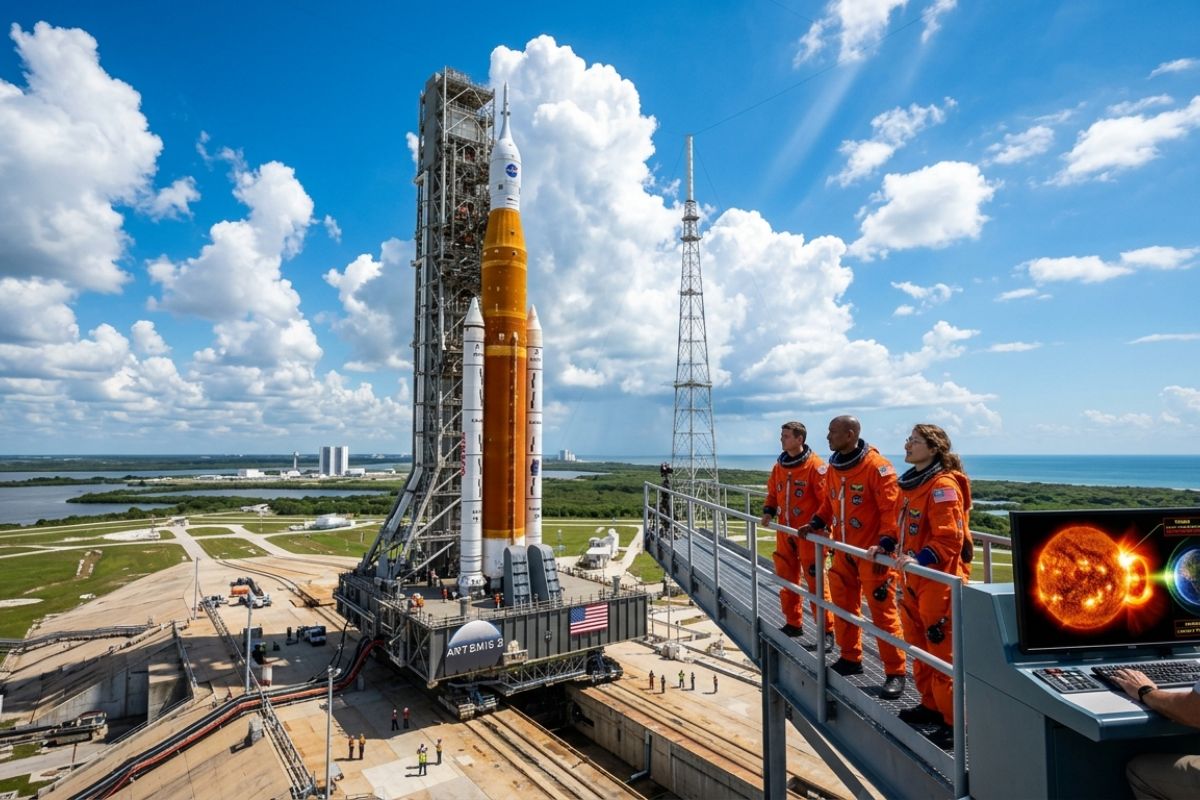
Artemis 2 astronauts head to the Moon in the Orion capsule, while NASA monitors class X solar eruption and warns of possible interferences
The astronauts of the Artemis 2 mission may take humanity back to lunar orbit for the first time in over half a century. If all goes as planned, the launch is scheduled for April 1 at 7:24 PM Brasília time, with a journey of about 10 days around Earth’s natural satellite.
At the same time, a space alert has come into play: a class X solar eruption and a coronal mass ejection could impact communications and interfere with critical flight stages. NASA has not announced any changes, but the situation requires attention as the coming hours coincide with the approach of this material toward our planet.
Artemis 2 takes four astronauts on a historic flight around the Moon

The Artemis 2 mission will be launched by the Space Launch System rocket, the SLS, with four astronauts on board.
-
The largest deposit of Vale was discovered by accident and today represents almost all the ore produced by the company.

-
The Brazilian Army takes F-5 fighters out of the garage and stars in an air combat with support from the KC-390.

-
In just 3 years, OMODA 5 surpasses 400,000 units and reaches a milestone that takes most cars a decade to achieve.

-
Without cement, without steel, and using only earth and recycled cardboard, engineers have created a construction system that drastically reduces carbon emissions and could change the way houses are built around the world.

Even without landing, the flyby represents a significant advancement in lunar exploration, as it tests systems and validates the human and technological infrastructure necessary for the next phases.
The flight also marks a symbolic return: it will be the first crewed mission of the Artemis program and the first flight with humans beyond low Earth orbit since Apollo 17 in 1972.
The crew will fly in the Orion capsule, propelled by the SLS, on a journey planned to last about 10 days.
Who are the astronauts of the mission and what is the goal of the flight
Artemis 2 includes astronauts Reed Wiseman, Víctor Glover, and Christina Koch from NASA, along with Jeremy Hansen from the Canadian Space Agency.
The goal is to fly by the Moon, test systems in a real environment, and ensure that the program’s structure is ready for more complex stages.
This type of mission serves as a general rehearsal on an unprecedented scale for the new lunar era. Each stage validates procedures, communication, navigation, and crew routines, reducing uncertainties before an attempt to return to the surface.
Alternative windows if the launch does not occur on April 1
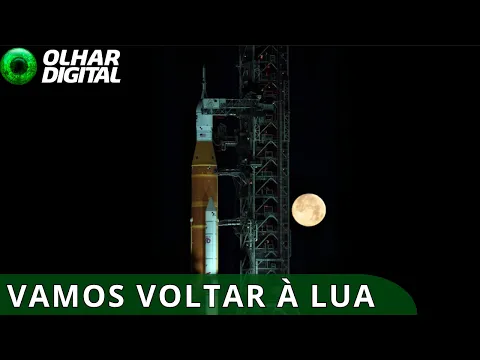

If the launch does not happen on Wednesday for any reason, new opportunities are scheduled for April 2, 3, and 6. After that, another window opens at the end of the month.
This flexibility is common in space missions, especially when involving astronauts, as weather, systems, and safety conditions need to align to avoid unnecessary risks.
Program schedule changes and pushes astronaut landing to 2028
The schedule for the next stages of the Artemis program has been restructured. The Artemis 3 mission, which was originally set to mark humanity’s historic return to the lunar surface, has been redesigned and will now serve as a complex training flight in Earth orbit, scheduled for 2027.
With this restructuring, the long-awaited landing of astronauts on the Moon has been moved to the Artemis 4 mission, planned for early 2028.
In the same year, the agency plans to launch Artemis 5, which is expected to conduct the second descent to the lunar surface of this new phase.
Class X solar eruption and coronal ejection may interfere with the launch
During the launch period, Earth may face the effects of a solar eruption of the most powerful type, classified as class X.
The phenomenon originated from sunspot 4405, an active region that has been growing on the Sun’s surface and has caught scientists’ attention.
The event was recorded by NASA’s Solar Dynamics Observatory, which monitored the explosion for several hours.
The eruption released extreme ultraviolet radiation, capable of ionizing upper layers of Earth’s atmosphere, which can affect signals and communications in certain scenarios.
Radio failures have occurred and the critical period coincides with the mission
Minutes after the event, there were radio communication failures in parts of Southeast Asia and Australia, with signal loss on frequencies primarily used in shortwave.
Additionally, the explosion launched a coronal mass ejection into space, a jet of solar material made up of plasma and charged particles.
Part of this material is heading toward Earth and is expected to reach the planet between Tuesday and Wednesday, a period close to the launch of the Artemis 2 mission.
Concern is growing because sunspot 4405 is rotating toward our planet, increasing the chance of new eruptions in the coming days.
What could happen to communications and space operations
Experts warn that solar flares could affect essential communications. This means there may be interferences during the launch of the lunar mission and in the initial maneuvers in orbit.
For now, NASA has not announced any changes to the plans. If Earth is grazed, another expected phenomenon is auroras at lower latitudes than usual.
Still, it is necessary to monitor developments to understand the real intensity of the effects and whether there will be a direct impact on operations with the astronauts.
In your opinion, should NASA proceed with the launch with the astronauts at the scheduled time or delay for precaution given the risk of solar interference?








Seja o primeiro a reagir!