





 Portuguese
  English
  Spanish
  6 min of reading
  0 comments


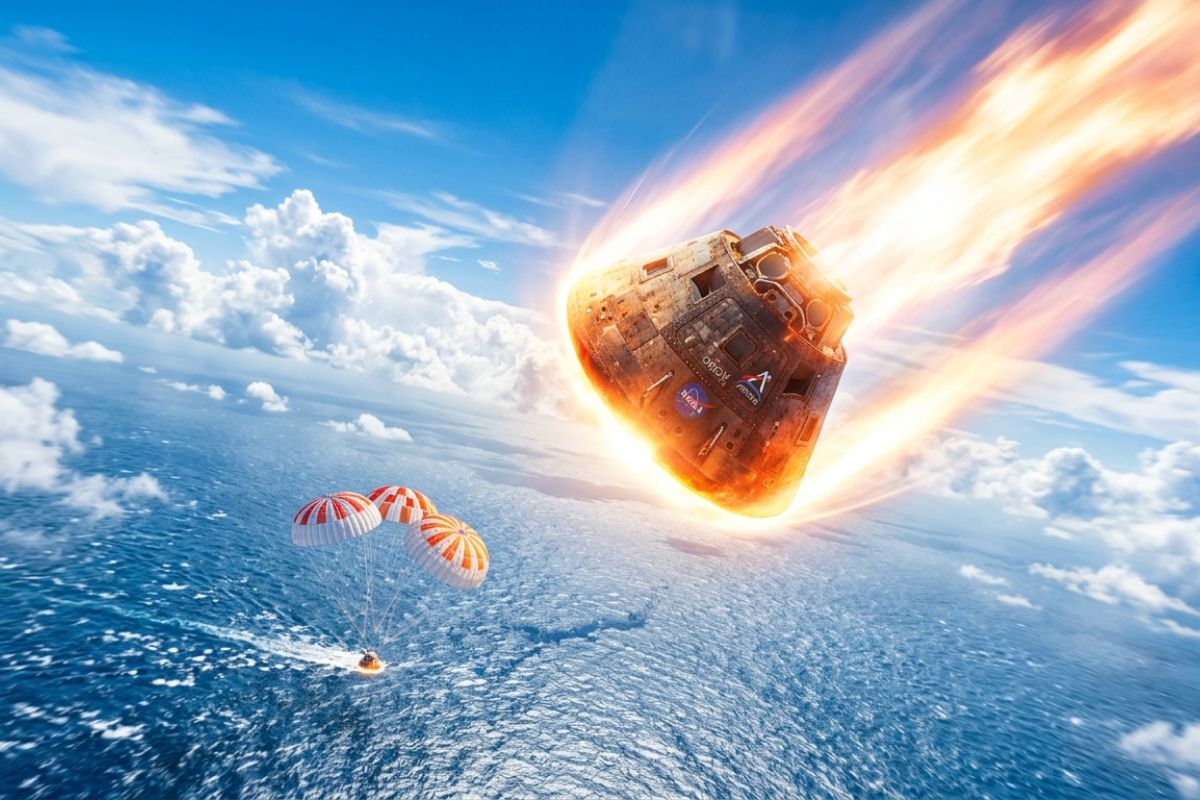
With the thermal shield at the base, the Orion capsule needs to hit a narrow reentry corridor, traverse plasma and communication blackout, open parachutes in sequence, and land safely in the ocean
The return of Artemis 2 to Earth is the most tense part of the mission, and the thermal shield makes the difference between a controlled return and an off-plan scenario. After traveling through space and orbiting the Moon, the Orion capsule faces minutes that concentrate years of engineering, testing, and calculations.
At this stage, nothing is “just descending.” The Orion arrives from deep space at extremely high speed, enters the atmosphere at the right point, at the right angle, and in the right alignment. Any deviation changes everything because reentry happens within extremely precise limits until it touches the ocean.
The return begins with extreme speed and zero comfortable margin

When Orion begins the return, it does not gradually reduce speed like an airplane. It crosses the atmosphere above 30,000 km/h, and this completely changes how the arrival works.
-
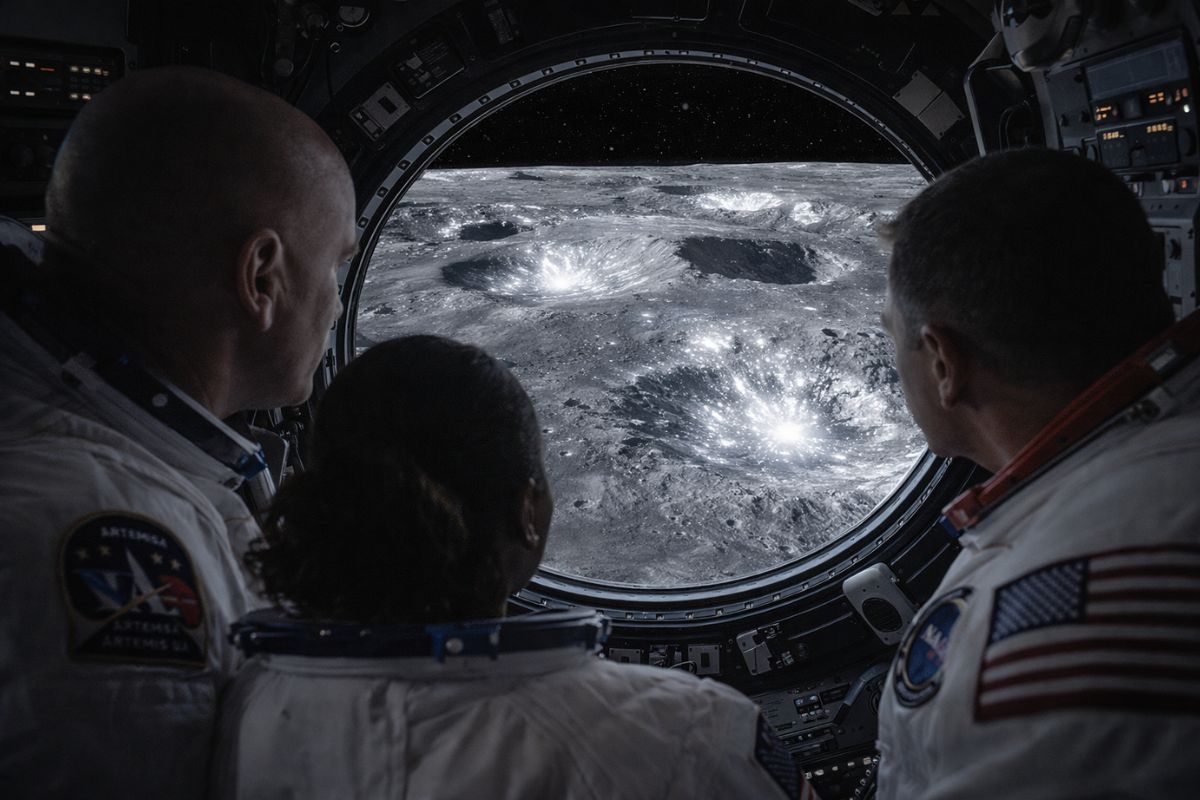
Astronauts from Artemis 2 flew over the side of the Moon that is never visible from Earth and found mysterious formations with such intense brightness that they appeared to be covered in snow.
-
Commercial satellites captured images in the Taklamakan Desert of giant replicas of US aircraft carriers and destroyers, with tracks and precise impact craters, deliberately exposed to demonstrate power and change the global naval game.

-
Motorola launches Moto G Stylus 2026 with a 5,200 mAh battery and 120 Hz OLED display; check out the price, technical specifications, and news.

-
A new technology in China looks like a giant tower, but it is used to store energy and provides 4 hours of electricity.
In such a scenario, every detail matters, from the position of the capsule in space to how it presents itself to the atmosphere.
That’s why the mission treats this segment as a timed sequence. For those watching, it seems fast. For the spacecraft, it is the most demanding part of the entire journey.
Reentry corridor: the invisible strip where everything can go right or wrong
The first major challenge lies in the reentry corridor, an invisible and extremely narrow strip through which the capsule must pass to decelerate correctly.
If the entry is too steep, the heating increases too much, and the forces on the structure rise rapidly.
If the entry is too shallow, the capsule may touch higher layers of the atmosphere and “bounce,” escaping back into space.
The comparison is clear: like a stone hitting water at the wrong angle. However, in the Orion, this happens on a much larger scale and with much more violent energy. That’s why reentry starts with precision, even before any impressive images appear.
Why the thermal shield is at the base and cannot fail
Before encountering the denser air, the capsule needs to be properly aligned so that the base faces the most intense part of reentry.
It is at this base that the thermal shield is located, and this detail is essential because the Orion was designed to return this way.
The shape of the capsule helps control the descent and better distribute the forces during the passage through the atmosphere.
When the spacecraft presents itself correctly, it uses its own geometry as part of the protection. From there, physics takes over.
2,700°C, air compression, and the phase where the atmosphere becomes an enemy
When the Orion encounters the first layers of the atmosphere, the air in front of it cannot move normally. The capsule is too fast.
This air is violently compressed, and the compression causes the temperature to rise extremely. This generates the brutal heat of reentry.
On the outside, the temperature can exceed 2,700°C, a level capable of destroying most common materials. And the most impressive part is that this happens while the capsule is still moving at extremely high speed. The Orion needs to use the atmosphere to slow down, but this same atmosphere becomes the most aggressive part of the return.
Plasma and communication blackout: the planned silence segment


As the heating increases, the air around the capsule transforms into plasma, a superheated and electrically charged gas that envelops the spacecraft and creates the intense glow of reentry. This “fireball” is the striking image, but plasma affects something even more sensitive: communications.
For a few minutes, radio signals cannot penetrate this layer. This is when the communication blackout occurs. The transmission disappears, the voice does not arrive, and the data stops appearing normally.
This silence is already part of the planning but remains one of the most delicate segments because the capsule continues to traverse the harshest phase without contact with Earth.
Autonomous navigation and onboard systems take control
During the blackout, the onboard systems guide the spacecraft on their own. Sensors track the trajectory, monitor the orientation, and keep the descent within the calculated profile.
The computers continue to work non-stop, executing what was programmed long before the launch.
It is at this moment that trust shifts to the onboard technology. The Orion traverses the critical part relying on autonomous navigation, sensors, and the precision of systems thoroughly tested before the flight.
Ablation: how the thermal shield “consumes” itself to save the capsule
At the center of all protection is the thermal shield. Without it, the capsule would not withstand. And the most interesting point is that this shield was not designed to come out intact. It was created to wear away in the right way.
As the heat increases, the outer layer of the material begins to consume itself in a controlled manner. This wear absorbs energy and prevents the extreme temperature from advancing inward. While the outside sacrifices itself, the cabin remains protected. This process is called ablation.
In practice, the thermal shield works because it loses material at the planned rate. Instead of trying to stay whole in an absurd environment, it uses its own wear as defense.
It is an elegant and extremely efficient solution, but it requires total precision because any difference changes how heat is distributed through the structure.
Layered parachutes: the sequence that transforms speed into landing

As the capsule traverses the most aggressive stages, it also begins to lose speed. After the hottest phase comes another decisive part: the opening of the parachutes.
The sequence is carefully calculated. First, smaller parachutes deploy, stabilizing the capsule and controlling oscillations.
Then the main parachutes, much larger, appear, responsible for reducing the final speed to a safe level. Nothing happens all at once because the deceleration needs to be gradual to prepare for the next phase.
Landing in the ocean and recovery: the mission only ends with the rescue
When the extreme brightness is left behind and the blackout ends, the Orion descends under the parachutes and approaches the pre-selected area.
The landing occurs in the sea, and this moment also follows the plan: after impact with the water, the capsule is stabilized, teams approach, and the recovery phase begins.
Ships, helicopters, divers, and specialists await the arrival. The condition of the spacecraft is checked, the crew is attended to, and the rescue procedures are initiated. The mission only truly ends when the capsule is secure and the astronauts have been successfully retrieved.
In the end, that’s what makes the return of Artemis 2 so important: in just a few minutes, the Orion needs to hit the reentry corridor, traverse plasma, deal with blackout, trust the thermal shield, open parachutes in the right order, and land safely in the ocean.
Did you imagine that the most delicate point of Artemis 2 was precisely on the return to Earth?








Seja o primeiro a reagir!