






 Portuguese
  Spanish


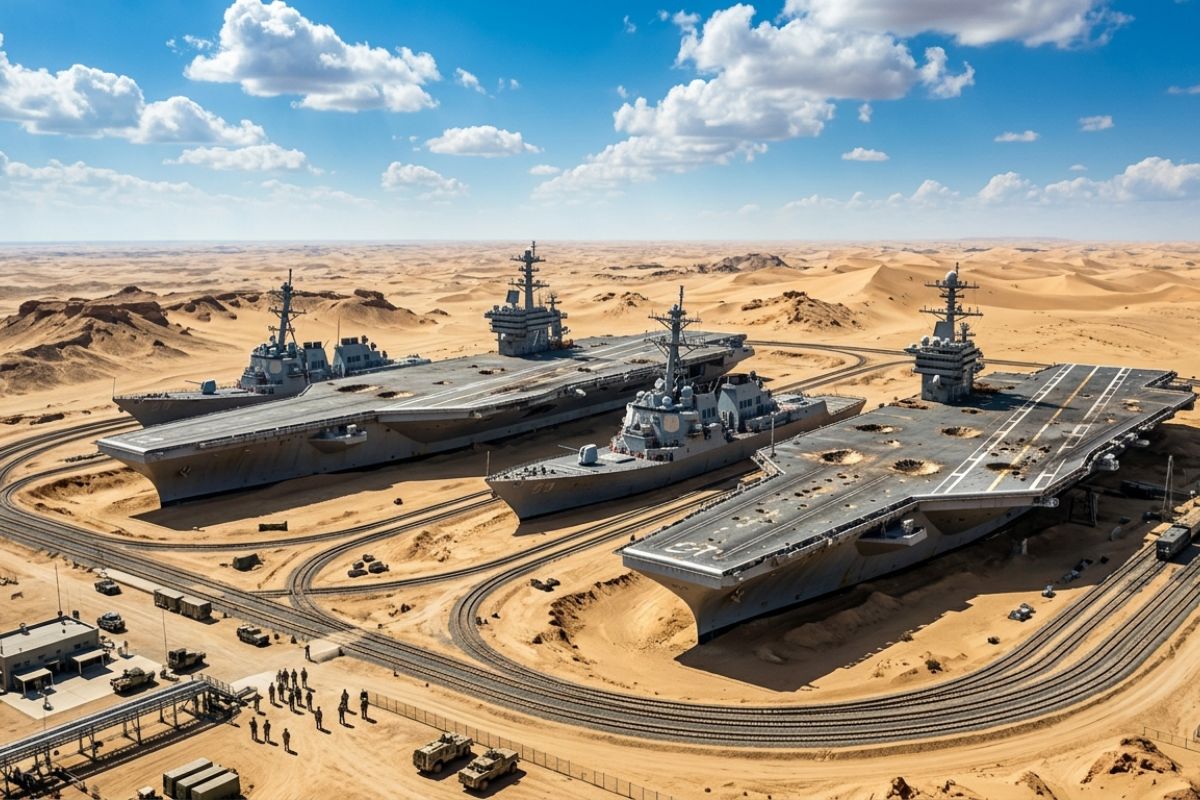

In the Taklamakan desert, commercial satellites record life-size replica of aircraft carrier and indicate tests with craters and tracks linked to the DF21D missile.
In the middle of the driest desert in northwest China, constructions have emerged that have caught global attention: giant replicas of American warships erected in the midst of a sea of sand. What is impressive is that they are not simple models. Some structures exceed 300 meters and replicate a modern aircraft carrier at full scale, with details that can even be seen in images taken by commercial satellites.
The most intriguing detail is that nothing seems to have been hidden. On the contrary, the structures have been left exposed, as if they were made to be seen. And each new satellite image reveals elements that directly affect the balance of naval power, especially when the central target is an aircraft carrier.
A life-size aircraft carrier visible from space

The works began in 2020 and continue to be expanded. The chosen setting was the Taklamakan desert, described as the second largest pure sand desert in the world, with extreme isolation, temperatures ranging from very cold in winter to intense heat in summer, and storms capable of burying vehicles in a matter of hours.
-
California Student Develops AI-Powered System to Detect Elderly Falls at Home, Even in the Dark, Earning Title of America’s Top Young Scientist

-
Workers Discover Ancient Sanctuary with Temples and Roman-Era Inscriptions While Clearing Bomb Debris for Highway Construction

-
Scientists Discover Over 600 Meteorite Glass Fragments in Northern Brazil, Evidence of a 6.3-Million-Year-Old Cosmic Impact with Unfound Crater

-
Philosophy Student Invents Self-Moving Wheelchair Controlled by Body Weight Using Pressure Sensors


In this environment, the first identified replica was of a Gerald Ford class aircraft carrier, described as the most advanced in the American fleet.
The structure mimics the real ship with command tower in the correct position, angled runway at the same angle, and even elevators that transport aircraft from the hangar to the deck. The idea does not give off the feeling of a generic set, but rather a reproduction planned for testing.
The destroyer that protects aircraft carriers also entered the target

Several kilometers away, another construction representing a destroyer of the Arleigh Burke class emerged, about 155 meters long, described as part of the group that accompanies and protects an aircraft carrier from attacks.
These are not random targets: the set faithfully represents a typical battle group used by the United States in naval operations.
This raises the central question of the case itself: why reproduce exactly these ships and with this level of fidelity?
Sensors, reflectors, and craters where it hurts most
On the replicas, hundreds of metal posts have been positioned, some over 20 meters tall. They appear as sensors to record the point of impact and also as radar reflectors, designed to replicate the behavior of a real steel ship.
And there is one signal that weighs even more: craters recorded in vulnerable points. The marks are described as impacts of extremely high precision, hitting areas of just a few meters in strategic locations, such as command tower and aircraft elevators.
The reading is straightforward: this is not random training, but a meticulous study of where an aircraft carrier suffers the most operational damage.
Tracks in the desert and an aircraft carrier that moves

One of the most unusual elements is the presence of railway tracks in the desert. About 8 km of tracks with tight curves have been mentioned, and images show that part of a replica of an aircraft carrier has been mounted on a mobile platform, recorded in different positions, indicating that it is not fixed.
The proposal is to simulate maneuvers that a ship would perform in the ocean, accelerating and changing direction to try to escape.
The platform is said to have reached about 55 km/h, described as a speed sufficient to create more realistic pursuit scenarios, with missiles fired at moving replicas.
The focus of the training: the DF21D, nicknamed the aircraft carrier killer
The set of tests is linked to the development of the anti-ship ballistic missile DF21D, nicknamed aircraft carrier killer.
The missile is described as nearly 11 meters long, about 15 tons, and launched from trucks hundreds of kilometers from the coast, with a range cited as exceeding 100 km.
The highlighted differential lies not only in the range or destructive power but in the final phase: the DF21D would release a maneuverable warhead that, at hypersonic speed, adjusts its course and pursues the moving target.
Hitting a ship of about 300 meters in motion from 1,000 km is treated as a technological feat, and the craters on the replicas are pointed out as evidence of impressive results.
Why this changes the calculation of power at sea
American aircraft carriers are described as the ultimate symbols of military power, with billion-dollar costs, dozens of aircraft, and a function as a floating base for operations in any ocean.
The strategic impact appears in the suggested scenario: if an aircraft carrier cannot approach the Chinese coasts without a real risk of destruction, its operational value decreases. And if it needs to stay at great distances, the range of the onboard aircraft becomes a limitation.
It is in this context that two regions appear as points of maximum tension: the South China Sea and the Taiwan Strait.
South China Sea, Taiwan, and the effect of demonstration
The text describes that China has transformed submerged reefs into military bases, with artificial islands, runways, radars, hangars, and defense systems.
One of these islands is cited as a “fixed aircraft carrier” in the ocean. On the other side, the United States responds by sending ships into these waters to assert the international nature of the sea.
Regarding Taiwan, it is described as a territory with its own government and democratic elections, while China insists it is a rebellious province that must return to Beijing’s control by force if necessary.
In 2022, after the visit of an American official, China fired 11 ballistic missiles around Taiwan, four of which crossed the island’s airspace. The distance between the Chinese coast and Taiwan is noted as 160 km, highlighting vulnerability.
The most revealing point, however, is the intention: dissuasion through demonstration. The logic presented is simple: there is no need to fire in real combat if the adversary already knows that the weapon exists and works.
Each satellite image with well-placed craters would send a clear message about the vulnerability of an aircraft carrier in a real scenario.
The final message behind the aircraft carrier in the desert
What happens in the Taklamakan desert is described as more than an exercise. It is the visible face of a silent competition that could define the course of global geopolitics, with replicas being repeatedly targeted before any real confrontation occurs.
And for you: if an aircraft carrier becomes a “trackable and hittable” target at this level of precision, who do you think has the advantage in this naval game, China or the United States?


