





 Portuguese
  English
  Spanish
 4 min of reading
  7 comments


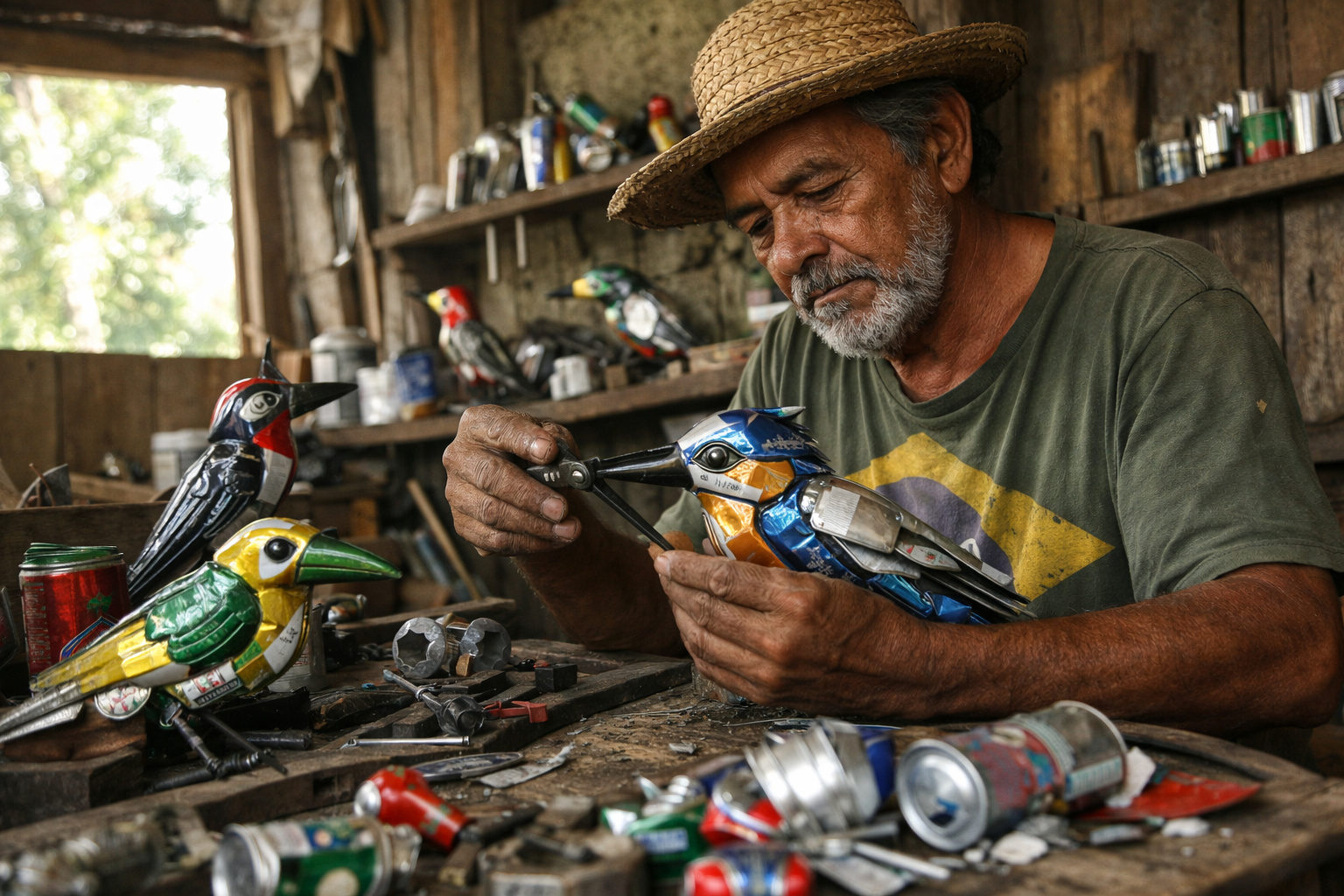


The Story of Joca dos Galos Shows, Above All, How Creativity, Environmental Awareness and Handicraft Can Transform Waste into Art, Income and Cultural Identity in Paraíba
What, for many, represents just worthless trash, on the other hand, for Joaquim Davi da Silva Neto, known as Joca dos Galos, has always meant opportunity. For over 20 years, the Paraiba craftsman has transformed discarded cans from landfills into vibrant, meaningful sculptures. With this, he has built a unique artistic identity. In addition, he has provided for his family and helped reduce environmental impacts.
This information was released in an article authored by Alexandre Nunes, according to a publication dated June 4, 2017. In this context, the text highlights initiatives by Paraiba artisans that demonstrate how waste can turn into art. Thus, Joca dos Galos emerges as one of the most representative examples of this transformation.
Since the year 2000, the craftsman has solely lived off the repurposing of metallic waste. In particular, he uses cans found in landfills or bought directly from collectors. In this way, he shows, in practice, that recycling, art, and dignity can go hand in hand.
-
6 sources of free fertilizer that you are throwing away every day and can transform your garden without spending anything.
-
With a water crisis on the radar, Sabesp invests in reclaimed water for data centers and transforms sewage treatment into a solution that saves millions of liters and protects public supply.

-
Foresea achieves 100% offshore waste reuse in 2025, eliminates landfill disposal, and consolidates sustainable strategy with 1,500 tons recycled.
-
With earth, bamboo, straw, and lime mortar, a specialist builds a house for just over $460 and draws attention for its cost being much lower than traditional construction.

Joca dos Galos: From Landfill to Studio, A Life Dedicated to Transforming Waste into Art
A resident of Bayeux in Paraíba, Joca dos Galos built his path by observing what many discard without reflection. Over time, he began to see the thrown-away cans as a rich raw material full of possibilities. In this way, what once polluted the environment took the form of roosters, peacocks, macaws, parrots, toucans, and other birds.
“I am 52 years old, and I have been working and surviving through handicrafts since 2000. I am married and have two children,” he reports. According to him, the process is entirely manual. First, he collects oil cans, milk cans, and other metallic containers. Then, he cuts each piece. After that, he welds them with hot iron. Finally, he finishes them with acrylic paint to prevent rust.
Moreover, the craftsman explains that he does not use ready-made molds. “I invent the birds from my head and consider handicrafts my life,” he states. In this manner, each piece becomes unique and carries cultural identity. At the same time, the work ensures the family’s livelihood.
Meanwhile, recognition has surpassed the borders of Paraíba. Joca has already sent pieces to Rio de Janeiro, São Paulo, and other regions of the country. In addition, at events like the Paraíba Handicraft Fair, his sculptures are often displayed with the support of the state government. With this, the work gains even more visibility.
Recycling, Income and Environmental Awareness Go Hand in Hand in Paraíba Handicrafts

Joca dos Galos’ journey, therefore, is part of a larger movement to value sustainable handicrafts in Paraíba. According to Lu Maia, manager of the Paraíba Handicraft Program (PAP), many artisans use waste as raw material. Thus, they promote responsible recycling while preserving cultural identity.
According to her, artisans who work with metal use 100% recycled raw material. Thus, they reduce the improper disposal of waste. In addition, they generate income and strengthen the local creative economy.
The numbers, in turn, reinforce the importance of these initiatives. According to IBGE, Brazil produces about 194 thousand tons of waste per day. However, a large part is recyclable. Therefore, specialists explain that everything that can be reused should be called waste. Only what has no possible reuse should be considered trash.
This logic, indeed, appears in electronic waste repurposing projects. A clear example is the Digital Inclusion Support (AID), from the University Center of João Pessoa (Unipê). In this case, the project recovers discarded computers and donates equipment to underprivileged communities. Thus, it promotes digital inclusion and reduces improper disposal.
Environmental Education, Public Policies and the Social Impact of Recycling

In addition to the individual efforts of artisans like Joca, on the other hand, public policies also play a fundamental role. In Paraíba, initiatives aimed at selective collection, inclusion of collectors, and environmental education have been gaining ground. Still, progress occurs in a gradual manner.
Currently, about 2,300 collectors receive support from the State Government. These actions occur through the Executive Secretariat of Food Security and Solidarity Economy (SESAES). In addition, the projects offer training, equipment, and technical assistance. With this, they reach regions such as Sertão, Zona da Mata, Brejo, and Agreste.
At the same time, institutions like Sudema promote workshops and lectures. Among the activities, workshops on repurposing PET bottles and the production of ecological soap with used cooking oil stand out. Furthermore, the Sudema at School project takes environmental education into classrooms.
According to Professor Claudiana Maria da Silva Leal, PhD in Civil Engineering and lecturer at IFPB, recycling reduces the consumption of water and energy. Moreover, it decreases the exploitation of natural resources. Consequently, it prevents pollution and generates income.
At IFPB, for example, the waste undergoes careful sorting. First, wet recyclables go to composting. In this process, carried out in 14 modules of one cubic meter, the material transforms into fertilizer in about four months.
Do you believe that stories like that of Joca dos Galos show that recycling can be both art, income, and social transformation?








Como o ser humano é uma criação extraordinaria!
Onde pode comprar?
Onde comprar peças dele.
Onde comprar.