





 Portuguese
  English
  Spanish
  4 min of reading


Rystad Energy Reveals Surprising Data for the Oil Exploration and Production Market in 2020
The devastating effect of the COVID-19 pandemic on global exploration and production (E&P) oil and gas companies is best understood based on the expected total annual revenues of the sector for 2020. An analysis by Rystad Energy shows that global E&P revenues are now forecasted to fall by about US$ 1 trillion in 2020, a decrease of 40%, to US$ 1.47 trillion, compared to US$ 2.47 trillion last year.
Before the COVID-19 pandemic, Rystad Energy expected total E&P revenue to reach US$ 2.35 trillion in 2020 and US$ 2.52 trillion in 2021. Now, 2021 revenues are also projected to be lower, at US$ 1.79 trillion.
The cash flow of companies is also expected to decline. For 2020, Rystad Energy said it estimates that free cash flow for the E&P sector will fall to US$ 141 billion, or one-third of what it was in 2019. This is based on the base oil price scenario of US$ 34 per barrel in 2020 and US$ 44 per barrel in 2021, and there is considerable risk of further decline if current low prices persist.
-
The next exploration auction in the pre-salt will offer 23 blocks in the Campos and Santos basins and may change the interest of oil companies in Brazil.
-
The next exploration auction in the pre-salt will offer 23 blocks in the Campos and Santos basins and could change the interest of oil companies in Brazil.
-
Red Sea, from biblical site to oil hope: South Korea reveals ambitious plan to create new oil routes through the Red Sea with the dispatch of 5 ships, agreements with 3 countries, and a focus on the strategic port of Yanbu.

-
SISTAC expands contract with Petrobras for maintenance of platforms in the Santos, Campos, and Espírito Santo basins using ROV and specialized underwater operations.
“This drop not only undermines the solidity of companies and reduces the funds available for investments and dividends, but it also significantly decreases the government’s tax revenues. It will be a challenge for petro-states, such as Russia and many countries in the Middle East, to sustain their budgets,” says Rystad Energy upstream analyst Olga Savenkova.
In the short term, national wealth funds may come to rescue and plug gaps in budgets to avoid spending cuts, but if the low-price environment persists, these countries could face serious financial difficulties, Savenkova adds.
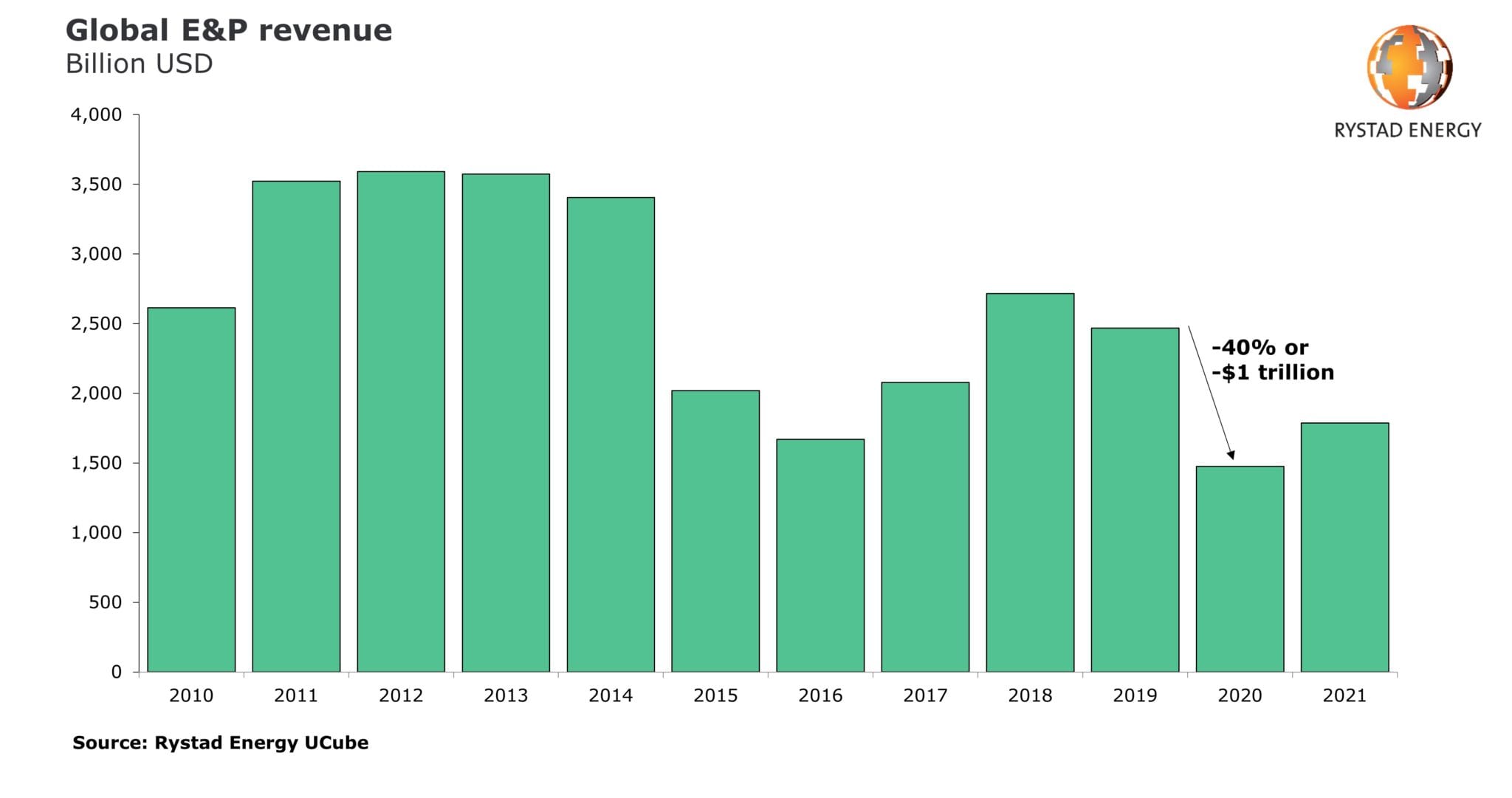
Oil Exploration and Production Profitability Chart up to 2021
Initially, Rystad Energy expected upstream spending to fall by about 20% this year as a result of the COVID-19 pandemic, which would reduce investments by US$ 100 billion compared to 2019 levels. As companies continued to cut spending, it now expects upstream spending to fall 25%, from US$ 530 billion in 2019 to US$ 410 billion this year.
U.S. shale continues to be the largest contributor to reported plans to reduce 38% of their previously announced capital budgets for 2020, implying a nearly 42% cut compared to 2019 spending. These record numbers are followed by oil sands producers, who also revised spending down by 42%. Conventional supply segments show cuts ranging from 19% for onshore to 12% for deepwater offshore assets, as these segments are not as flexible when it comes to managing their capital costs.
Rystad Energy said that cuts in CAPEX will have a particularly strong impact on discoveries and on companies’ ability to proceed with final investment decisions (FIDs) on new projects. This year may be marked by the lowest project sanctioning activity since the 1950s in terms of total sanctioned investments, dropping to US$ 110 billion, or less than a quarter of the 2019 level, with most projects being delayed.
An operator may need several years to bring a deferred project back on track, as more stringent economic requirements are applied for a new FID. Facing the threat of prolonged oil prices, stakeholders are likely to reduce the required break-even price of projects, which was already averaging below US$ 35 per barrel even before the crisis. This will send many developments on a lengthy journey of cost optimization.
However, in contrast to the previous crisis, Rystad Energy said that this time the situation is complicated by the distressed position of many service companies. The oilfield services sector has already made substantial improvements in the supply chain, with significant cost reductions in 2015–2016, and operators cannot rely on repeating that performance for a second time.
Now, operators are demonstrating extreme caution when it comes to future investment commitments, resulting in a decline in sanctions as projects are restructured and paused until oil prices recover. Given the high maturity of most oil-producing regions, this approach to dealing with the crisis jeopardizes large volumes of unauthorized production, potentially harming liquid production levels in the medium term.
Rystad Energy also noted that it sees a growing sentiment for decarbonization among E&P players and investment banks, with key players aiming for carbon neutrality. As a result, the current low appetite for new project sanctions may mean that the “peak oil” will arrive sooner than previously thought just a few months ago.







Seja o primeiro a reagir!