





 Portuguese
  English
  Spanish
  4 min of reading
  0 comments


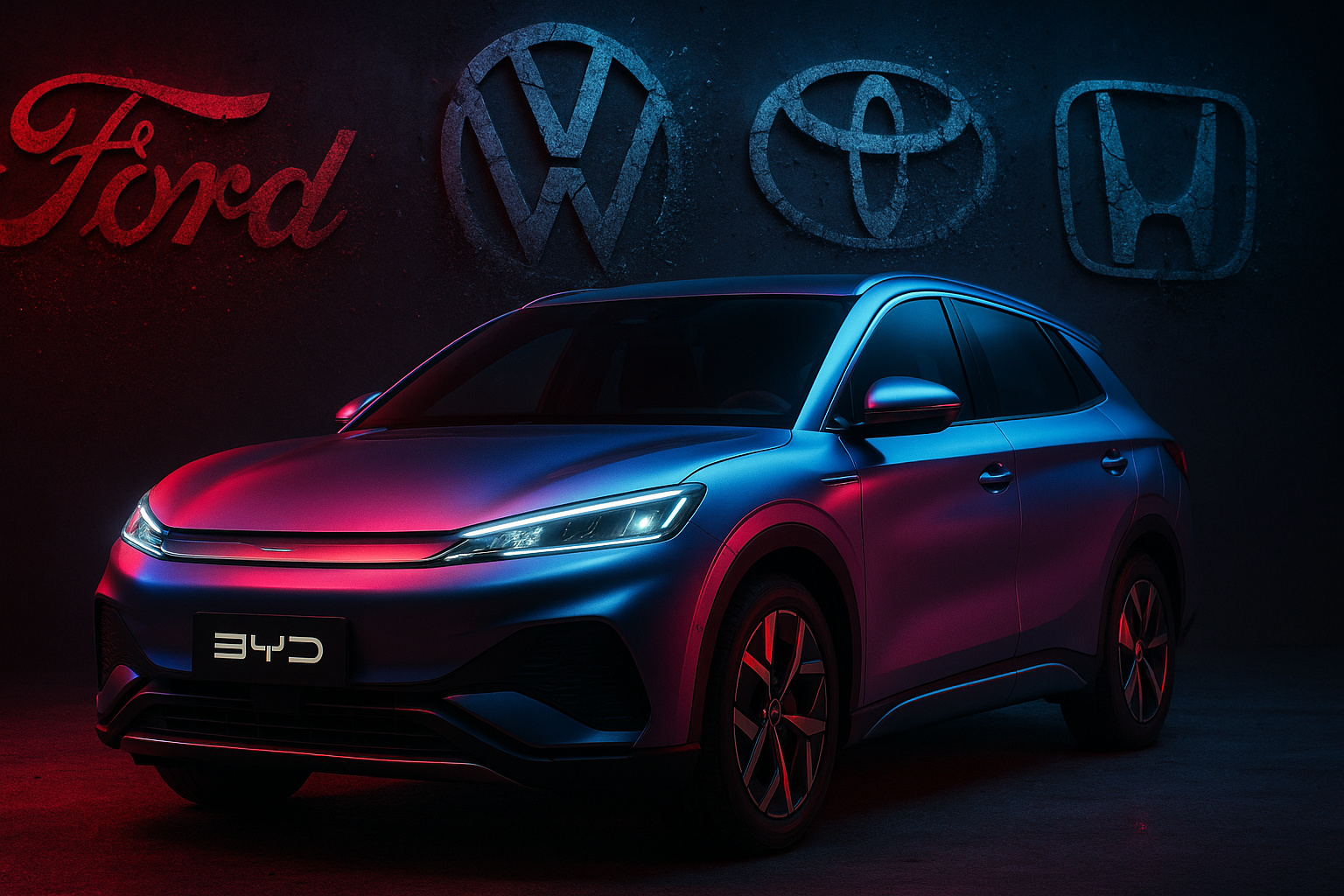
Chinese Giant Predicts Brutal Consolidation in the Electric Sector; Analysts Project That Only 15 Brands Will Survive Until 2030 Amid Price Wars and Oversupply.
The automotive sector is experiencing a historic turning point. Stella Li, vice president of BYD, the world’s largest electric vehicle manufacturer, stated that up to 100 automakers could disappear in the coming years, victims of price wars and oversupply primarily affecting the Chinese market.
This estimate was made in recent interviews and is already shared by international consultancies. For them, the frantic race for dominance in electric mobility has resulted in a scenario of excess brands, compressed margins, and regulatory pressures that will force consolidation.
An Overcrowded Market
China is now the heart of the electric revolution. More than 130 automakers are competing for space in the world’s largest car market. Among giants like BYD and Tesla, dozens of smaller manufacturers have emerged, often focused on niches, state subsidies, or local strategies.
-
Six diseases that seem common but can prevent the renewal of the driver’s license for the elderly throughout Brazil and surprise experienced drivers — could any of them affect you without showing clear signs?

-
With 122 hp, fuel consumption of up to 17.7 km/l, and a trunk capacity of 440 liters, this hybrid SUV impresses even though it costs up to R$ 47,000 more than the Yaris — meet the Toyota Corolla Cross.
-
600 km with three Chinese plug-in SUVs, same mode and air conditioning on: Jaecoo 7, BYD Song Plus, and Haval H6 hit the road, and the pump reveals who was truly the most economical.
-
With a price almost R$ 100 thousand lower, the Haval H9 surpasses the SW4 for the first time in March, but Toyota still leads in the accumulated total for 2026; the Chinese SUV bets on technology and premium finishing to compete at the top.



The problem is that rapid expansion has created an offer far exceeding demand. With factories producing more than they can sell, prices have plummeted. Automakers have begun to offer aggressive discounts, often below cost, to clear inventory.
The Chinese government intervened to contain this war, but the effects are already being felt: only the strongest will be able to withstand.
The Forecast: Only 15 Brands Will Survive
A study by AlixPartners, a global consulting firm specialized in the automotive industry, reinforces BYD’s forecast. According to the analysis, by 2030 only about 15 brands of electric and hybrid cars will have the financial viability to survive in the Chinese market.
This means that more than 100 manufacturers could disappear, be absorbed, or merged in just a few years. For analysts, this is a natural consolidation process, similar to what happened in other sectors throughout history—but with unprecedented speed.
The Role of BYD
While many automakers struggle to breathe, BYD is growing rapidly. The company has surpassed Tesla in electric vehicle sales, dominates the Chinese market, and is already aggressively advancing in Europe and Latin America.
Among its most ambitious plans is the complete production of electric cars on the European continent. The first factory is already under construction in Hungary, and by 2028, the company promises to manufacture 100% of the models sold in Europe on European soil.
This move ensures competitiveness against more stringent tariffs and regulations, as well as reinforcing the brand’s image as a global leader in innovation and scale.
A Natural Selection in the Sector
According to experts, what is happening today with electric automakers in China is a process of natural selection. Over the past five years, hundreds of startups have received investments, launched prototypes, and sought space in an expanding market.

Now, with cuts to state subsidies and demand saturation, only those with scale, capital, and cutting-edge technology will survive. It is in this context that BYD stands out: with verticalized production, battery dominance, and strategic state support, it positions itself to dictate the sector’s direction.
The Global Impact
The disappearance of so many automakers will not be a phenomenon restricted to China. The global market is already feeling the effects of the competition. Traditional European and American automakers struggle to compete on price with the Chinese electric vehicles.
If the forecast that only 15 brands will survive by 2030 holds true, the world could witness a new geopolitics of electric mobility, with fewer manufacturers, but much more concentrated and powerful.
For the consumer, this could mean more affordable and technologically advanced cars, but also less diversity of brands and models available.
Up to 100 Automakers Could Disappear
The meteoric rise of BYD symbolizes an unprecedented transformation in the automotive industry. What seemed like a fragmented market, with room for everyone, is about to become a field of a few giants.
If the forecasts from the company and market analysts come true, the sector will experience a revolution within this decade: up to 100 automakers could disappear, consolidating the power of giants like BYD.
More than just a warning, this is a reality that has already begun to unfold. The future of electric cars will see few survivors—and the race to be among them is already underway.







-

Uma pessoa reagiu a isso.