





 Portuguese
  English
  Spanish
  5 min of reading
  0 comments


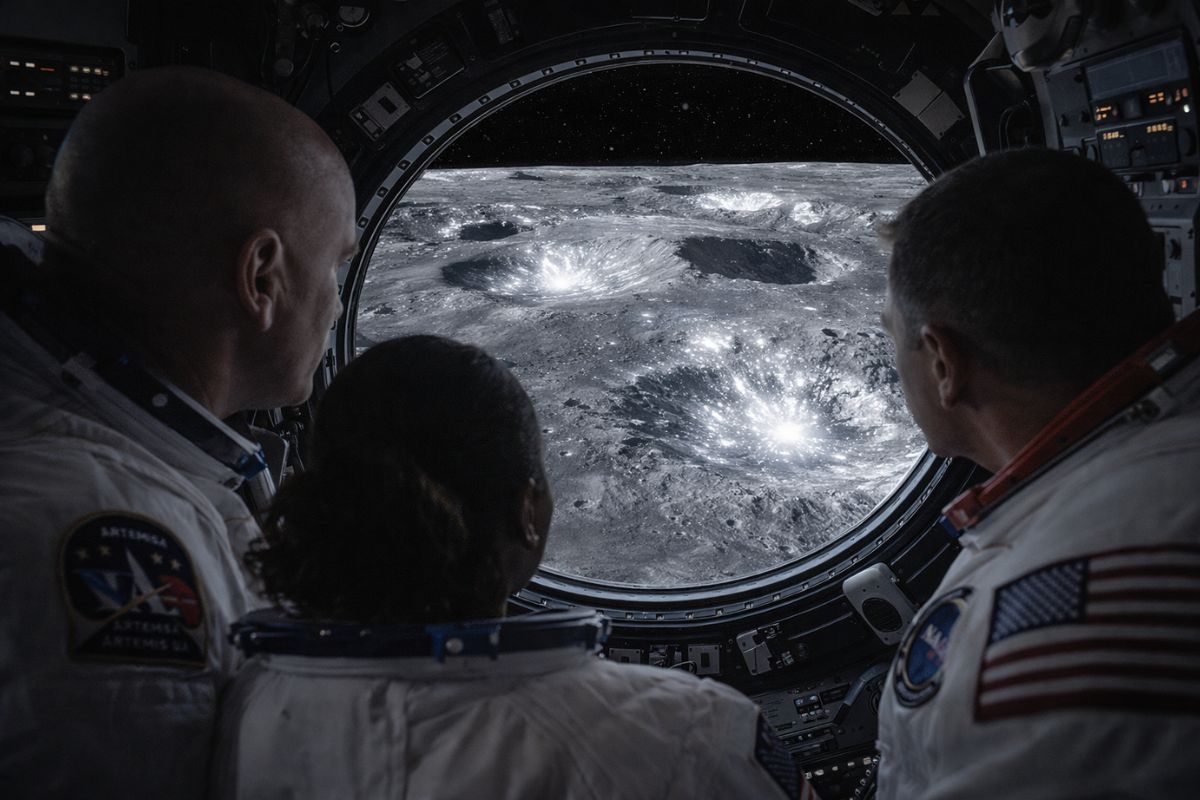
The Artemis 2 astronauts completed a historic seven-hour flyby around the Moon, observed the hidden side that is never visible from Earth, found formations with intense brightness resembling snow, and witnessed a solar eclipse from space, breaking the distance record of Apollo 13.
Four NASA crew members have just starred in the most distant crewed flight in human history. The Artemis 2 astronauts conducted a flyby of approximately seven hours around the Moon this Monday (6) and had access to regions never directly observed by human eyes, including the enigmatic hidden side of the natural satellite. The mission, launched in early April from the Kennedy Space Center, marks the return of crewed flights to the lunar vicinity after more than five decades. During the journey, the Orion spacecraft surpassed 400,000 kilometers from Earth, breaking the record set by Apollo 13.
What the Artemis 2 astronauts found as they approached the Moon surprised even those who expected desolate landscapes. Some formations on the lunar surface exhibited such intense brightness that they appeared to be covered in snow, a visual phenomenon that immediately caught the crew’s attention and will be analyzed in detail by NASA scientists in the coming weeks. The images captured by professional equipment and by crew members’ personal devices promise to contribute to studies on the formation of the Moon and the solar system itself.
What the Artemis 2 astronauts saw on the hidden side of the Moon

The hidden side of the Moon is never visible from Earth because the satellite takes the same time to rotate around itself as it does to orbit the planet, always keeping the same face turned towards us.
-
Commercial satellites captured images in the Taklamakan Desert of giant replicas of US aircraft carriers and destroyers, with tracks and precise impact craters, deliberately exposed to demonstrate power and change the global naval game.

-
Motorola launches Moto G Stylus 2026 with a 5,200 mAh battery and 120 Hz OLED display; check out the price, technical specifications, and news.

-
A new technology in China looks like a giant tower, but it is used to store energy and provides 4 hours of electricity.

-
Hidden beneath the dense vegetation of the Amazon, scientists have discovered a monumental network of 6,000 structures that reveal 2,500-year-old garden cities and change everything that was thought about the forest’s past.

The Artemis 2 astronauts were able to directly observe this mysterious region and document details that had only been recorded by robotic probes until now.
Among the points of greatest interest is the Orientale impact basin, a gigantic formation about 950 kilometers long that is one of the largest impact structures in the solar system.
In addition to the Orientale basin, the Artemis 2 astronauts observed craters, mountain ranges, and areas formed by ancient lava flows that tell the geological history of the satellite spanning billions of years.
The difference between seeing these formations in satellite images and observing them directly through the window of the Orion spacecraft is comparable to the difference between seeing a photo of a mountain and standing in front of it. The scale, texture, and light contrasts that the astronauts recorded should provide visual data that complements decades of remote research.
The formations with intense brightness that surprised the Artemis 2 astronauts

The report about surfaces that appeared to be covered in snow is one of the most intriguing aspects of the mission. The Artemis 2 astronauts described formations with intense brightness that stood out from the typically gray and dark lunar landscape, suggesting different mineral composition or light reflection properties that still need to be studied.
The brightness may be related to materials ejected by recent impacts (in geological terms) or to specific mineral concentrations that reflect sunlight unusually.
These observations made by the Artemis 2 astronauts add a layer of data that remote instruments do not capture with the same fidelity. Human perception of contrast, depth, and brightness variation complements measurements made by cameras and sensors.
NASA scientists will need to cross-reference the astronauts’ descriptions with existing spectral data to determine whether these bright formations correspond to known mineral compositions or represent something that has not yet been cataloged.
The solar eclipse seen from space during the Artemis 2 astronauts’ flyby
During the lunar flyby, the crew witnessed a phenomenon that very few humans have ever seen.
The Moon completely blocked the sunlight as seen from the Orion spacecraft, creating a solar eclipse observed from space under conditions that allowed for the visualization of the solar corona, the outermost layer of the star’s atmosphere, with a clarity impossible to achieve from the Earth’s surface.
The eclipse allowed the Artemis 2 astronauts to observe other celestial bodies that are normally overshadowed by sunlight, including Mercury, Venus, Mars, and Saturn.
The opportunity to see several planets at the same time, without the interference of the Earth’s atmosphere, offers visual and scientific perspectives that complement data collected by space telescopes. For the crew, the moment represented an experience that no human had lived since the Apollo missions.
The distance record that the Artemis 2 astronauts broke
The Orion spacecraft surpassed 400,000 kilometers from Earth during the mission, breaking the record set by Apollo 13 in 1970. The Artemis 2 astronauts became the humans who have traveled farthest from the planet in history, surpassing a mark that remained untouched for more than half a century.
Apollo 13, which was forced to fly around the Moon after an explosion on board, had inadvertently set the previous record during the emergency return procedure.
The difference is that the Artemis 2 astronauts broke the record in a planned manner, as part of a mission designed to test the Orion spacecraft under real lunar flight conditions before future missions that will include landing on the surface.
The capsule, navigation systems, thermal shield, and communication procedures were all validated during the outbound journey, the flyby, and the return, which is expected to culminate with a landing in the Pacific Ocean in the coming days.
What the Artemis 2 astronauts’ mission means for the future of lunar exploration
Artemis 2 is not the final destination. It is the strategic step that paves the way for Artemis 3, which will be the first mission to land astronauts on the lunar surface since Apollo 17 in 1972.
The Artemis program aims to establish a sustainable human presence on the Moon, focusing on the lunar south pole region, where scientists believe there are deposits of water ice in permanently shadowed craters.
The Artemis 2 astronauts proved that the Orion spacecraft works, that the crew can endure the journey, and that the navigation systems are reliable. With this validated data, NASA can move forward to the next stages with greater confidence.
The expectation is that future missions will include operations in lunar orbit and, subsequently, sending astronauts to the surface, gradually building the infrastructure that will support a permanent lunar base.
What impressed you most about the Artemis 2 astronauts’ mission: the bright formations that looked like snow, the eclipse seen from space, or the distance record broken? Do you think we will see astronauts walking on the Moon again in the coming years? Let us know in the comments. Humanity is returning to the Moon, and this time the plans are to stay.







Seja o primeiro a reagir!