





 Portuguese
  English
  Spanish
  5 min of reading
  0 comments


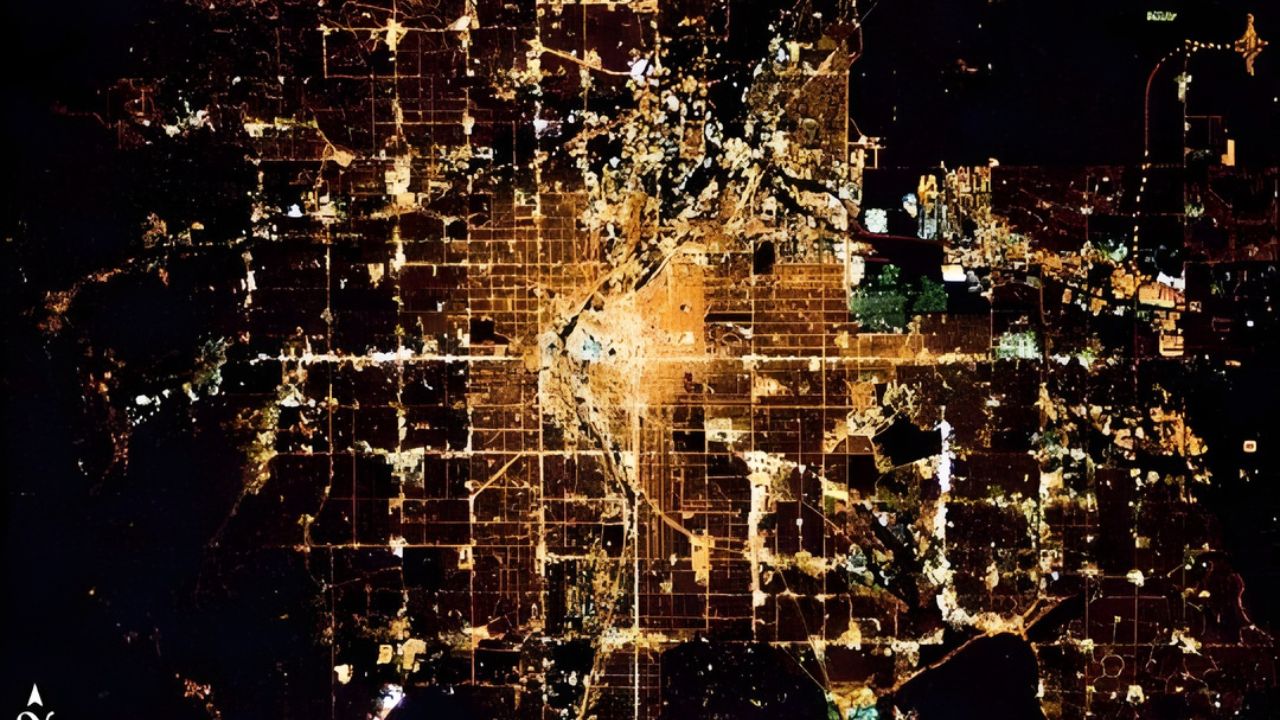
Astronauts confirm that cities shine from space like artificial constellations, while highways are more visible than the Great Wall of China.
In records made since the 2000s by astronauts aboard NASA and the International Space Station, a phenomenon repeatedly draws attention: entire cities can be clearly seen from space at night, forming luminous patterns that resemble artificial constellations scattered across the Earth’s surface. According to NASA itself, images captured by astronauts show that urban lights allow for precise identification of city limits and their most densely populated areas, and are even used for studies on urbanization and human activity.
Astronaut accounts reinforce this practical observation. NASA records show that photographs taken from the ISS reveal clear urban patterns, with intensely illuminated centers and regions connected by networks of light that follow roads and urban corridors.
The most relevant data is that the distribution of night light allows for the identification of not only cities but also their spatial organization. According to NASA, these images help map urban boundaries and population density, highlighting how artificial lighting reveals the structure of cities as seen from Earth orbit.
-
A magnitude 9.2 earthquake in Alaska reshaped the coastline in minutes, sank entire cities, raised sections of the seabed by several meters, and left one of the fastest geographical transformations ever recorded on Earth.

-
The entire Brazil is expected to face above-average rainfall in the next ten days, with accumulations reminiscent of the peak of summer, raising concerns especially for those living in the Southeast, Northeast, and Northern regions of the country.

-
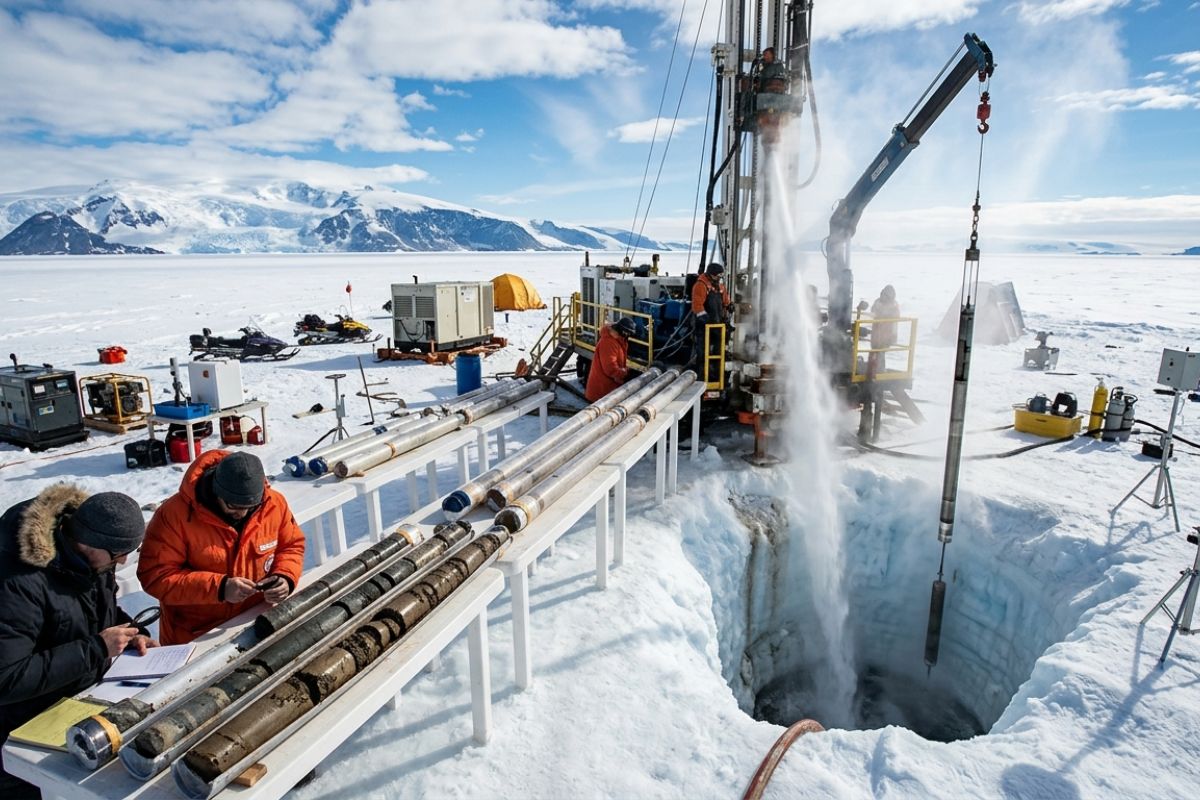
With pressurized hot water, scientists melt 523 meters of ice in West Antarctica and extract a 228-meter rock core with a record of 23 million years, revealing ice-free periods and global warnings.
-
Denmark resumes the idea of building the world’s first energy island with $30 billion, connecting several countries and changing the European energy game amid uncertainty due to the war in Iran.

Satellite images show luminous patterns that reveal population density
The visual observation made by astronauts is reinforced by data from satellites such as the VIIRS (Visible Infrared Imaging Radiometer Suite), which records the Earth’s night luminosity with high precision.
These images show that highly urbanized regions emit large amounts of light, forming true luminous maps of the planet. Scientific studies use this information to analyze urban growth, energy consumption, and economic activity, although population estimates are not made directly “by eye,” but rather through mathematical models based on luminosity data.


This phenomenon has transformed artificial lighting into a scientific tool, allowing for the monitoring of socioeconomic changes on a global scale.
Highways and linear infrastructures can be more visible than large historical structures
Another aspect confirmed by astronauts is the visibility of linear structures, especially in regions of high environmental contrast.
In desert areas, for example, paved highways appear as dark or illuminated lines against light backgrounds, making them easily identifiable from orbit. This occurs because the contrast between asphalt and sand creates a visual signature much more evident than structures that blend in with the environment.
Chris Hadfield has reported that roads, airports, and bridges are often easier to identify from space than many historical monuments, precisely due to this contrast factor.
The Great Wall of China is practically invisible from space to the naked eye
Contrary to what has been popularized for decades, the Great Wall of China is not visible to the naked eye from space under most conditions.
This claim has been debunked by various scientific institutions, including NASA. The reason is technical: the wall has a relatively small width, follows the terrain of the mountains, and is built with materials similar to the surrounding environment, which drastically reduces its visual contrast.
Even in low orbit, where the ISS operates at about 400 km altitude, the wall blends in with the terrain, becoming practically indistinguishable without the aid of optical equipment or ideal lighting conditions.
This contrast between popular expectation and scientific reality has turned the wall into one of the greatest myths about spatial visibility ever propagated.
Visual contrast is the determining factor for seeing objects from space
The ability to observe terrestrial structures from space depends not only on size but primarily on contrast relative to the environment.


Elements that present a strong difference in color, brightness, or texture tend to stand out more easily. This explains why:
- Illuminated cities are extremely visible at night
- Desert highways stand out as defined lines
- Industrial infrastructures and ports appear clearly
- Large historical structures can visually disappear
The critical factor is not absolute size, but the relationship between the object and its surrounding environment.
Observing the Earth from the ISS reveals invisible patterns on the surface
The continuous observation of the Earth from the ISS has provided a unique perspective on the planet. Astronauts report that, in addition to cities, it is possible to identify phenomena such as wildfires, storms, maritime activity, and even agricultural patterns.
These records not only have scientific value but also help to understand the scale of human activity on the planet.
Artificial lighting, seen from space, reveals the direct impact of urbanization and energy consumption, transforming the planet into a dynamic mosaic of light and darkness.
Science confirms that human visual perception in space has clear limitations
Despite the impressive observations, experts emphasize that human vision in orbit has limitations. The identification of details depends on factors such as altitude, atmospheric conditions, lighting, and the observer’s experience.
Therefore, although astronauts can identify cities and some infrastructures, more detailed analyses are conducted with specialized sensors and satellites.
The combination of human observation and technology is what allows these images to be transformed into reliable scientific data.
Cities shine brighter than monuments and redefine what is visible from space
Astronaut accounts and scientific data converge to a clear conclusion: what stands out on the planet seen from space are not necessarily the largest structures, but those that present greater contrast and luminous intensity.

Illuminated cities transform into true artificial constellations, visible from hundreds of kilometers in altitude, while highways can cut through entire landscapes as perfectly defined lines.
On the other hand, historical structures like the Great Wall of China, despite their grandeur, visually disappear by integrating into the natural environment.
This inversion of perception reveals that, on an orbital scale, the brightness of human activities surpasses even some of the greatest works ever built by civilization.






Seja o primeiro a reagir!