





 English
  Francês
  Alemão
  Italiano
  Japonês
  Norueguês
  Portuguese
  Spanish
  4 min of reading
  0 comments


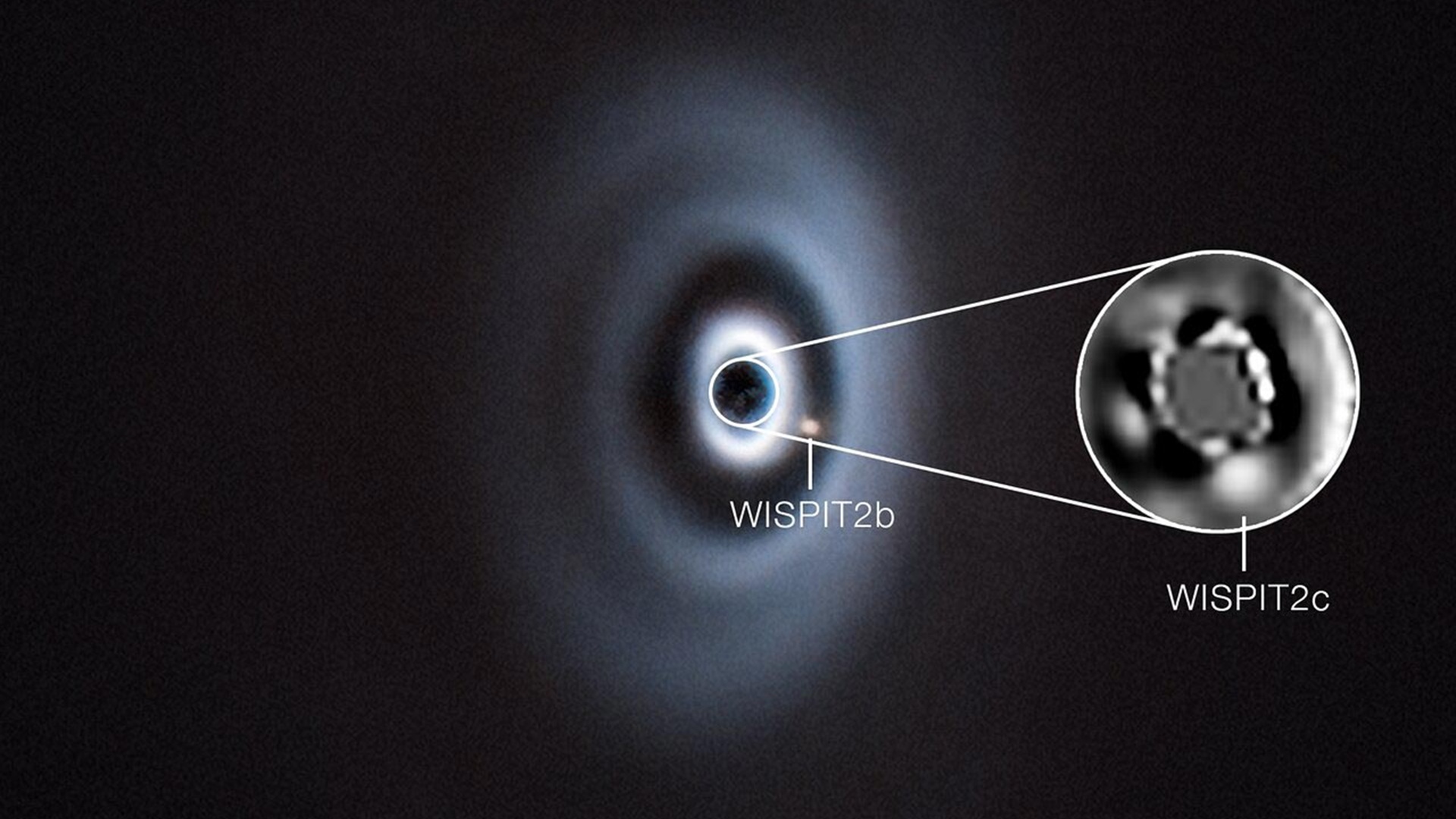
Observations of the WISPIT 2 system revealed two giant planets in full formation around a young star, a rare record in astronomy that also raised the possibility of a third world emerging in the same disk of gas and dust
Astronomers recorded the formation of two giant planets around the young star WISPIT 2, in a system surrounded by gas and dust that has drawn attention for resembling an early phase of the Solar System. The observations, detailed in a study published this Monday, March 24, reinforce the capability of current instruments to monitor in real-time the birth of worlds beyond Earth.
The identification of the two developing planets was made within the disk surrounding WISPIT 2, a young star whose structure features well-defined rings and gaps. For researchers, this design offers a rare opportunity to observe how planetary systems can organize from their earliest stages.
According to Chloe Lawlor, a PhD student at the University of Galway in Ireland and the lead author of the study, the system provides the best view ever obtained of the past of the Solar System itself. The research was published in the journal The Astrophysical Journal Letters.
-
Salaries of up to R$ 25,000, a shortage of professionals, and exploding demand in 2026 make the no-code automation specialist one of the most sought-after careers in Brazil, even without requiring a degree or programming knowledge.

-
The first commercial-scale hydrogen-powered brick factory will be established.

-
Goodbye to the noisy exhaust fan: silent and smart technology transforms modern kitchens with more comfort, design, and efficiency in everyday life.

-
At just 14 years old, a boy creates a system without energy, using steel pipes buried in the ground, that irrigates seedlings with moisture from the air, to combat the water scarcity threatening reforestation in northern China.


Rare system shows simultaneous formation of planets
WISPIT 2 is only the second known system in which astronomers have been able to directly observe the formation of two planets around the same star. The first identified case was the PDS 70 system.
What differentiates WISPIT 2, according to researchers, is the size of the planetary formation disk and the clarity of its internal structures. The observed rings and gaps suggest that this environment may harbor even more planets in the process of emerging.
Lawlor stated that these structures indicate the possibility of other bodies forming in the system and being detected in the future. Co-author Christian Ginski, also from the University of Galway, said that WISPIT 2 serves as a crucial laboratory to observe not only the birth of an isolated planet but an entire planetary system.
The observation of systems like this, according to the authors, helps to understand how young planetary sets evolve until they reach more mature configurations. The comparison with our Solar System appears as one of the keys to the analysis presented by the researchers.
WISPIT 2b and WISPIT 2c expand the portrait of the system
The first planet identified in the system, called WISPIT 2b, had already been reported last year. According to the study, it has nearly five times the mass of Jupiter and orbits its star at a distance about 60 times greater than the distance between Earth and the Sun.
Richelle van Capelleveen, a PhD student at the Leiden Observatory in the Netherlands and leader of the previous study, stated that the discovery of this first world in formation demonstrated the potential of current instruments. After that, astronomers noticed another object near the star and deepened the investigation.
With new observations, scientists confirmed that this second object was also a planet. Named WISPIT 2c, it orbits much closer to the star, at a distance about four times smaller than that of WISPIT 2b, and has approximately double the mass of the first planet.
The two confirmed bodies are gas giants, similar to Jupiter and the other outer planets of the Solar System. This characteristic reinforces the comparison between the observed system and an early version of the cosmic neighborhood in which Earth formed.
ESO telescopes were decisive for the confirmation
To verify the nature of WISPIT 2c, researchers turned to the Very Large Telescope (VLT) of the European Southern Observatory, using the SPHERE instrument to obtain direct images. They then used the GRAVITY+ instrument of the VLT Interferometer to confirm that the object was indeed a planet.
Guillaume Bourdarot, a researcher at the Max Planck Institute for Extraterrestrial Physics in Garching, Germany, and co-author of the study, stated that the recent upgrade of GRAVITY+ was crucial for detection. According to him, without this improvement, it would not have been possible to obtain such a clear observation of a planet so close to its star.
In addition to recording the two gas giants, astronomers analyzed their arrangement within the disk of gas and dust. Both occupy well-defined gaps, opened as the material from the disk is attracted by gravity and incorporated into the forming planet.
This process leaves visible marks on the system. As the planet gathers nearby material, a gap appears in the traversed region, while the remaining gas and dust organize into ring patterns around these areas.
A third gap raises new suspicion
Researchers also identified a smaller and more distant gap in the WISPIT 2 disk. The structure drew attention because it differs from the other two by being narrower and shallower.
For Chloe Lawlor, there is suspicion that a third planet may be occupying this space. According to the researcher, this potential new world would have a mass comparable to that of Saturn, precisely because of the characteristics observed in this third gap.
The team intends to deepen the study of the system in future observations. Christian Ginski stated that, with the future Extremely Large Telescope of the ESO, it may be possible to obtain direct images of this potential third planet.
At the moment, however, the main advancement lies in the confirmation of two giant planets in full formation around a young star. For astronomers, WISPIT 2 consolidates as one of the most relevant examples ever observed to closely monitor how a planetary system is born.








Seja o primeiro a reagir!