





 Portuguese
  English
  Spanish
  7 min of reading
  0 comments



In Analysis of Nearly 457,000 Post-Main Sequence Stars Observed by TESS, Astronomers Compared Young and Aged Systems, Found 130 Planets and Candidates in Short Orbits and Reinforced the Evidence that Sun-Like Stars Make Worlds Become Rare as They Grow and Intensify Tidal Decay.
The astronomers turned their attention to a specific moment in stellar life and found a signal that is alarming due to its coherence: when Sun-like stars age and leave the main sequence, the closest planets tend to disappear more frequently than in younger systems. The clue came from the intersection of TESS data and a sample of 456,941 post-main sequence stars.
The reading that emerges from this comparison does not point to mere chance of formation. What appears is a pattern in which inner worlds become rarer as the star grows, amplifies tidal forces, deteriorates short orbits, and approaches the phase where it can literally engulf bodies that orbit too closely. It is a statistical preview of a fate that, on a scale of billions of years, also looms over the Solar System.
What Astronomers Found When They Placed Young and Old Stars Side by Side

Edward Bryant, from the University of Warwick, and Vincent Van Eylen, from University College London, compared systems with stars still in the main sequence, like the current Sun, with systems where the star has already advanced to the post-main sequence phase.
-
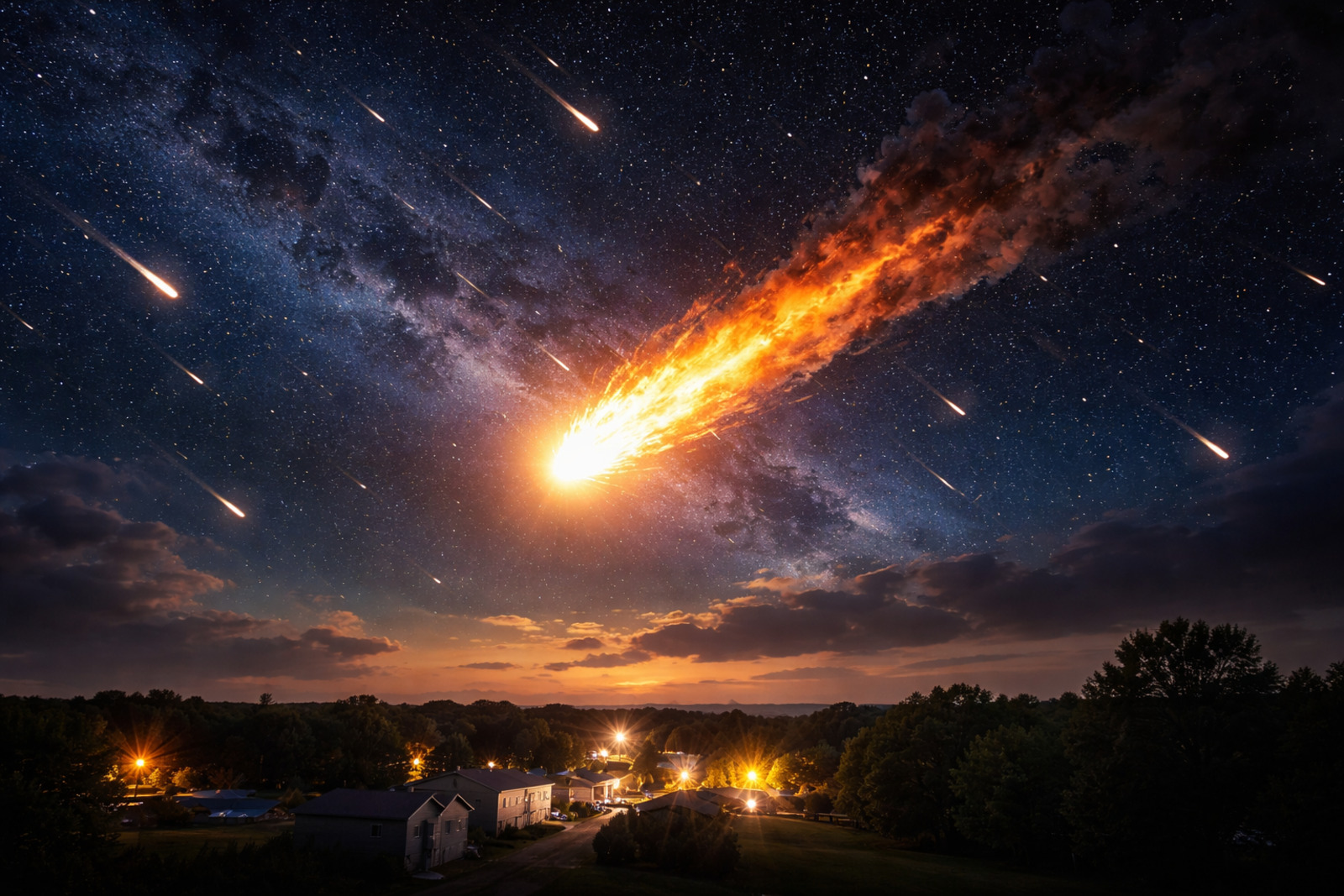
Fireballs shoot across the skies of the USA and meteor explosions draw attention: what is causing this mysterious wave of sightings?
-
Brazil has quietly developed an electric tactical drone that takes off and lands vertically without needing a runway, flies at 140 km/h in a fully autonomous manner, and can operate in forests, conflict zones, and remote areas.

-
Novo drone Guardian debuts in the United States with an 8-mile range, robotic battery swapping, and Starlink connectivity for continuous response.

-
100 kW megalasers are already pointing to a new industrial phase, with enough power to cut thick steel, drill through rocks, accelerate mining, and increase productivity in operations previously considered too difficult.


The question was straightforward: do nearby planets continue to appear with the same frequency as the star ages, or does something systematically change?
The result was a clear imbalance. Among the 456,941 post-main sequence stars identified in TESS data, researchers found 130 planets and planet candidates in close orbits.
The fraction of stars with short-period planets decreases significantly, especially precisely where theory predicted greater vulnerability.
The astronomers weren’t seeing a random void, but a depletion consistent with orbital destruction.
Bryant emphasized that the discrepancy does not seem to arise from differences in the initial formation of these systems. According to him, there are no significant contrasts in mass and chemical composition between the compared populations that could alone justify the absence of these worlds near the older stars.
This strengthens the interpretation that the planets were there and ceased to be.
This point changes the weight of the finding. It is not just a matter of saying that old stars “have fewer planets” due to some detail of origin.
The more severe conclusion is another: nearby planets are likely being removed from the system as the star evolves, either through direct engulfment or by a gradual process of orbital loss and disintegration.
How an Aged Star Begins to Eat Its Inner Worlds

When a Sun-like star exhausts its nuclear hydrogen fuel, its diameter can grow more than a hundred times. This increase completely alters the immediate neighborhood.
Planets that once orbited in relatively stable regions start to face a larger, more aggressive star from a gravitational standpoint and more destructive for any body that comes too close.
Complete engulfment is the most dramatic image, but it is not the only mechanism at play.
As the star turns into a giant, tidal forces increase and begin to deteriorate the orbits of nearby satellites. These tides can strip away atmosphere, force orbital spirals towards the star, and even completely disintegrate the planet.
Planetary death can come as a final dive or as slow erosion until collapse.
It was precisely this aspect of orbital decay that Bryant and Van Eylen placed at the center of their model.
Instead of just searching for worlds already destroyed, they analyzed the frequency with which planets still appear around different types of stars, measuring the number of planets per star throughout stellar evolution.
The pattern found aligns well with theory. For shorter-period planets, the drop in occurrence is stronger, precisely where tidal decay is expected to intensify as the star ages.
In other words, the closest worlds seem to be the first to pay the bill when the star ceases to be stable.
Why This Picture Matters for the Future of Earth
The Sun is approximately halfway through its own life, which places Earth on the same cosmic clock.
The scenario described by the astronomers is still a long way off, at least 5 billion years from now, but the scientific value of the discovery lies in offering a realistic rehearsal of what happens to systems similar to ours when they enter the final stage of the host star’s evolution.
The stars studied have much larger surface areas than the current Sun, but comparable masses, and this is crucial.
A star with a similar mass will generally pass through the same fundamental stages of life and death. It is this equivalence that makes the observed sample act as a mirror for the future, albeit imperfectly, for our system.
This does not mean that Earth’s fate is sealed in every detail based on this data.
What the astronomers show is that the disappearance of inner worlds does not seem to be an exotic exception, but a plausible and even expected process when stars like ours leave the main sequence. The Solar System, therefore, would not be outside this general logic.
Sabine Reffert, an astronomer at the University of Heidelberg who did not participate in the study, called the approach very promising and emphasized that previously there were not enough planets to statistically observe this type of difference between main-sequence stars and giants.
The gain here is not only conceptual: it’s sample-related. For the first time, the number of cases begins to allow the idea to shift from being merely a beautiful hypothesis to an observable trend.
What TESS Can See and Where the Limits of the Picture Still Lie
TESS finds exoplanets by observing small drops in brightness when they pass in front of their stars, in mini-eclipses called transits.
This method favors large planets, the size of Jupiter, in relatively short orbits, sometimes much less than half a terrestrial year. This means that the sample is not a true representation of systems identical to ours in every aspect.
Post-main sequence stars present an extra problem: being larger, the transit of a planet of the same size appears smaller and weaker.
Bryant summed up this difficulty well by explaining that if the star is bigger, the planet’s signal shrinks, making it harder to find these systems.
Part of the challenge is not only that the planet is dying but also that it becomes harder to detect even before that.
Another sensitive point is metallicity, the abundance of chemical elements heavier than helium. Older stars tend to have lower metallicity, and previous observations have found a correlation between high metallicity and greater abundance of exoplanets.
Reffert noted that small differences in this parameter can even double occurrence rates, indicating that details of the model will still need refinement.
This does not undermine the general conclusion but advises caution with fine precision.
Improving spectral measurements of metallicity, stellar mass, and planetary mass should make the picture more robust. Additionally, the Plato mission of the European Space Agency, scheduled for December 2026, promises to add more sensitive data to what TESS has already opened up.
Astronomers seem to have found the right track, but they have yet to reach the final degree of clarity.
What This Disappearance of Planets Changes in the Reading of Solar Systems
Since the discovery of the first exoplanet about 30 years ago, astronomy has confirmed more than 6,000 worlds outside the Solar System and accumulated many other candidates.
The study of planet-eating stars pushes this field into a new stage: it is no longer enough to just count how many planets exist, it is necessary to understand how they cease to exist throughout the life of the star.
This shift in focus is important because it links planetary evolution to stellar evolution in an inseparable manner. A planet does not live isolated from the body that hosts it. Its orbit, atmosphere, and even its survival depend on the aging of the star.
In this sense, the solar system begins to be seen as a dynamic structure, where worlds can be born, migrate, lose mass, and, ultimately, become incorporated into the central star itself.
By observing Sun-like stars in different phases, astronomers begin to assemble a chronology of destruction, not just of formation. This makes the end of inner worlds less abstract.
The question shifts from “can this happen?” to “how frequently is this already happening?”
It is precisely this shift that strengthens the research. The disappearance of nearby planets does not emerge as an isolated curiosity but as an expected part of the life of mature stellar systems.
When stars age, they do not only illuminate less the future of their inner worlds; they may literally begin to consume them.
In the end, the comparison of nearly 457,000 aged stars and younger systems reinforces the evidence that nearby planets become rare when stars like the Sun leave the main phase and enter a stage where growth, pull, and destruction cease to be exceptions.
TESS not only showed worlds vanishing. It showed a coherent process of coevolution between star and planet, with profound implications for how the fates of entire solar systems are perceived.
If you had to choose the most disturbing point of this discovery, what would weigh more: to know that stars like the Sun can eat their inner worlds, to realize that this is already statistically present in hundreds of thousands of stars, or to face that Earth might be looking at a very distant version of its own end?








-

-

-

-

-

33 pessoas reagiram a isso.