





King of Brazilian cattle, Roque Quagliato controls a complex with more than 240,000 cattle, 100,000 hectares, and about 50 retreats in Pará.
A rural territory larger than 100,000 hectares, divided into dozens of production centers and occupied by more than 240,000 cattle, has made Roque Quagliato one of the most well-known figures in national livestock. At 86 years old, the businessman dubbed the king of Brazilian cattle remains connected to an operation whose size approaches the structure of a small city.
The numbers regarding the herd and properties were released by the portals Compre Rural and Agrozil in July 2026. The estate is managed through the Grupo Rio Vermelho, responsible for organizing production spread over an extensive rural area.
King of Brazilian cattle manages farm divided into 50 centers
The size of the property required the creation of a decentralized structure, where different areas function as productive units with their own teams and facilities. These points are called retreats and allow for monitoring the animals without concentrating all management in a single location.
-
The foreigners have discovered the Brazilian jabuticaba and are paying many dollars for mature trees of the Brazilian fruit, described as sweet and similar to grapes.

-
Sewage sludge that would go to landfills, increase urban costs, and waste nutrients undergoes treatment, becomes biosolid, and returns to the soil as a fertilizer and agricultural conditioner, in a volume equivalent to the weight of about 238,000 trucks loaded with 10 tons each.
-
Embrapa evaluates the use of biochar to utilize coffee residues and reduce dependence on fertilizers

-
Tons of sweet potatoes rejected by retailers are turned into protein for cattle, industrial alcohol, and biogas in the interior of São Paulo: Better Beef repurposes 40,000 tons of waste and plans to replace diesel with biomethane in a future project.


Each retreat houses approximately 3,000 cattle and has corrals dedicated to feeding routines, health monitoring, and herd movement. Altogether, the complex gathers nearly 50 of these units, which operate as small farms within a much larger property.
The division reduces the distances traveled by workers and animals during daily activities. In an area larger than 100,000 hectares, centralizing all procedures in just one corral would make control much more difficult.
Operation gathers more than 240,000 heads of cattle
The herd attributed to the group exceeds 240,000 animals, a quantity that places the company among the largest private structures focused on beef cattle in the country. The number also helps to gauge the need for labor, pastures, facilities, and continuous monitoring.


The scale achieved by the Brazilian cattle king did not arise from a single acquisition. The empire was built over decades of territorial expansion, herd growth, and the organization of different properties under the same administration.
Move to Pará began in the 1970s
Before dedicating himself to cattle ranching in the North of the country, Roque Quagliato lived in Ourinhos, in the interior of São Paulo, where he worked as a mill owner. In the 1970s, he decided to leave this activity and transfer his investments to a region that still offered large areas available for agricultural projects.
The move was considered risky by those close to him, as it involved trading an established position in São Paulo for an enterprise far from the more consolidated economic centers. The businessman, however, stuck to the plan and began forming the first properties.
As the operation advanced, Sapucaia became the main reference point for the group. The area is located near Xinguara, a municipality situated in one of the regions most connected to cattle ranching in southern Pará.
Brazilian cattle king expanded assets with new purchase
The expansion continued even after the group reached an area exceeding 100 thousand hectares. In one of the most notable rural operations attributed to the businessman, approximately 27 thousand hectares that belonged to Grupo AgroSB were acquired.
The purchase added an area equivalent to thousands of football fields to the set already controlled by the family. The deal reinforced the presence of Grupo Rio Vermelho in an area where land value has increased over the past decades.
The operation also showed that the strategy of the Brazilian cattle king was not limited to maintaining existing assets. Even with a consolidated structure, the group continued to seek new areas capable of sustaining cattle production.
Complex functions like a small rural town
Managing hundreds of thousands of animals in such a vast territory requires more than corrals and grazing areas. The property needs to offer conditions for teams and families to stay close to the different production points.
The division into retreats creates nuclei with their own routines, responsible for taking care of a specific part of the herd. This organization reduces the dependence on constant travel to the main headquarters and allows problems to be identified more quickly.
In practice, the complex brings together housing, work, animal management, and productive infrastructure within the same area. The territorial dimension makes the farm operate with characteristics similar to those of an autonomous rural community.

Numbers show the size of Grupo Rio Vermelho
The main data associated with the enterprise include:
- more than 240 thousand cattle distributed across the properties;
- total area exceeding 100 thousand hectares;
- approximately 50 retreats within the complex;
- around 3 thousand animals kept in each unit;
- additional purchase of approximately 27 thousand hectares;
- headquarters of activities in the region of Sapucaia, in the south of Pará;
- total assets associated with the range of billions of reais;
- operation organized by Grupo Rio Vermelho.
The combination of area, herd, and internal structure differentiates the group from a conventional farm. The operation resembles a network of properties connected by the same production strategy.
Comparison with soap opera helped popularize the title
The expression “king of cattle” gained great prominence in Brazil with the soap opera broadcast on television, which presented family and economic conflicts linked to large rural landowners. Outside of drama, the nickname came to be associated with Roque Quagliato because of the size of his herd.
The comparison, however, does not depend solely on the number of animals. The size of the lands, continuous expansion, and business organization also contributed to consolidating the public image of the entrepreneur.
While the television story belongs to fiction, the numbers of the Pará complex help explain why Quagliato came to be cited as the king of Brazilian cattle in publications related to agribusiness.
Intensive cattle raising requires permanent control
An operation with 240 thousand cattle needs to constantly monitor the feeding, health, reproduction, and movement of the animals. The organization of the retreats was created to allow each team to take care of a smaller group, although still formed by thousands of heads.
The corrals installed in each unit serve as support points for the procedures carried out on the herd. The division also facilitates the identification of differences between areas, lots, and management conditions.
This model allows for the management of a large-scale farm without turning all decisions into exclusive tasks of the headquarters. Each retreat takes on part of the routine, while the central administration maintains coordination of the whole.
Heritage was built over almost half a century
Roque Quagliato’s journey in Pará began approximately five decades ago, during which the region underwent significant economic transformations. The business grew alongside the expansion of cattle ranching and the appreciation of rural areas.
The businessman accumulated land, increased the herd, and structured an operation capable of functioning in different centers. The transition from a sugar mill owner in the interior of São Paulo to the owner of one of the largest livestock complexes in the country occurred gradually.
At 86 years old, Quagliato remains the main figure associated with Grupo Rio Vermelho. His story has come to represent a case of business expansion based on land, animal production, and large-scale management.
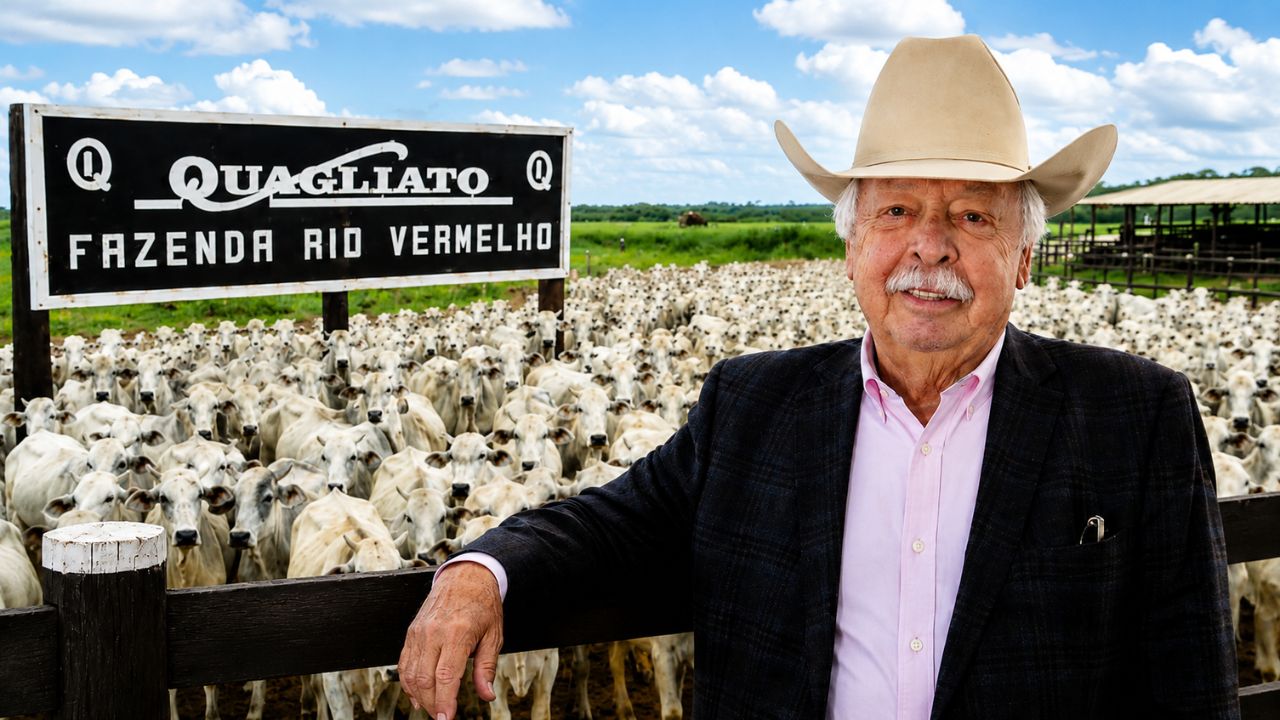
King of Brazilian cattle maintains one of the largest livestock empires in the country
The enterprise managed by the Quagliato family boasts rare numbers even within the Brazilian agribusiness. There are hundreds of thousands of cattle, dozens of internal units, and a territory that surpasses the area of several cities.
The structure built in southern Pará shows how a farm can transform into an organization with multiple production centers. The large extension has ceased to be just a territorial measure and has come to determine the entire management style of the business.
Almost half a century after leaving São Paulo, Roque Quagliato remains associated with a billion-dollar heritage and a herd exceeding 240,000 animals. It is this combination of scale, expansion, and longevity that sustains his identification as the king of Brazilian cattle.
Source: Revista CARAS and Compre Rural


