





 Portuguese
  English
  Spanish
  5 min of reading
  0 comments


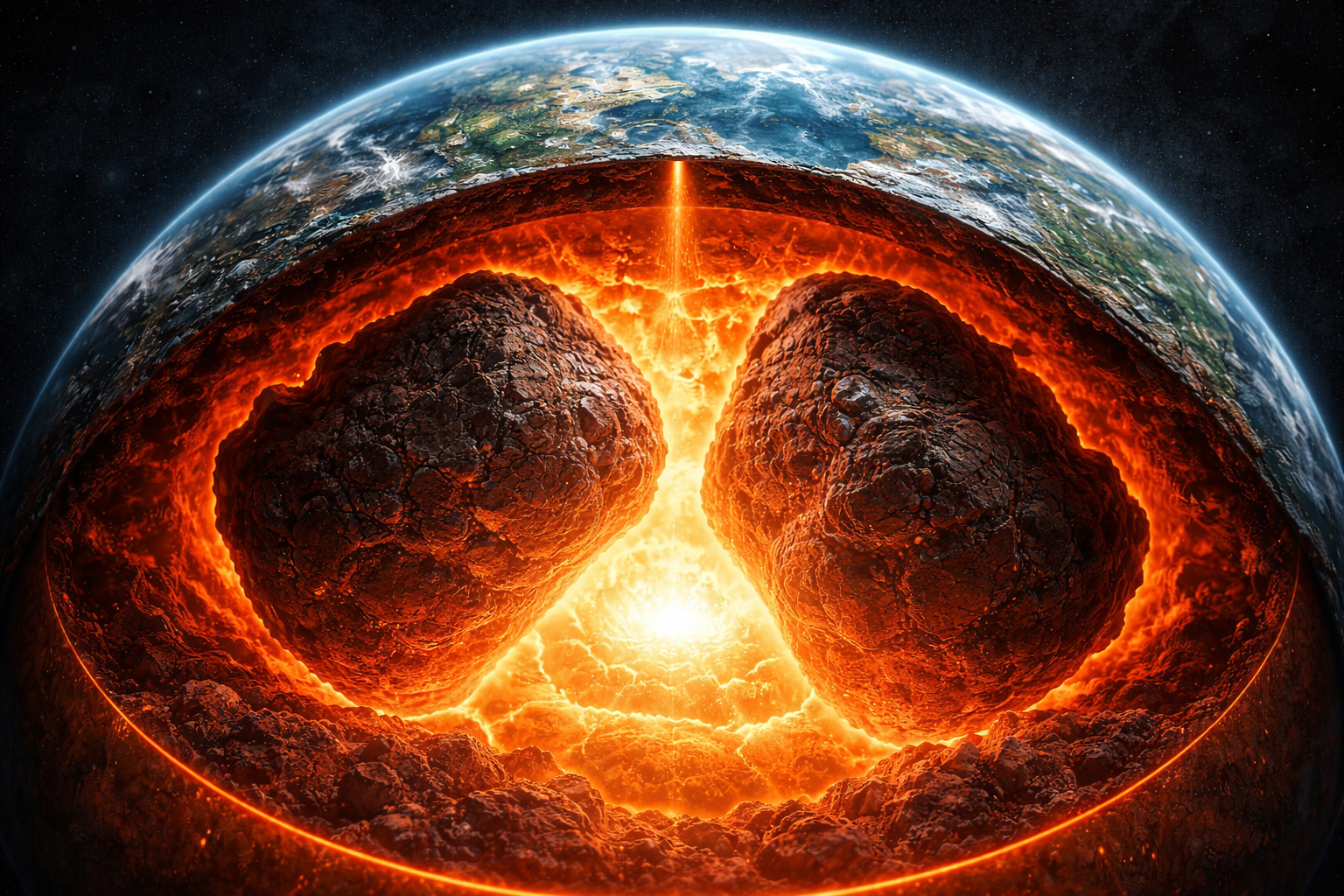
Giant structures larger than the Moon exist in the Earth’s interior at 2,900 km depth and may have emerged from core leakage 4 billion years ago.
According to researchers from Rutgers University, who published their work in the scientific journal Nature Geoscience in September 2025, the Earth’s interior holds two continental-scale structures that challenge traditional models of planetary formation since their identification by seismologists in the 1980s. These formations lie at the boundary between the mantle and the core, approximately 2,900 kilometers deep, an area inaccessible to any human instrument. For decades, their origin remained unexplained.
The new study proposes a hypothesis that profoundly alters the understanding of the planet’s initial formation: these structures would be the result of contamination of the mantle by material from the Earth’s core, occurring about 4 billion years ago, when the Earth was still a global ocean of magma and life did not exist.
What are Tuzo and Jason, the giant structures known as LLSVPs in the Earth’s mantle
The two formations have been nicknamed Tuzo and Jason, names given in honor of pioneering researchers in plate tectonics. Technically, they are classified as Large Low-Shear-Velocity Provinces (LLSVPs), regions identified exclusively through the analysis of seismic wave speeds.
-
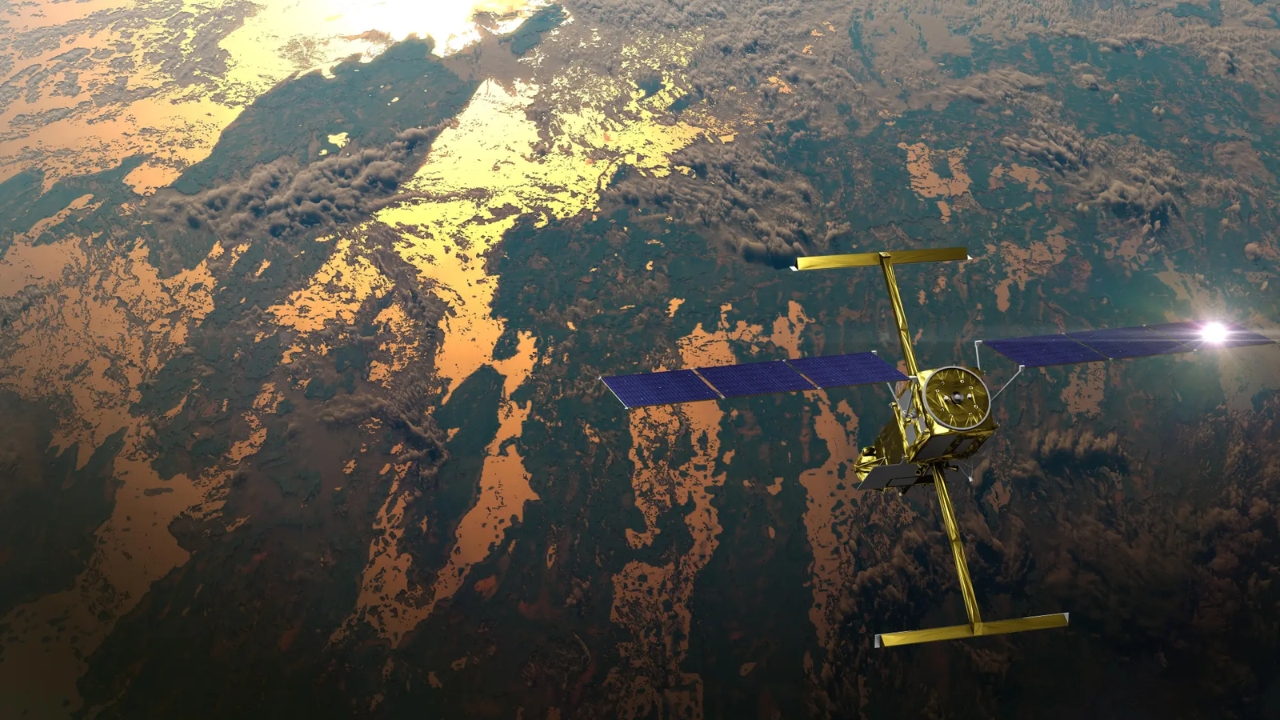
NASA and France use a high-precision radar satellite to monitor 127,000 river segments and discover incredible data about the global fluctuations in water volume.
-
Amazon is moving forward with the discontinuation of old Kindles, directly impacting users; discover an effective alternative that allows you to maintain access to digital books and avoid immediate replacement of the device.

-
The global space economy has surpassed $613 billion and is expected to reach up to $1.8 trillion by 2035, but 78% is already dominated by the private sector, and the explosive growth comes from satellites that operate daily on Earth while rockets take off only occasionally.

-
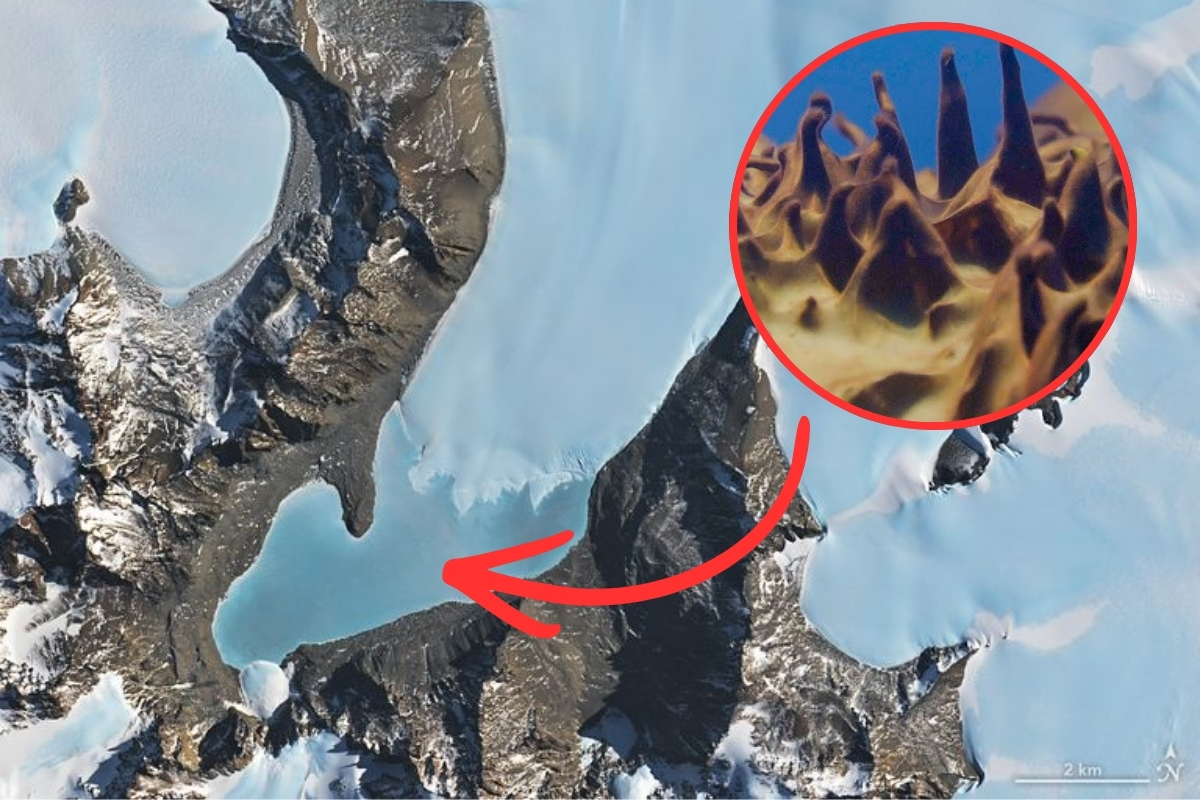
A lake in Antarctica hides water with rare chemistry, a depth of nearly 170 meters, and microbial structures that help scientists search for signs of life on Mars.


Whenever an earthquake occurs, seismic waves travel through the Earth’s interior and are detected by sensors around the world. The speed of these waves varies depending on the density, temperature, and composition of the materials they traverse.
Tuzo and Jason stand out as regions where shear waves significantly slow down, indicating materials that are hotter and denser than the surrounding mantle.
Structures larger than the Moon occupy up to 3% of the volume of the Earth’s mantle
Each of these structures has continental dimensions. The structure located beneath the Pacific Ocean, known as Jason, measures about 3,000 kilometers in horizontal extent and hundreds of kilometers in height.
Tuzo and Jason together occupy between 2% and 3% of the total volume of the Earth’s mantle. In absolute terms, this scale makes them larger than the Moon itself.
The two structures are positioned almost antipodally, meaning on opposite sides of the planet, a configuration that aligns with the mantle convection patterns over billions of years.
Traditional models of Earth formation did not explain the existence of these structures
The classical theory of Earth’s formation describes an extremely violent process about 4.5 billion years ago, with successive collisions of celestial bodies. This process generated enough heat to melt much of the planet, creating a global ocean of magma.
As this ocean cooled, models predicted a clear chemical separation: denser materials would sink, while lighter ones would rise, resulting in a stratified and relatively homogeneous mantle.
However, seismic data show a different scenario, with the presence of irregular, dense, and hot structures like Tuzo and Jason, which do not fit into these models.
Core leakage to the mantle may explain the origin of the deep structures
The model developed by Yoshinori Miyazaki, in collaboration with researchers from Princeton University, introduces a previously neglected factor: the interaction between the metallic core and the basal magma ocean.
The Earth’s core is primarily composed of molten iron and nickel, also containing lighter dissolved elements such as silicon and magnesium.
As the core cooled, these elements were expelled and migrated to the mantle in a process known as exsolution.
This phenomenon would have contaminated the magma ocean at the base of the mantle, altering its composition and preventing the formation of uniform chemical layers.
Formation of dense piles in the mantle explains the current distribution of Tuzo and Jason
Over time, the contaminated material solidified into a heterogeneous mix of core and mantle components.

Simulations indicate that this material was transported by the mantle’s convection currents and accumulated in two large regions, forming the structures now known as Tuzo and Jason.
These regions correspond exactly to the points where the convection currents converge, explaining their current position.
Ultra-low seismic velocity zones reinforce evidence of core material in the mantle
The study also reproduces the existence of the so-called Ultra-Low Velocity Zones (ULVZs), regions where seismic waves slow down by up to 50% compared to normal.
These zones appear mainly at the edges of the LLSVPs and are interpreted as areas with a higher concentration of material derived from the core.
This evidence reinforces the hypothesis that there was a transfer of material between the core and mantle in the early stages of the Earth.
Deep structures influence volcanism and island formation such as Hawaii and Iceland
The LLSVPs are directly associated with so-called volcanic hot spots. Regions such as Hawaii, Iceland, Réunion, and Samoa are located above thermal plumes that originate at the boundary between the mantle and the core.
These plumes transport heat and material from the deep interior to the surface, feeding volcanoes for millions of years.
Tuzo and Jason function as generating zones for these plumes, connecting deep processes to the geological activity observed at the surface.
The implications of the study go beyond geophysics. The way the planet cooled, the intensity of volcanism, and the composition of the atmosphere may have been influenced by the presence of these deep structures.
Comparisons with other planets show striking differences: Venus has an extremely dense atmosphere, while Mars has a thin atmosphere.
These differences may be related to the internal dynamics of each planet, including processes similar to those identified on Earth.
The Earth’s mantle may hold a chemical memory of 4 billion years of planet formation
The study suggests that the mantle is not completely homogeneous, as previously believed. Instead, it may preserve chemical records of the initial interactions between the core and mantle.
This “memory” allows for the reconstruction of events that occurred billions of years ago, offering a new perspective on the planet’s evolution.
The authors highlight that the models used still present simplifications, such as two-dimensional simulations and reduced chemical compositions.
Future research with three-dimensional models and high-pressure experiments will be necessary to fully validate the conclusions. Even so, the results already represent a significant advance in understanding the Earth’s interior.
Now we want to know: can these structures change everything we know about Earth formation?
The existence of two structures larger than the Moon at nearly 3,000 kilometers deep directly challenges classical geological models. If confirmed, the hypothesis of core leakage to the mantle could rewrite the early history of the planet.
In your view, do these discoveries completely change the understanding of how the Earth formed?







Seja o primeiro a reagir!