





 Português
  Inglês
  Espanhol
  5 min de leitura
  0 comentários


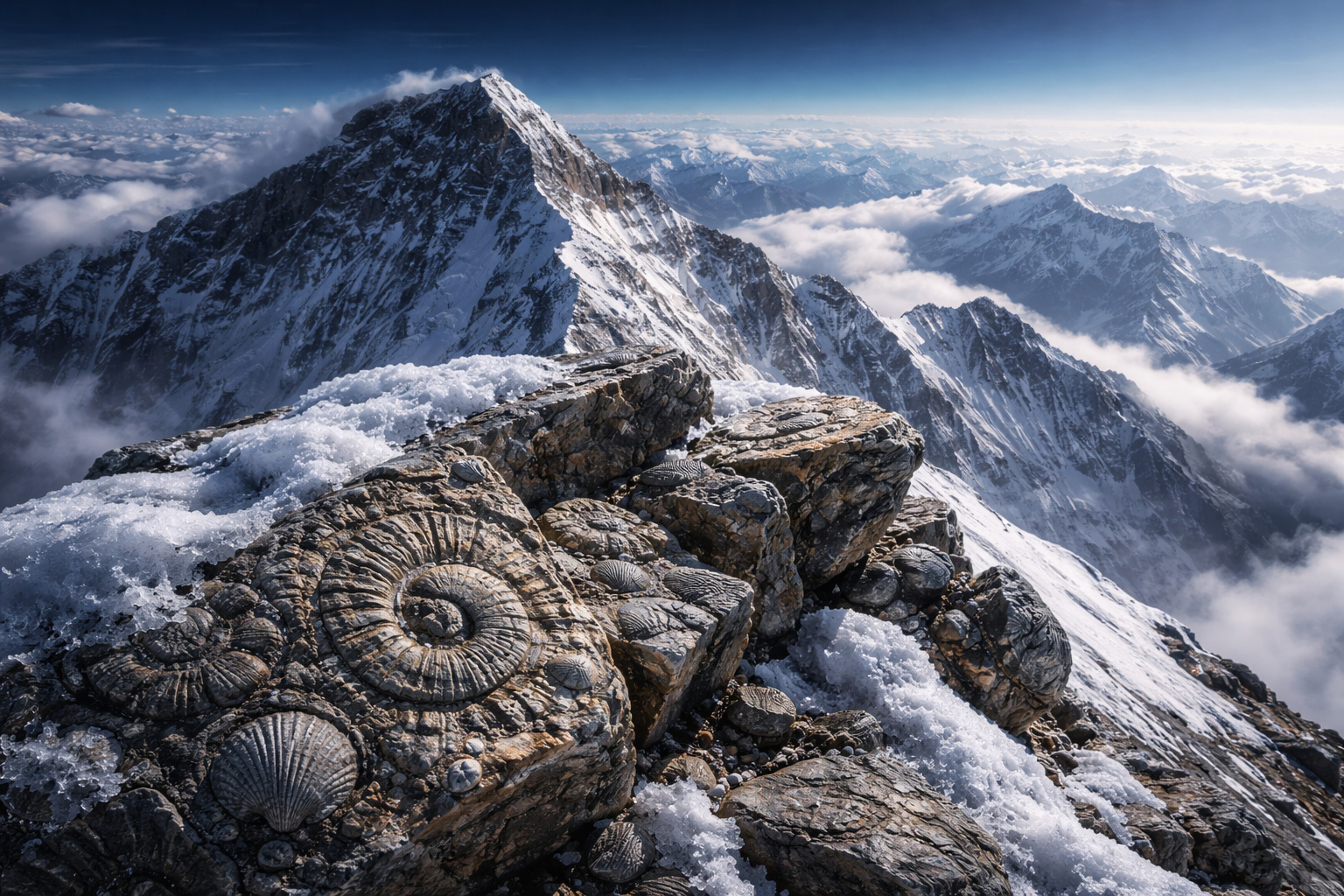
Top of Everest contains marine rocks up to 500 million years old, proof that the mountain was once under an ancient ocean.
In 2024, geological analyses widely referenced by scientific institutions and academic reviews reinforced one of the most impressive facts of modern geology: the summit of Mount Everest, located on the border between Nepal and China, is formed by rocks that originated from the bottom of an ancient ocean. According to geological studies on the formation of Everest, compiled in scientific surveys and described in reviews of Himalayan geology, the peak of the mountain is composed of marine limestone from the Qomolangma Formation, containing fossils of organisms such as trilobites and crinoids, direct evidence of its origin in shallow oceanic environments.
The most striking fact is that, at more than 8,848 meters in altitude, marine fossils have been found embedded in the rocks at the summit, including fragments of organisms that lived hundreds of millions of years ago. This finding is reinforced by classic geological analyses conducted throughout the 20th century when samples of sedimentary limestone were collected near the summit, confirming that Everest is formed by marine sediments that were uplifted during the collision between the tectonic plates of India and Asia.
This evidence transforms Everest into one of the most extreme examples of geological transformation on the planet: an ancient portion of ocean floor that, over millions of years, was pushed up to become the highest point on Earth.
-
Japan targets a remote island in the Pacific measuring only 1.51 square kilometers, located 1,900 kilometers from Tokyo, to store nuclear waste for up to 100,000 years, raising alarms at sea.
-
A 1,900-year-old papyrus found in the Judean Desert reveals a crime of the Roman Empire involving fraud, forgery, and a detailed court hearing.

-
New technology transforms the human body into a “machine”: centaur robot reduces effort when carrying up to 20 kg, improves balance during walking and impresses in practical tests in China.

-
A traffic police robot has started operating at a school, technology from Omoda & Jaecoo expands the use of artificial intelligence in smart cities.


How marine rocks reached the highest point on Earth
The presence of marine rocks at the top of Everest is directly linked to the movement of tectonic plates, one of the fundamental processes that shape the Earth’s surface.
About 500 million years ago, the region where the Himalayas are located today was covered by an ocean known as Tethys. In this environment, sediments such as limestone accumulated on the sea floor, forming layers over millions of years.


Over time, the Indian tectonic plate began to move northward, colliding with the Eurasian plate. This collision was not instantaneous but rather a continuous process that is still occurring today.
The collision between these two continental masses generated a colossal force capable of pushing entire layers of rock upward, elevating ancient marine sediments to extreme altitudes. This process gave rise to the Himalayan mountain range, including Mount Everest.
The role of the collision between India and Asia in the formation of the Himalayas
The formation of Everest cannot be understood without analyzing the dynamics between the tectonic plates involved. The Indian plate, which originally was part of the supercontinent Gondwana, moved thousands of kilometers until it collided with Asia.
This movement occurred at a geologically rapid speed, estimated at about 15 to 20 centimeters per year during certain periods. Upon reaching the Eurasian plate, there was no complete subduction, as occurs in other tectonic boundaries.

Instead, intense compression occurred. The rocks were folded, pushed, and stacked, forming complex geological structures.
This process, known as orogenesis, transformed the bottom of an ocean into one of the highest mountain ranges in the world, elevating materials originally deposited in marine environments to the top of the planet.
Fossil evidence confirms oceanic origin of the rocks
One of the most concrete pieces of evidence for the marine origin of Everest is the presence of fossils found in its rocks. These fossils include marine organisms such as trilobites and crinoids, which lived in shallow oceanic environments hundreds of millions of years ago.
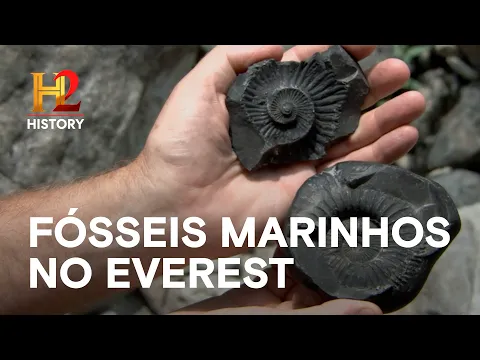
These fossil records have been identified in limestone formations near the summit of the mountain, especially in the so-called Qomolangma Formation.
The presence of these fossils at extreme altitudes leaves no doubt about the marine origin of the rocks, serving as direct evidence of the region’s oceanic past. Furthermore, the mineral composition of these rocks is consistent with marine sedimentary environments, reinforcing scientific conclusions.
Why Everest continues to grow today
The process that elevated Everest has not ended. The collision between the tectonic plates is still ongoing, which means that the Himalayan mountain range continues to form.
Studies indicate that Everest grows a few millimeters each year, although this growth is partially offset by erosion caused by wind, ice, and gravity.
This balance between tectonic uplift and natural wear keeps the mountain in constant transformation, even on timescales that are not perceptible in human experience. This ongoing dynamic is characteristic of tectonically active regions.
Transformation of the seafloor into extreme mountain
The geological history of Everest represents an extreme transformation of the Earth’s surface. What was once a submerged environment, with sediments slowly accumulating over millions of years, has been compressed and elevated to nearly 9,000 meters in altitude.
This type of transformation is only possible due to the internal forces of the planet, which act on gigantic scales and over prolonged geological periods.
The existence of marine rocks at the highest point on Earth is clear evidence of the ability of plate tectonics to completely reshape the planet’s surface. The phenomenon is not exclusive to Everest but reaches its most impressive example in this region.
The scientific importance of Everest for geology
Everest is not just a geographical landmark, but also a natural laboratory for geological studies. It allows scientists to directly observe processes that typically occur at depth.
The analysis of rocks, fossils, and tectonic structures in the region provides information about the history of the Earth, including continental movement and ocean evolution.
This data helps reconstruct the configuration of the planet during different geological periods, contributing to the understanding of Earth’s dynamics. The study of the Himalayas is also fundamental for predicting future tectonic behaviors.
What this discovery reveals about the history of the Earth
The presence of oceanic rocks at the top of Everest demonstrates that the Earth’s surface is not static, but rather dynamic and in constant transformation.
Continents move, oceans form and disappear, and mountains arise from processes that take millions of years to complete.
This geological cycle reveals that the planet undergoes continuous changes, often invisible on human scales, but fundamental to its evolution. Everest, in this context, serves as a physical record of these transformations.
Mount Everest represents one of the most impressive pieces of evidence of the Earth’s geological history. The presence of marine rocks and fossils at the highest point on the planet demonstrates that this region was once submerged under an ancient ocean.
Having been elevated by tectonic forces over millions of years, Everest has become a direct testament to the dynamics of the planet, connecting the ocean floor to the top of the world in a single geological formation.
This connection between extreme environments reinforces the complexity of natural processes and highlights how the Earth continues to undergo constant transformation.







Seja o primeiro a reagir!