






 Portuguese


Hydrothermal Vents Located Thousands of Meters Deep Maintain Water Above 400 °C in Liquid State, Release Minerals, and Sustain Life Forms That Survive Without Sunlight in Extreme Ocean Conditions
There is a natural phenomenon occurring at the bottom of the ocean that continues to amaze today, and few are aware of it. Thousands of meters below the surface, ocean water can exceed 400 °C and remain liquid. This phenomenon occurs around hydrothermal vents, where extreme pressure, heat from regions near magma, and dissolved minerals create one of the most severe environments known at the seafloor.
In structures like Sisters Peak on the Atlantic floor, hydrothermal fluids can reach temperatures of 464 °C, according to data published by the National Institutes of Health.
At the surface, such temperatures would rapidly turn water into vapor. However, conditions are quite different in the deep ocean.
-
Scientists Achieve Floating Titanium for the First Time: 3D-Printed Structure Remains Afloat Even After Cracking and Losing an Entire Layer

-
Chinese Battery Promises 100 km Range per Minute, Charging from 10% to 70% in 5 Minutes, and Reaching 97% in 9
-
A Nevada photographer aimed his camera at the moon on September 19 and caught a Falcon 9 rocket with 27 satellites blazing across the sky instead

-
Earth’s Center Shifts a Few Millimeters Yearly as Snow, Amazon Rainfall, and Monsoons Redistribute Trillions of Tons of Water Globally


The explanation lies in the immense pressure exerted by the column of water above these regions. In areas located between 2,000 and 3,500 meters deep, pressure can exceed 250 atmospheres.
This compression alters the physical conditions of the water and allows fluids above 400 °C to remain liquid.
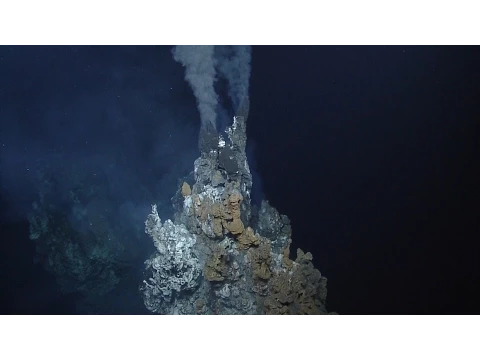

Ocean Phenomenon: Water Enters Through Rocks, Heats Near Magma, and Returns Loaded with Minerals
The process begins when seawater penetrates fractures in the oceanic crust. It descends to warmer regions, comes into contact with rocks heated by the Earth’s internal heat, and undergoes chemical reactions along the way.
Afterward, this water returns to the ocean floor at high temperatures and loaded with dissolved minerals.
Upon encountering the cold water from the depths, typically between 2 °C and 4 °C, a sudden temperature change occurs.
The minerals present in the fluid precipitate rapidly and begin to accumulate around the exit points. This is how what are known as hydrothermal vents are formed.
Among the most well-known structures are the black smokers. Despite their appearance, the dark cloud that emanates from these vents is not smoke produced by combustion. It is made up of mineral particles suspended in the water.
These structures can gather metal sulfides and compounds of iron, copper, and zinc, resulting from reactions between water, heat, and deep rocks.

In the Total Darkness of the Ocean, Life Depends on Chemistry Instead of Solar Light
Hydrothermal vents exist in regions where sunlight does not reach, eliminating traditional photosynthesis as the base of the food chain.
Nonetheless, whole communities manage to survive around these chimneys.
The source of energy comes from chemosynthesis. In this process, bacteria obtain energy by oxidizing chemical compounds found in hydrothermal fluids, such as hydrogen sulfide.
These microorganisms support animals adapted to the extreme conditions of the deep ocean. Among the cited examples are giant tube worms, bivalve mollusks, and abyssal mussels.
Some of these species maintain symbiotic relationships with bacteria capable of utilizing sulfur, methane, or other chemical compounds. In practice, chemistry replaces sunlight as the primary energy source for the ecosystem.
Extreme Heat, Pressure, and Metals Transform the Ocean Floor into a Natural Laboratory
Hydrothermal vents combine temperatures exceeding 400 °C and pressures above 250 atmospheres at certain depths, along with a lack of light and water rich in sulfur and metals.
This combination makes these locations an important environment for studies in geology, biology, and oceanography.
The vents demonstrate that the ocean floor is far from a stagnant region. Water circulates through the rocks, receives heat from the Earth’s interior, transports minerals, and returns to the sea, where it participates in the formation of structures and maintains specialized biological communities.
For researchers, these environments also aid in the investigation of organisms capable of living under extreme conditions, of light-independent metabolisms, and of potential clues related to the origin of life.
At the ocean floor, pressure, heat, and chemistry converge in a system where water exceeds 400 °C without boiling and still helps sustain entire ecosystems in the dark.
Sources: Revista Oeste and data published by the National Institutes of Health on hydrothermal fluids and the Sisters Peak structure.


