





 Portuguese
  English
  Spanish
  5 min of reading
  0 comments


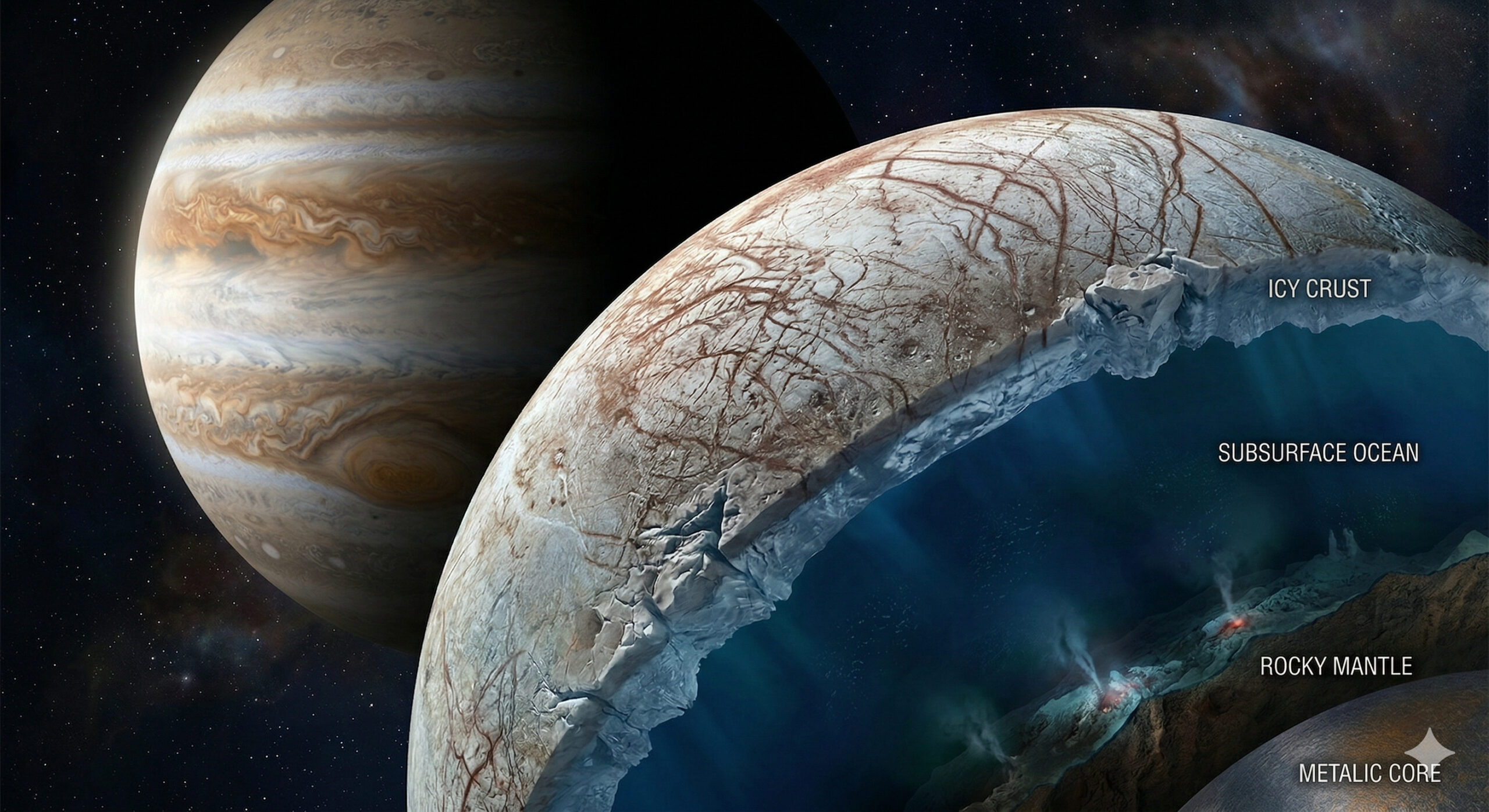
Jupiter’s moon houses ocean under up to 25 km of ice and may have conditions for life, according to NASA research and space missions.
In 2024, NASA reinforced, based on data accumulated since the Galileo mission and preparations for the Europa Clipper mission, that the moon Europa houses a vast liquid ocean beneath an ice crust. According to official NASA information, the ice layer may be between 15 and 25 kilometers thick, covering a global ocean that may contain more than double the water of all Earth’s oceans combined, making Europa one of the most promising environments in the search for life beyond our planet. The most relevant data is that, even located hundreds of millions of kilometers from the Sun, this ocean remains liquid. According to NASA itself, this occurs due to internal heating generated by the tidal gravitational forces exerted by Jupiter, which keep the moon’s interior active despite the extremely low temperatures on the surface.
This scenario places Europa at the center of modern astrobiological investigations, being considered one of the main candidates to harbor life in the Solar System.
How scientists discovered the ocean beneath the frozen surface
The existence of the underground ocean has not been directly observed but inferred from multiple pieces of evidence collected over decades.
-
The appliance that should cool your home may be driving up your electricity bill when installed with the wrong power, forcing the device to work harder and consume much more than necessary.

-
Airbnb now offers private car service to pick you up at the airport in 125 cities around the world with a fixed price and no extra fees: the platform aims to become a complete hotel within your smartphone.

-
Japan tests for the first time a hydrogen-powered engine for large cargo ships and achieves over 95% of the fuel’s energy at full load, paving the way to equip a 17,500-ton cargo ship already planned for 2027.

-
A mega drill costing R$ 50 million, weighing 130 tons, and the only one of its kind in Brazil has arrived in Balneário Camboriú to build the foundations of the Senna Tower, the skyscraper that honors Ayrton Senna.


During the Galileo mission, which orbited Jupiter from 1995 to 2003, sensors detected variations in the magnetic field around Europa. These data indicated the presence of a conductive material beneath the surface, consistent with salty water.


Additionally, detailed images revealed a surface marked by cracks and patterns that suggest movement of material beneath the ice. These combined pieces of evidence led to the conclusion that there is a global ocean beneath the frozen crust.
Ice thickness and ocean depth impress with scale
Current estimates indicate that Europa’s ice crust varies between approximately 15 and 25 kilometers thick. Below this layer lies an ocean with a depth that can range from 60 to 150 kilometers, covering the entire moon.
This volume of water is so large that it exceeds the total found in all of Earth’s oceans, despite Europa being only about a quarter of the diameter of our planet.
This scale makes Europa one of the largest reservoirs of liquid water known in the Solar System.
Internal heating keeps water liquid even far from the Sun
One of the main scientific questions involves how this ocean remains liquid in an extremely cold environment. The answer lies in the tidal forces generated by the gravitational interaction between Europa, Jupiter, and other nearby moons. This effect causes internal deformations that generate heat.
This internal heating is sufficient to prevent the total freezing of the water, keeping the ocean in a liquid state. This mechanism creates a stable environment over millions of years, increasing the potential for habitability.

For life to exist, three elements are considered essential: liquid water, energy sources, and basic chemical elements. In the case of Europa, liquid water is already considered highly probable. Energy can come from both internal heating and chemical reactions at the ocean floor.
Studies suggest that the interaction between water and the rocky core may generate chemical compounds similar to those found in hydrothermal environments on Earth.
These environments, known to harbor extremophile life forms, reinforce the hypothesis that Europa may offer similar conditions.
Ice surface may allow material exchange with the ocean
Europa’s ice crust is not completely static. The cracks and fissures observed indicate that there is movement and possible exchange of material between the surface and the interior.
In some cases, scientists believe that jets of water may be expelled into space, allowing for indirect analysis of the ocean.
This possibility paves the way for more detailed studies without the need to drill kilometers of ice.
Europa Clipper mission seeks answers about habitability
The Europa Clipper mission, scheduled to explore the moon in greater detail, aims to investigate the conditions for habitability.
The spacecraft will be equipped with instruments capable of analyzing the surface composition, measuring ice thickness, and studying possible water plumes.

The focus is not to find life directly, but to determine if the environment has conditions to sustain it. This approach represents a fundamental step in the exploration of ocean worlds.
On Earth, extreme environments such as hydrothermal vents at the ocean floor harbor life forms that survive without sunlight. These organisms use chemical energy to thrive, showing that life can exist under very different conditions than those on the surface.
The similarity between these environments and the possible ocean floor of Europa is one of the main scientific arguments for the search for life. This comparison broadens the traditional concept of habitability.
Technological challenges still limit direct exploration
Despite the advancement of space missions, directly exploring Europa’s ocean still presents significant challenges.
The ice thickness, extreme radiation conditions, and distance from the planet make it difficult to send equipment capable of penetrating the surface.
Currently, the scientific strategy focuses on indirect observations and remote data collection. The development of more advanced technologies will be necessary for deeper exploration in the future.
The confirmation of the existence of an ocean under up to 25 kilometers of ice on Europa represents one of the most significant advances in recent space exploration.
With a volume of water greater than that of Earth and potentially favorable conditions for life, this moon stands out as one of the main targets in the search for extraterrestrial life.
Although there is still no direct evidence of organisms, scientific data indicates that Europa gathers fundamental elements that make the existence of life possible, placing it at the center of future missions and research in the Solar System.







Seja o primeiro a reagir!